Your business shows up in search results when someone in your town needs exactly what you offer. That’s the goal. The frustrating reality for most local service businesses is that dozens of nearby customers search for “plumber near me” or “HVAC repair [city name]” every single day, and those businesses never appear. Not because the service is bad, but because no clear, repeatable local SEO strategy exists. This guide breaks down a proven workflow that any service business owner can follow to fix that invisibility problem and start pulling in more local leads consistently.
Table of Contents
- Understanding the essentials of local SEO
- What you need before you start: Tools, accounts, and info
- Step-by-step: The local SEO strategy workflow that works
- How to track results and adjust your local SEO workflow
- Avoid these common local SEO mistakes
- Why simplicity beats complexity in local SEO workflows
- Ready to improve your local SEO? Stellor can help
- Frequently asked questions
Key Takeaways
| Point | Details |
|---|---|
| Step-by-step workflow | A clear process lets local service businesses get found and win more local customers. |
| Essential setup matters | Proper tools and business info speed up results and lower costly errors. |
| Measure and improve | Tracking your local SEO efforts helps you focus on what drives real growth. |
| Avoid common pitfalls | Steer clear of inconsistent business info and skipping review requests to boost rankings. |
| Simple wins | Consistent basic steps outperform complicated strategies in local SEO. |
Understanding the essentials of local SEO
Local SEO is not the same animal as traditional SEO. Regular SEO is about ranking for broad terms on a national or global level. Local SEO is about showing up when someone in your city, ZIP code, or neighborhood searches for a service. For a roofing company in Denver or a cleaning service in Atlanta, that distinction matters enormously.
The biggest trap local service businesses fall into is random effort. They claim a Google Business Profile one week, ask for reviews the next, then forget both for three months. Without structure, nothing compounds. The essential local SEO workflow steps are critical because they turn scattered actions into a system that builds on itself over time.
Here’s a snapshot of what a solid local SEO workflow actually looks like:
| Workflow component | What it involves | Impact level |
|---|---|---|
| Keyword research | Finding local search terms your customers use | High |
| Google Business Profile | Setup, optimization, and regular updates | Very High |
| Local citations | Consistent name, address, phone listings | High |
| Review management | Requesting, responding, and monitoring reviews | High |
| On-page content | Service pages targeting local keywords | Medium |
| Tracking and reporting | Monitoring rankings, traffic, calls | Medium |
Benefits for local service businesses specifically:
- You appear in the Google Map Pack, which captures the most clicks in local searches
- Customers who find you through local SEO are already looking for your specific service
- Strong local signals build trust faster than paid ads with cold audiences
- Organic rankings continue to generate leads without ongoing ad spend
- A documented workflow creates accountability, even for solo operators
Pro Tip: Start with your Google Business Profile before touching anything else. It’s free, takes less than an hour to optimize fully, and can move the needle on local rankings within weeks. Getting key SEO terms clear before you start will also save you from chasing the wrong metrics.
What you need before you start: Tools, accounts, and info
The fastest way to stall in the middle of a workflow is realizing you don’t have the login you need. Get these accounts set up and accessible before you do anything else:
- Google Business Profile (your most important local asset)
- Google Analytics 4 (tracks website traffic and behavior)
- Google Search Console (shows which keywords bring visitors to your site)
- A review platform login (Google, Yelp, or industry-specific like Angi or HomeAdvisor)
- Your website’s admin panel (WordPress, Wix, Squarespace, or whatever you use)
The right toolset matters too. Measuring SEO results effectively means picking tools that match your budget and technical comfort level. Here’s a quick comparison:
| Tool | Monthly cost | Core feature | Best for |
|---|---|---|---|
| Google Search Console | Free | Keyword and index data | All businesses |
| BrightLocal | $29+ | Local rank tracking and citations | Growing businesses |
| Semrush Local | $50+ | Full local audit and competitor data | Competitive markets |
| Moz Local | $14+ | Citation management | Citation cleanup |
| Stellor | Subscription | AI tracking, content, audits, backlinks | All-in-one local SEO |
Business information and assets you’ll need on hand:
- Your exact business name (as it appears legally and consistently everywhere)
- Primary business address, including suite or unit numbers
- Local phone number, not a toll-free number
- Business hours, including holiday variations
- Service area details if you’re a mobile or at-home service provider
- High-quality photos of your work, your team, and your location
- A short business description written with your primary local keyword in mind
- Your main service categories
One practical tip: document all of this in a single shared document or spreadsheet before you start. When you’re updating fifteen directory listings, you want to copy-paste, not retype from memory and accidentally create inconsistencies.
Step-by-step: The local SEO strategy workflow that works
This is the core of what you’re here for. Follow these steps in order, especially when starting from scratch.

1. Keyword research Search for the terms your local customers actually use, not industry jargon. Tools like Google’s free keyword planner or even Google’s autocomplete feature are a solid starting point. Focus on “service + city” combinations and “near me” phrases.
2. Optimize your Google Business Profile Fill out every single field. Add photos, write a keyword-informed description, select accurate categories, and enable messaging. The SEO optimization guide makes it clear that Google Business Profile optimization and citation building are the twin pillars of local search performance.

Pro Tip: Post to your Google Business Profile at least once a week. These posts signal to Google that your business is active, and they give customers a reason to engage with your listing before they even visit your website.
3. Build local citations Submit your business to major directories: Yelp, Apple Maps, Bing Places, Angi, Yellow Pages, and industry-specific directories. The key is absolute consistency in how your name, address, and phone appear across every listing.
Warning: Inconsistent NAP (Name, Address, Phone) information is one of the fastest ways to undermine your local rankings. Even small differences, like “St.” versus “Street” or a missing suite number, can cause Google to distrust your listing. Audit your citations at least twice a year.
4. Ask for reviews systematically After every completed job, send a follow-up text or email with a direct link to your Google review page. Don’t wait. The longer you wait, the less likely a happy customer will follow through.
5. Optimize your website’s service pages Each core service you offer should have its own dedicated page, not just a line item on a general “services” page. Include the city or service area in the page title, URL, and first paragraph. This is where using AI in local SEO can save you real time, especially for generating initial page drafts and meta descriptions.
6. Build locally relevant content Write blog posts or service area pages that target neighborhood-level or city-level searches. A lawn care company in Phoenix might write about “best grass types for Phoenix yards” or “when to start lawn prep in the Valley.” This content signals local relevance and earns backlinks from local sites.
7. Track everything Without tracking, you’re guessing. Set up rank monitoring for your target keywords, watch your Google Business Profile insights, and check call volume trends monthly.
How to track results and adjust your local SEO workflow
Tracking isn’t optional. It’s what separates businesses that slowly grow from businesses that plateau after a few months of effort.
The metrics that matter most:
- Local pack rankings (are you appearing in the Map Pack for target keywords?)
- Google Business Profile views and calls (the insights tab shows these directly)
- Organic traffic from local searches (visible in Google Analytics and Search Console)
- Review count and average rating (track monthly growth)
- Lead volume (calls, form fills, bookings)
Real-time SEO tracking tools help you spot drops quickly before they become lasting damage to your visibility. A sudden drop in local rankings often points to a specific fixable problem, like a competitor outpacing you in citations or a spike in negative reviews.
Free and affordable tracking tools for beginners:
- Google Search Console (free, essential)
- Google Business Profile Insights (free, built-in)
- Google Analytics 4 (free, tracks website behavior)
- BrightLocal’s free trial (for a one-time citation audit)
- Stellor’s dashboard (tracks rankings and AI citation mentions in one place)
Here’s a number worth sitting with: 76% of local searches result in a phone call or store visit within 24 hours. That stat should make tracking feel urgent, not optional.
Monitoring your SEO health score gives you a single number that benchmarks your overall technical and local SEO performance. Think of it as a dashboard warning light. When it drops, something specific needs your attention.
Schedule a 30-minute SEO review every month. Look at ranking changes, review counts, and traffic trends. Adjust the one or two things that are lagging, and keep doing what’s working.
Avoid these common local SEO mistakes
Even with a solid workflow, these are the errors that quietly sabotage results:
- Inconsistent NAP across directories. If your phone number changed two years ago and you updated it on your website but not on Yelp or Apple Maps, Google sees a conflict. Fix it by doing a citation audit and correcting every listing.
- Ignoring mobile experience. More than half of local searches happen on phones. A slow-loading or hard-to-navigate mobile site loses customers instantly, even if you rank well.
- Not asking for reviews. Happy customers almost never leave reviews unprompted. Build the ask into your post-job process as a standard step, not an afterthought.
- Setting and forgetting profiles. Google Business Profile isn’t a one-time task. Regular updates, posts, and photo additions keep your profile competitive.
- No measurement in place. Without tracking, you cannot improve. Consistent business information and active review management are the two things that separate businesses winning in local search from those that stagnate.
Pro Tip: Once a month, Google your own business name and top keyword. Check that your info is accurate, look at what competitors show up ahead of you, and identify one specific thing to improve. That simple habit, done consistently over 12 months, compounds into a measurable edge.
Why simplicity beats complexity in local SEO workflows
Here’s a perspective most people won’t give you: the majority of local service businesses don’t need sophisticated tactics. They need to execute the basics better and more consistently than their competitors.
We’ve seen small landscaping companies with two employees outrank large regional firms with six-figure marketing budgets. The reason is almost always the same: consistent workflow over time. The smaller company updated their Google Business Profile weekly, asked every customer for a review, and kept their NAP identical across every directory. The larger company had more budget but no discipline or system.
The “shiny object syndrome” is real in local SEO. New tools, new platforms, new tactics pull attention away from the fundamentals. But for a service area business trying to rank in one city or a few ZIP codes, 90% of your results will come from Google Business Profile, consistent citations, genuine reviews, and locally relevant content on your website. That’s it.
Simple, measurable SEO results come from routine, not complexity. Think of it like a gym membership. Showing up three times a week for a year beats one intense month followed by nothing. Your local SEO workflow is the same. Schedule the tasks. Repeat them. Track the results. Adjust only when the data tells you something specific needs changing.
The businesses that struggle are almost always trying to do too many things at once without finishing any of them. Pick the workflow. Follow it every month. The results will come.
Ready to improve your local SEO? Stellor can help
If going through this workflow yourself sounds like a lot to manage alongside running an actual business, you’re right, it is. Most service business owners don’t have spare hours to spend on citations, content, and rank tracking every month.
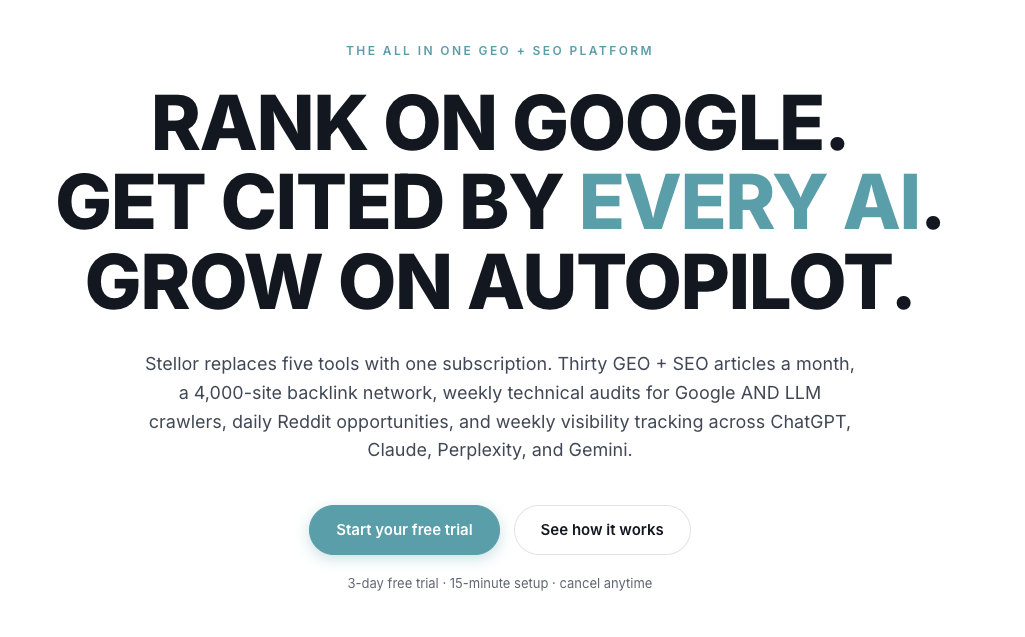
That’s exactly what Stellor was built for. The platform handles content creation, citation building, technical site audits, and real-time AI visibility tracking inside one subscription, so you’re not juggling five different tools or paying agency rates. Whether you offer home services, professional services, or anything in between, Stellor’s system deploys fast and tracks what matters. If you’re ready to stop guessing and start growing, explore what GEO + SEO for professional services looks like for your specific business type.
Frequently asked questions
What is a local SEO strategy workflow for service businesses?
It’s a step-by-step process focused on boosting your online presence to attract more customers in your service area. Foundational workflow steps tailored for local service businesses are critical for consistent online visibility.
How long does it take to see results from local SEO?
Most local businesses see measurable improvements within two to three months if they follow the workflow consistently. The right setup and tools from the start make timelines shorter and results more predictable.
Which tools do I need to track my local SEO workflow?
You need access to Google Business Profile, Google Analytics, and a local rank tracker for best results. Real-time tracking tools help local businesses spot growth opportunities and catch issues before they damage rankings.
What is the most common local SEO mistake?
Failing to keep your business info consistent across directories is the top mistake that hurts rankings. Consistent, accurate business information and active review management are non-negotiable for sustained local SEO success.
Can I do local SEO myself or should I hire a pro?
Many owners handle the basics themselves effectively, but hiring help or using a platform like Stellor can fast-track results and free up your time for the work that actually generates revenue.