Potential customers in your neighborhood are searching for the exact services you offer right now, but your website isn’t showing up. That gap between showing up and getting skipped costs local businesses real revenue every single day. 86% of small business sites lack even basic SEO fundamentals, which means most local service businesses are essentially invisible to nearby searchers. A structured SEO audit checklist changes that by turning guesswork into a clear, repeatable process that fixes the right problems in the right order.
Table of Contents
- Set the right audit priorities for local SEO
- Technical SEO audit steps for local businesses
- Optimize your Google Business Profile (GBP)
- On-page SEO: Pages, schema, and location signals
- Content, reviews, and backlink checks
- What most SEO checklists miss about local search success
- Need help with your local SEO audit?
- Frequently asked questions
Key Takeaways
| Point | Details |
|---|---|
| Prioritize highest-impact fixes | Fix technical issues and Google Business Profile first for the fastest SEO improvement. |
| Technical health is essential | A fast, crawlable site is required before other SEO steps matter. |
| Optimize local signals | Consistent business info and on-page schema boost local rankings. |
| Content and links support visibility | Fresh content and strategic backlinks keep your business relevant online. |
| Proximity and NAP matter most | Being near searchers, plus clarity in your business details, outranks review quantity for local SEO. |
Set the right audit priorities for local SEO
Not every SEO issue deserves your attention equally. Spending a week perfecting blog content while your site takes eight seconds to load is a losing trade. When you start an audit with the wrong priorities, you burn time and see little movement in your rankings.
For local service businesses, the priority stack looks like this:
- Technical health (crawlability, site speed, indexing, mobile usability)
- Google Business Profile (GBP) accuracy and completeness
- On-page signals (titles, meta descriptions, schema, NAP consistency)
- Content quality and freshness
- Backlinks and off-site authority
This order matters because technical and GBP fixes deliver the most impact fastest. There’s one more thing most checklists underplay: proximity. The physical distance between your business and the person searching is the dominant factor in whether you show up in the local 3-pack. In fact, proximity accounts for 96% of top-3 position variance in local search results. Reviews matter, but they play a supporting role, not the lead.
Understanding this priority stack is what separates businesses achieving measurable local SEO results from those spinning their wheels month after month.
Pro Tip: Schedule your full SEO audit quarterly and also run a quick check after any major website update, server migration, or Google algorithm update. Problems introduced by a redesign can quietly drain your rankings for months if left unchecked.
Applying local SEO optimization strategies consistently will help you build a compounding advantage over competitors who audit only when something breaks.
Technical SEO audit steps for local businesses
Once you know what to prioritize, start with a technical foundation. Technical problems are the silent killers of local search performance. You can have the best service in town with glowing reviews, but if Google can’t crawl your site efficiently or your pages load slowly on mobile, none of that matters.
Here are the core technical checks every local business should run:
- Site speed: Measure load time using Google PageSpeed Insights. Target under 3 seconds. Painfully, 61% of small business sites load in more than 4 seconds, which drives users away before they even see your services.
- Mobile usability: Use Google’s Mobile-Friendly Test. Most local searches happen on phones, so a broken mobile experience directly translates to lost leads.
- Crawlability: Check your robots.txt file to confirm you’re not accidentally blocking Google from indexing important pages.
- Indexation: Search Google for site:yourdomain.com to see how many pages are indexed. Missing pages often signal crawl errors or noindex tags left over from development.
- Orphaned pages: Pages buried more than 4 clicks deep from your homepage receive far less crawl budget and rank poorly. Identify these using SEO tools for technical checks and add internal links to surface them.
- HTTPS: Confirm your entire site runs on a secure SSL certificate. An insecure site loses trust signals immediately.
Here’s a quick benchmark table to measure your site against common standards:
| Metric | Poor | Acceptable | Strong |
|---|---|---|---|
| Page load speed | Over 4 seconds | 2 to 4 seconds | Under 2 seconds |
| Mobile usability score | Below 70 | 70 to 89 | 90 and above |
| Indexed pages vs. live pages | Under 60% | 60% to 85% | Above 85% |
| LocalBusiness schema implemented | No | Partial | Full |
| HTTPS across all pages | No | Some pages | All pages |
Understanding your SEO health score basics will help you interpret these numbers and build a fix timeline rather than trying to solve everything at once. If you’re new to some of these terms, reviewing key SEO terms explained will make the audit process far less intimidating.
Pro Tip: Strong content cannot rescue a technically broken site. Fix your crawl and speed issues first, then invest in content. Reversing that order wastes effort.

Optimize your Google Business Profile (GBP)
With the technical foundation in place, focus on your GBP. Think of it as the front door for your local customers. When someone searches “plumber near me” or “best electrician in [city],” your GBP listing often appears before your website does. A weak or incomplete profile loses customers before they ever land on your site.
Here’s a step-by-step GBP audit process:
- Verify NAP accuracy. Your business name, address, and phone number must match exactly what appears on your website and across all directories. Even small differences like “St.” versus “Street” can confuse Google about your business entity.
- Select the right primary category. Your primary category carries significant weight. Analyze the GBP categories of your top local competitors and align yours accordingly.
- Add secondary categories. If you offer roofing and gutter cleaning, both should be listed so Google understands your full service scope.
- Upload original photos and videos. Skip the stock imagery entirely. GBP audit data shows that real owner-uploaded photos and video content build authenticity and improve engagement.
- Respond to every review. A 4.5-star average rating is considered ideal for conversion. Responding to all reviews, including negative ones, signals that you’re an active and credible business.
- Confirm business hours. An astonishing only 41.8% of small business sites list their hours accurately. Wrong hours erode trust fast.
- Use Google Posts. Publishing regular updates, offers, or announcements keeps your profile fresh and signals ongoing business activity.
- Review GBP Insights. Look at how customers are finding you, what queries trigger your listing, and where they’re coming from. This data shapes your broader strategy.
Traditional SEO wisdom says more reviews and stronger backlinks are the keys to local pack rankings. The reality in 2026 is more nuanced. Recent data shows that the correlation between review quality and local pack position is surprisingly weak (ρ = -0.036). Proximity and entity clarity are doing most of the heavy lifting.
Here’s how audit priorities have shifted based on current data:
| Old GBP audit priority | Updated 2026 priority |
|---|---|
| Chase review volume | Focus on NAP entity clarity |
| Backlink quantity | Proximity and category accuracy |
| Keyword stuffing in business name | Clean, accurate business name |
| Generic stock photos | Authentic owner-uploaded media |
| Respond only to bad reviews | Respond to all reviews consistently |
Understanding why Google rankings matter for growth gives you the conviction to invest time in GBP optimization rather than treating it as a one-and-done task. Your GBP is a living profile that rewards ongoing attention.
Pro Tip: Add your service area cities directly inside your GBP service area settings. This expands the geographic zone where Google considers showing your listing, without requiring a physical address in each city.
On-page SEO: Pages, schema, and location signals
With GBP optimized, tighten your site’s on-page signals so Google sees your business as a local authority, not just a website that happens to exist in a particular city.
Here are the key on-page steps to audit:
- Optimize page titles and meta descriptions for local intent. Your homepage title should include your primary service and city. For example, “Roof Repair Services in Austin, TX” is far stronger than a generic “Welcome to Our Company.”
- Implement LocalBusiness schema. Schema markup (a type of structured data that helps Google understand your business details) remains underused. Only 18.5% of small business sites use LocalBusiness schema, making this an easy competitive edge.
- Maintain NAP consistency across every page. Your name, address, and phone number should appear in your footer or header on every page, formatted exactly the same way across your site and all external directories.
- Embed Google Maps on your contact page. A Google Maps embed reinforces your physical location to Google and helps users find you more easily.
- Build out dedicated location or city pages. If you serve multiple areas, create a unique page for each city with genuinely original content, not just a copied template with the city name swapped out.
- Use internal links strategically. Link from your blog posts and service pages to your location pages and contact page to concentrate ranking signals where you need them most.
| On-page fix | Impact on local rankings |
|---|---|
| Add LocalBusiness schema | High: improves entity understanding |
| Unique city landing pages | High: captures geo-specific searches |
| NAP consistency in footer | Medium: strengthens entity signals |
| Google Maps embed | Medium: reinforces location relevance |
| Local keyword in page title | Medium: targets intent-driven queries |
| Internal links to location pages | Medium: concentrates ranking signals |
Using AI for local SEO can help you scale this process, especially if you operate across multiple service areas and need unique page content without spending weeks writing everything manually. Pair your on-page work with on-page SEO management tools to track changes and confirm improvements are sticking.
Content, reviews, and backlink checks
Finally, make sure your content, reputation, and authority measures aren’t lagging behind competitors. These are often the last items businesses check, but they can quietly sabotage even a technically clean site.
Here’s what to look for:
- Outdated content. Old blog posts with expired promotions, outdated pricing, or stale service information send negative freshness signals. Refreshing dates alone can provide a quick ranking boost, but genuinely updating the content itself produces stronger results.
- Orphaned pages. Pages buried more than 4 levels deep in your site structure receive little crawl attention. Map your site’s structure and bring important pages closer to the surface through internal linking.
- Review diversity and recency. A business with 200 reviews from two years ago and none recently looks less active than one with 40 reviews posted in the last 90 days. Recency matters.
- Backlink profile health. Examine your incoming links for quality and anchor text diversity. 70% of small business sites have fewer than 10 backlinks, which makes even modest link building a significant competitive differentiator.
- AI visibility. This is the emerging factor most businesses haven’t thought about yet. When someone asks ChatGPT or another AI tool to recommend a local service provider, is your business being cited? Checking for AI mentions is now part of a forward-looking SEO audit.
- Anchor text distribution. If most of your backlinks use the exact same keyword phrase, that can look unnatural to Google. A healthy profile mixes branded terms, naked URLs, and varied keyword phrases.
Run a backlink quality check to see whether your links are coming from relevant, authoritative sources or from low-quality directories that offer little value. For a broader view of how to compete in local SEO for service businesses, this content and authority audit phase is where you refine long-term strategy.
What most SEO checklists miss about local search success
Here’s an uncomfortable truth most generic SEO checklists avoid: they were built for national or e-commerce brands and then loosely adapted for local use. The result is a lot of advice focused on backlinks and review counts, both of which have far less impact on local pack rankings than proximity and entity clarity.
Research confirms that the correlation between review quality scores and local pack position is essentially negligible (ρ = -0.036). That doesn’t mean reviews are worthless. They build trust and influence click-through rates. But if you’re stuck outside the top 3 and spending your energy on a review solicitation campaign, you’re optimizing the wrong variable.
What actually moves the needle is helping Google clearly understand what your business does and where it operates. That means consistent NAP data across every online touch point, accurate GBP categories, LocalBusiness schema on your site, and location-specific pages that reinforce your geographic service area. The cleaner and more consistent your entity signals, the easier it is for Google to confidently place you in front of nearby searchers.
If your business is stuck on page two or just outside the 3-pack, the answer is almost never “get more reviews.” It’s usually a combination of proximity optimization (ensuring your service area is correctly defined), entity clarity (consistent business information everywhere Google looks), and crawl depth (making sure your most important pages are easy to find and index).
Why prioritizing Google rankings matters becomes clearest when you see how quickly a technically sound, entity-clear local business climbs above competitors who focus only on link volume and review counts.
Pro Tip: If you’re stuck outside the top 3 despite strong reviews, audit your crawl depth and internal linking first. A location page buried five levels deep may be your entire problem.
Need help with your local SEO audit?
Running through this checklist yourself is absolutely doable, but it takes time, the right tools, and the experience to interpret what you find. Most local business owners have all three in short supply.
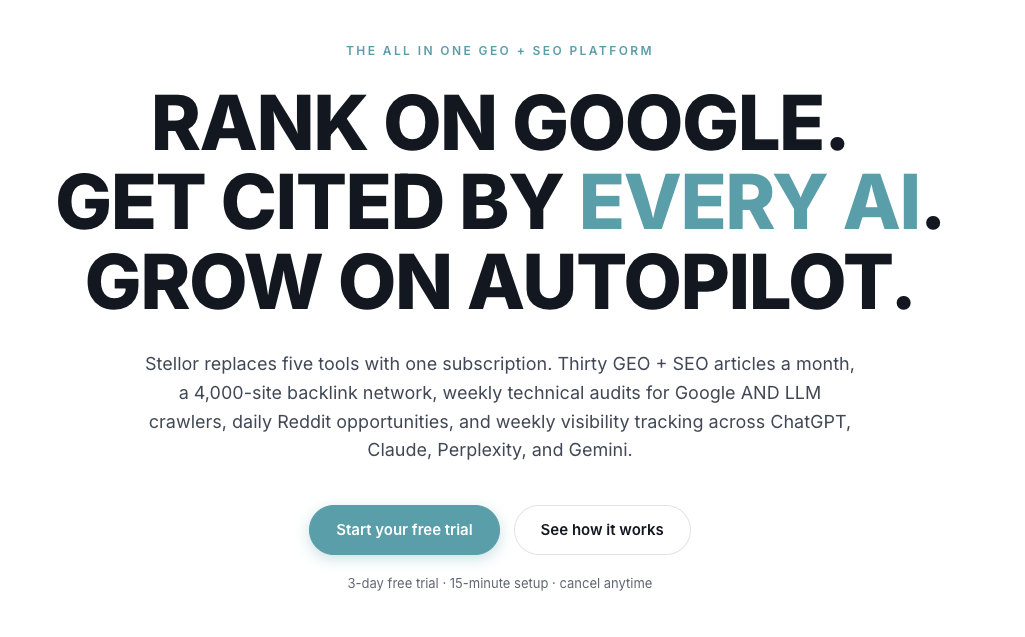
Stellor makes this process faster and more reliable by consolidating technical audits, content creation, backlink building, and AI citation tracking into one platform built specifically for local service businesses. Instead of juggling multiple tools and vendors, you get a single system that continuously monitors your SEO health, flags issues before they cost you rankings, and helps you build the kind of long-term online presence that compounds over time. Take a look at what expert audit help looks like in practice, or explore the full range of Stellor’s local SEO services to see how quickly you can move from audit to results.
Frequently asked questions
How often should I run an SEO audit for my local business?
Run a full audit quarterly at minimum, and also after any significant changes to your website or Google Business Profile. Consistent audits catch ranking problems before they become expensive.
Does my Google rating or number of reviews matter more for top local rankings?
Proximity has far more influence on local rankings than either review rating or volume, with data showing a near-zero correlation between review quality and local pack position. Reviews still matter for building customer trust and improving click-through rates.
What is the most overlooked technical SEO issue for local businesses?
Slow site speed and missing LocalBusiness schema are the most widespread problems, with over 61% of sites loading too slowly and more than 81% lacking schema markup. Both are fixable quickly and deliver immediate ranking benefits.
How do I know if my content is hurting my SEO?
Outdated content and orphaned pages buried more than 4 levels deep in your site structure can suppress your rankings by limiting crawl access and signaling low freshness to Google. Refreshing old content and improving internal linking are the fastest fixes.