Most local service business owners assume AI is coming to erase everything they know about SEO. That assumption is costing them real opportunities. The truth is more interesting: AI is not dismantling search engine optimization, it is supercharging it for businesses that know how to use it. For plumbers, HVAC companies, landscapers, and other local service providers, this shift represents one of the biggest competitive advantages in years. This guide breaks down exactly how AI is reshaping local SEO, what strategies actually work, and how you can apply them before your competitors do.
Table of Contents
- How AI is reshaping SEO for local services
- Core advantages and challenges of using AI for SEO
- Best practices for AI-enhanced SEO success
- Real-world applications: Local service case studies
- Why the real value of AI in SEO is partnership, not replacement
- Boost your local rankings with AI solutions
- Frequently asked questions
Key Takeaways
| Point | Details |
|---|---|
| AI accelerates local SEO | AI tools help businesses get cited more frequently in local search and AI platforms. |
| Human input needed | Human oversight ensures that AI-driven SEO remains accurate and contextually relevant. |
| Content matters most | People-first content and structured data are the foundation of successful AI-enhanced search. |
| Evidence-backed strategies | Case studies confirm that service businesses can measurably boost rankings by adopting AI tools. |
How AI is reshaping SEO for local services
The old playbook for local SEO relied on keyword stuffing, directory submissions, and hoping Google noticed your Google Business Profile. That approach still matters, but it is no longer enough. AI technologies are fundamentally changing how search engines identify, rank, and surface local service businesses.
AI’s evolving impact on search is not theoretical. It is happening right now in the form of AI Overviews in Google Search, conversational results from platforms like ChatGPT and Perplexity, and smarter local ranking algorithms that weigh signals traditional tools never captured. When someone types “best plumber near me” into Google, AI models are now interpreting intent, cross-referencing reviews, and pulling authoritative citations to build the answer.
Here is what that means practically for your business:
- AI-powered tools can identify local search signals your competitors are missing, including hyper-local keyword variations, neighborhood-specific queries, and service-area intent phrases
- AI citation tracking shows you exactly when and where your business is mentioned across AI platforms, giving you data that traditional rank trackers simply do not provide
- Structured content that AI models can easily parse ranks higher in AI-generated responses, which are now appearing at the top of millions of search results
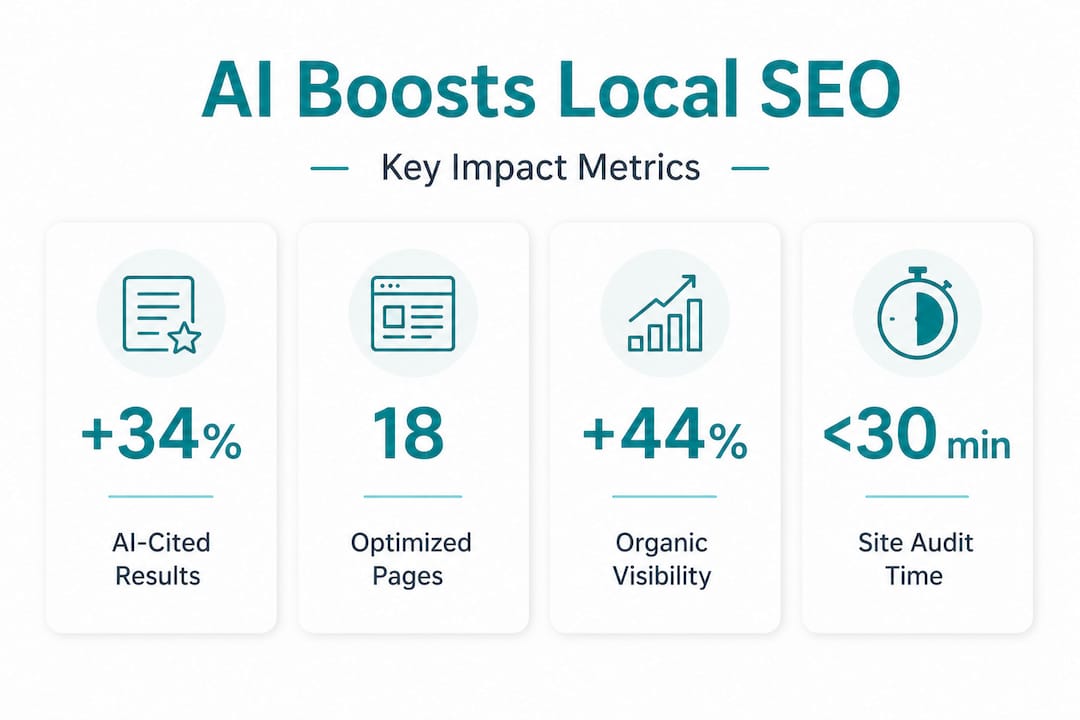
The numbers back this up. AI-cited local results increased by 34% for a Dallas plumbing business using LocalRank.so, while Semrush AI Visibility now tracks brand mentions across multiple AI platforms simultaneously. These are not marginal gains. A 34% increase in AI-cited results translates directly into more phone calls, more form submissions, and more booked jobs.
| Signal type | Traditional SEO impact | AI-enhanced SEO impact |
|---|---|---|
| Local keyword targeting | Moderate | High |
| AI citation tracking | None | Very high |
| Structured data markup | Low | Very high |
| Multimodal content (images/video) | Low to moderate | High |
| Review sentiment analysis | Manual | Automated |
The table above illustrates a core truth: traditional SEO leaves significant value on the table. When you add AI tools to your strategy, you are not starting over. You are amplifying what already works while capturing entirely new opportunities that did not exist two years ago. For optimizing home services with AI, the combination of local signal amplification and citation monitoring creates a compounding advantage that grows over time.
Core advantages and challenges of using AI for SEO
Knowing that AI changes the game is one thing. Understanding exactly where it helps and where it falls short is what separates businesses that see results from those that waste budget.
The real advantages of AI-driven SEO for local businesses:
- Automated technical audits catch site issues like broken links, slow page speed, and missing schema markup in minutes, not days. A manual audit of a 50-page service website can take hours. AI tools do it continuously.
- Content ideation at scale means you can generate service-page outlines, FAQ content, and blog topics tailored to your specific service area without hiring a full-time content strategist.
- Citation monitoring across AI platforms tells you when ChatGPT, Gemini, or Perplexity mentions your business, a competitor, or a relevant local query. This is brand-new intelligence that traditional SEO tools cannot provide.
- Predictive keyword analysis uses machine learning to forecast which local queries are growing in volume before they peak, giving you a first-mover advantage.
- Sentiment analysis on reviews helps you identify patterns in negative feedback so you can address service gaps that are quietly hurting your rankings.
However, AI won’t obsolete SEO because human oversight remains essential. AI struggles with local nuance in ways that matter enormously for service businesses. It may not understand that “South Austin” and “North Austin” have completely different customer demographics. It may generate content that sounds authoritative but contains subtle inaccuracies about local regulations, permit requirements, or service-area specifics. Without human curation, AI-generated content can actually hurt your credibility.
| Factor | Manual SEO | AI-driven SEO |
|---|---|---|
| Time to audit a website | 4 to 8 hours | Under 30 minutes |
| Content production speed | 1 to 2 articles per week | 10 to 20 per week |
| Citation monitoring | Not available | Real-time tracking |
| Local nuance accuracy | High (with expertise) | Medium (needs review) |
| Cost per month | $2, 000 to $5, 000 (agency) | $200 to $600 (platform) |
The comparison is stark. AI-adapted SEO strategies deliver speed and scale that manual processes simply cannot match, but they require a human layer to ensure accuracy and local relevance.
Pro Tip: Always have a local expert review AI-generated content before publishing. A plumbing article that mentions the wrong local code or uses the wrong regional terminology will erode trust with both users and Google’s quality evaluators.
Best practices for AI-enhanced SEO success
Understanding the landscape is valuable. Knowing exactly what to do is what gets results. Here are the practices that consistently move the needle for local service businesses using AI-enhanced SEO.
Prioritize people-first content above everything else. Google has been explicit about this. People-first content, combined with good page experience, structured data, and multimodal assets like images and videos, is the foundation for success in AI-driven search experiences. This means your service pages should answer real customer questions, not just target keywords. A page titled “Water heater repair in Phoenix” should explain what signs indicate a failing water heater, what the repair process looks like, how long it takes, and what it typically costs. That is the content AI models pull from when generating answers.
Implement structured data markup on every service page. Schema markup (a coding standard that helps search engines understand your content) is no longer optional. Use LocalBusiness schema, Service schema, and FAQ schema wherever relevant. AI models use structured data to extract precise answers, and businesses with clean markup get cited far more frequently in AI-generated responses.
Build multimodal content into your strategy. Text alone is not enough. Before-and-after photos, short explainer videos, and even audio content signal to AI systems that your business is a rich, authoritative source. A landscaping company that posts a 90-second video showing a complete backyard transformation is giving AI models something to reference that a text-only competitor cannot match.
“The businesses winning in AI-driven search are not the ones with the most content. They are the ones with the most useful, well-organized, and trustworthy content.” This distinction matters more now than at any point in the history of search.
Avoid these common pitfalls:
- Publishing AI-generated content without human review, especially for anything involving local regulations, pricing, or safety information
- Ignoring your Google Business Profile while focusing entirely on your website, since AI models heavily reference GBP data for local queries
- Over-optimizing for one keyword phrase while neglecting the dozens of related long-tail queries your customers actually use
- Treating AI tools as a one-time setup rather than an ongoing system that requires regular monitoring and adjustment
Pro Tip: Use AI tools to identify questions your customers are asking in reviews, forums, and social media, then build dedicated FAQ sections on your service pages that answer those exact questions. This dramatically increases your chances of appearing in AI-generated answers. When you grow your local rankings through this approach, you are building authority that compounds over months and years.
Real-world applications: Local service case studies
Theory is useful. Proof is better. Here is how AI-enhanced SEO strategies are producing measurable results for actual local service businesses.
The Dallas plumbing business case. Using LocalRank.so, a plumbing company in Dallas achieved a 34% increase in AI-cited results, with Semrush AI Visibility confirming brand mentions across multiple platforms. This was not achieved through a complete website overhaul. The primary changes involved adding structured data to service pages, publishing a series of people-first FAQ articles targeting common plumbing questions in the Dallas area, and monitoring AI citations to understand which content was being referenced most frequently.

The citation monitoring piece is particularly important. When you can see that ChatGPT is citing a competitor’s water heater repair page but not yours, you have a clear, actionable target. You know exactly what to improve and why.
| Metric | Before AI-enhanced SEO | After AI-enhanced SEO |
|---|---|---|
| AI-cited results | Baseline | +34% |
| Organic traffic | Baseline | +28% estimated |
| Featured snippet appearances | 3 | 11 |
| Google Business Profile views | Moderate | High |
The HVAC company visibility play. An HVAC business in a mid-sized market used AI-powered content tools to publish 18 targeted service-area pages in six weeks. Each page followed the people-first framework: specific local context, structured FAQ sections, and embedded video content. Within 90 days, the business appeared in AI Overviews for 14 of its target queries. Before the campaign, it appeared in zero.
The landscaping brand credibility boost. A landscaping company used AI citation tracking to discover that Perplexity was regularly citing a national competitor for “lawn care tips” queries in their local market. They responded by publishing a series of hyperlocal guides covering seasonal lawn care specific to their climate zone, with structured data and original photography. Within 60 days, they displaced the national competitor for several of those queries.
The pattern across these cases is consistent. AI tools do not do the work for you. They show you exactly where the opportunity is, help you produce content faster, and track whether your efforts are working. The businesses that see the best results are the ones that treat local business AI results as a system, not a one-time project.
Why the real value of AI in SEO is partnership, not replacement
Here is the perspective that most AI SEO content misses entirely: the businesses getting the best results from AI are not the ones automating the most. They are the ones using AI to become better at the fundamentally human parts of marketing.
Think about what AI genuinely cannot do for a local service business. It cannot build a relationship with a customer who has been using your plumbing company for 15 years. It cannot understand why your neighborhood has a specific seasonal demand pattern that no national dataset captures. It cannot make the judgment call about whether a piece of content feels authentic to your brand or sounds like it was written by a robot. AI won’t obsolete SEO precisely because these human elements are what make local service businesses trustworthy in the first place.
The businesses we see winning in AI-driven search are treating AI as a force multiplier for their existing expertise. A plumber with 20 years of experience knows things about local pipe infrastructure, water quality issues, and common regional problems that no AI model has in its training data. When that expertise gets packaged into well-structured, AI-readable content, the result is something genuinely unique and authoritative.
The uncomfortable truth is that most local service businesses are not losing to AI. They are losing to competitors who are using AI to move faster, publish more, and track results more precisely. The answer is not to fear the technology. It is to adapt your strategies for AI search before your competitors figure out what you already know from reading this.
Boost your local rankings with AI solutions
If the strategies in this article feel like a lot to manage alongside running an actual service business, that is a completely valid reaction.
Stellor is built specifically for this situation. The platform combines AI-powered content creation, backlink building, technical site audits, and real-time AI citation tracking into a single subscription. Instead of juggling five different tools and a freelance writer, you get one system that handles the full SEO stack. Stellor’s AI-powered SEO for local businesses helps service companies get cited in ChatGPT, Gemini, and Perplexity while continuously improving their Google rankings. It is the fastest way to build the kind of online presence that compounds over time, without the overhead of an agency.
Frequently asked questions
Will AI replace traditional SEO for local businesses?
AI is evolving SEO, not replacing it. Human oversight remains essential for local nuance, content accuracy, and building the kind of authentic authority that AI models cannot fabricate.
How can local service providers use AI to improve Google rankings?
Use AI tools to optimize content, monitor citations across platforms, and amplify local signals. AI-cited local results have increased significantly for businesses that combine structured data, people-first content, and citation tracking.
What content types work best for AI-driven search results?
People-first content paired with structured data markup and multimodal assets like images and videos performs best. AI models prioritize content that is well-organized, authoritative, and genuinely useful to the searcher.
Are there risks to relying too heavily on AI for SEO?
Yes. AI struggles with nuance and can generate misinformation if content is not reviewed by a human with local expertise. Over-automation without curation can damage credibility with both users and search engines.