Running a great plumbing service, landscaping company, or HVAC operation does not guarantee that customers can find you. The uncomfortable truth is that local SEO visibility directly determines whether high-intent customers call you or your competitor, and word-of-mouth alone simply cannot sustain the growth most business owners want. This guide breaks down exactly how SEO works as a growth engine for local service businesses, what the most effective strategies look like in practice, and how to connect your online visibility directly to bookings, calls, and revenue.
Table of Contents
- How SEO powers visibility and credibility
- SEO as a sustainable, compounding growth channel
- What effective SEO for local service growth looks like
- From visibility to sales: SEO’s conversion power
- Owning and integrating SEO for measurable business outcomes
- Why most local SEO advice misses the revenue mark
- Accelerate your business growth with proven SEO and AI tools
- Frequently asked questions
Key Takeaways
| Point | Details |
|---|---|
| SEO drives local growth | Showing up in search results means more high-intent customers find your business. |
| Long-term visibility | SEO keeps working for you over time, unlike paid ads that stop when the budget runs out. |
| Conversion matters most | Pairing visibility with strong calls to action turns more site visitors into sales and leads. |
| Operational ownership wins | Businesses that make SEO a priority and measure real outcomes grow faster and outpace competitors. |
How SEO powers visibility and credibility
Most local service owners think about SEO as a vague, optional extra. It is not. When someone types “emergency plumber near me” or “best HVAC repair in [city]” into Google, they are ready to hire someone immediately. The businesses that appear at the top of those results, especially in the Google Maps local pack, capture almost all of that demand.
Local search visibility drives higher-intent traffic that converts into calls, visits, and booked jobs far more reliably than social media posts or cold outreach. This is because the person searching already has a problem and is actively looking for a solution. Your job is simply to be visible when they look.
Here is what local SEO visibility actually delivers:
- Map pack placement: Appearing in the top three results on Google Maps puts your business in front of customers before they even scroll to the website results.
- “Near me” traffic: Searches that include location terms are exploding in volume and carry extremely high purchase intent.
- Review visibility: SEO surfaces your reviews prominently, and customers read them before clicking your phone number.
- Credibility by association: Customers unconsciously trust businesses that rank highly. If Google shows you first, you must be good.
Consider a concrete example. An HVAC company stuck on page two of Google was generating roughly 12 inbound calls per month from organic search. After a focused local SEO push, including optimizing their Google Business Profile, earning local backlinks, and publishing service-specific content, they broke into the top three positions. Monthly calls jumped to over 60. Nothing else changed. The phone rang more because they became visible.
“The businesses that show up consistently in local search are not always the best in their market. They are simply the best at being found.”
To understand how to rank faster with local SEO, it helps to think of Google as a trust machine. It surfaces businesses it considers credible, relevant, and authoritative for a specific location and service type. Your goal is to demonstrate all three of those qualities through consistent, well-structured SEO activity.
SEO as a sustainable, compounding growth channel
Paid ads are a fast lane with a toll booth. The moment you stop paying, the traffic disappears. SEO is more like building a highway that keeps delivering vehicles long after the construction is complete. This distinction matters enormously for local service businesses operating on tight margins.

SEO compounds long-term organic visibility in a way that paid advertising simply cannot replicate. Every article you publish, every backlink you earn, and every Google Business Profile update you make stacks on top of previous work. Six months of consistent SEO activity does not just give you six months of results. It accelerates the next six months.
Here is a clear comparison of how SEO and paid ads perform over time:
| Factor | Paid ads | Organic SEO |
|---|---|---|
| Results timeline | Immediate | 3 to 6 months |
| Cost over time | Increases with competition | Reduces as authority builds |
| Traffic when paused | Stops immediately | Continues for months or years |
| Trust signal to customer | Low (labeled “Ad”) | High (organic ranking) |
| Long-term ROI | Decreasing | Compounding upward |
A landscaping business in a mid-sized market spent $2, 400 per month on Google Ads for two years. When they shifted half that budget to SEO content and backlinks, their organic traffic grew by 340% over 18 months. More importantly, their cost per lead dropped by 60% because organic leads kept arriving without additional spend.
Pro Tip: Think of SEO spending as a bank deposit, not a monthly bill. Every dollar you put in keeps earning interest. Every dollar in ads disappears the moment you stop depositing.
The measuring SEO ROI conversation becomes much easier once you frame it as compounding asset growth rather than a recurring expense. This shift in perspective helps business owners commit to the longer horizon that SEO requires and rewards.
What effective SEO for local service growth looks like
Knowing that SEO matters is one thing. Knowing exactly what to do is another. The good news is that the core ingredients are well established and proven.
Modern SEO for growth rests on four foundational pillars: matching content to what your best customers actually search for, building topical authority through interconnected content, ensuring excellent page experience, and earning trustworthy backlinks. Every tactic you execute should ladder up to one of these four areas.
Here is a step-by-step framework for local service SEO that moves the needle:
- Audit your current technical health. Slow pages, broken links, and poor mobile experience kill rankings before you even start. Google’s crawlers evaluate your site’s technical condition as a baseline signal.
- Research the real search terms your customers use. Tools like Google Search Console show you what people actually type. “HVAC repair” and “AC not blowing cold air” are very different searches with different intent.
- Publish service-specific content pages. One page per core service, optimized for the local market. A plumber serving three suburbs needs three optimized location pages, not one generic “services” page.
- Optimize your Google Business Profile consistently. Post updates, add photos, respond to every review, and keep your hours and service categories current.
- Earn backlinks from local sources. Chamber of commerce listings, local news coverage, and partnerships with complementary businesses all build local authority.
- Track performance with analytics and Search Console. Know which pages drive calls, which keywords are climbing, and where visitors abandon your site.
| SEO element | Impact level | Time to see results |
|---|---|---|
| Google Business Profile | Very high | 2 to 4 weeks |
| Service and location pages | High | 2 to 4 months |
| Technical site health | High | 1 to 3 months |
| Backlink building | High | 3 to 6 months |
| Review generation | Medium to high | Ongoing |
Following a solid local SEO optimization guide prevents the common mistake of doing a little of everything and excelling at nothing. Focus matters. And improving SEO health at the technical level is often the fastest way to unlock ranking improvements that content alone cannot achieve.
From visibility to sales: SEO’s conversion power
Ranking on page one is exciting. But a ranking that does not generate revenue is just a trophy on a shelf nobody visits. The real goal is turning search impressions into booked jobs.
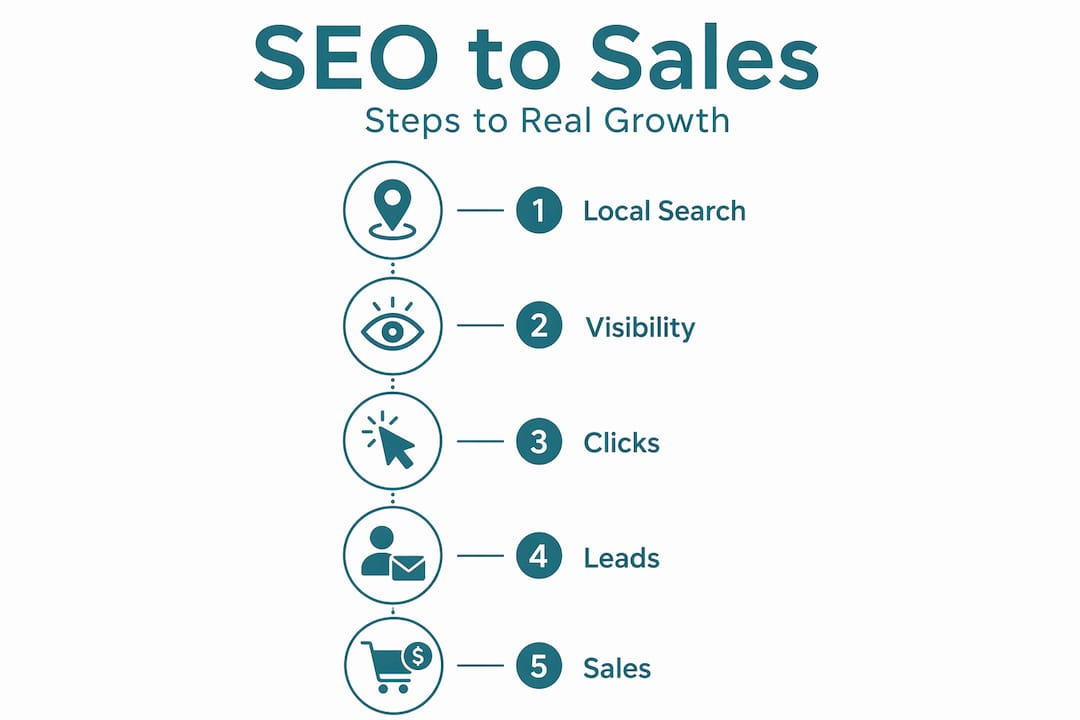
SEO visibility must pair with strong conversion design to generate actual customers. Organic search converts at roughly 2.86% on average across industries, but that number swings wildly based on how well your page answers the visitor’s question and how clearly it tells them what to do next. AI search referrals are showing early signs of converting even higher because those users have typically already gotten context from an AI tool before clicking through to your site.
Here is what moves visitors from “interesting” to “I’m calling now”:
- Clear and prominent phone numbers. If a visitor on mobile cannot tap-to-call within two seconds of landing, you are losing jobs.
- Specific service descriptions. Vague pages about “quality service” do not convert. Pages that describe the exact problem you solve, for exactly the type of customer you serve, perform far better.
- Real reviews displayed prominently. Testimonials placed near a call to action lift conversion rates measurably.
- Fast page loading. A one-second delay in page load time reduces conversions by roughly 7%. Slow equals lost revenue.
- Consistent NAP (Name, Address, Phone). If your business information is inconsistent across directories and your website, customers lose confidence and search engines penalize you.
Pro Tip: Use Google Search Console to find pages getting traffic but generating no clicks to your contact page. Those pages are leaking potential customers. Fix the call-to-action or improve the offer, and you can often double a page’s lead generation without any additional SEO work.
Using AI with SEO is increasingly relevant here. AI tools can analyze your site’s conversion funnel, identify where visitors drop off, and suggest content or design changes that improve lead capture without requiring a complete website rebuild.
Owning and integrating SEO for measurable business outcomes
Here is where most local service businesses fall short. They invest in SEO, see some rankings improve, and then lose track of whether any of it is actually affecting revenue. The problem is not the SEO. It is the lack of operational ownership.
Effective SEO-as-business-growth requires someone to actively align SEO priorities with commercial outcomes, not just rankings. That means tracking which keywords are generating calls, which pages are driving form completions, and which SEO investments are producing the best cost-per-acquisition.
Here is how to operationalize SEO so it actually connects to revenue:
- Set revenue-tied KPIs from the start. “Rank for 10 keywords” is a vanity goal. “Generate 40 inbound leads per month from organic search” is a business goal.
- Review Search Console and analytics weekly. Look at which queries are driving clicks, which pages have high bounce rates, and where impressions are growing without clicks (a sign that your title or meta description needs work).
- Run small experiments with your Google Business Profile. Changing your service categories, posting offers, or adding new photos are fast experiments that often produce measurable changes in map pack visibility within weeks.
- Assign clear ownership. Someone on your team or a trusted vendor must own the SEO results. When nobody owns it, nothing improves consistently.
- Use AI-powered tools to surface opportunities faster. AI can process ranking data, competitor activity, and content gaps at a scale that would take weeks to do manually.
The tracking SEO impact process is where discipline separates growing businesses from stagnant ones. Leaders who review their SEO data regularly can redirect effort within weeks rather than waiting for a quarterly report to tell them something went wrong three months ago.
Pro Tip: Create a simple monthly dashboard that shows three numbers: organic sessions, leads from organic, and cost per organic lead. Update it every month. That single habit creates more accountability than any SEO report ever will.
Why most local SEO advice misses the revenue mark
Here is an uncomfortable truth we see repeatedly. Most SEO advice focuses obsessively on rankings and traffic, as if a higher number in a rank tracker automatically means a healthier business. It does not.
Rankings are a leading indicator. Revenue is the outcome. Treating rankings as the goal is like a restaurant owner measuring success by how many people walk past the door rather than how many sit down and order. The traffic is a prerequisite, not the point.
The most common SEO mistakes we observe among local service businesses all share the same root cause: they optimize for what is easy to measure, not what actually matters. Keyword rankings are easy to report. Phone calls generated from page three versus page one are harder to attribute, so many businesses never bother tracking it.
AI-powered insights are changing this dynamic significantly. Platforms that track how often your business is referenced in AI-generated answers, for example when someone asks ChatGPT for a recommendation, reveal a brand visibility layer that traditional rank tracking completely misses. Local businesses that get cited in AI answers are building credibility with a new generation of customers who use AI tools to make purchasing decisions.
But the bigger shift we advocate for is this: SEO leadership must sit with someone who understands the full customer journey. That person needs to care about the call that comes in, the booking that gets completed, and the review that follows, not just the ranking that made it possible. Understanding how to measure SEO outcomes from a revenue perspective is what separates businesses that grow from businesses that simply maintain.
Most businesses that plateau with SEO do so because they solved the visibility problem but ignored the conversion and retention problems. The most powerful insight we share with local service owners is this: SEO’s job is not to replace your sales process. It is to deliver better-qualified customers to the front door of that process. If the process is broken, more traffic makes the problem worse, not better.
Accelerate your business growth with proven SEO and AI tools
If this article has made one thing clear, it is that effective SEO for local service businesses is not just about showing up in search results. It is about connecting visibility to revenue through the right strategy, execution, and measurement.
Stellor is built specifically for local service businesses that want to grow without hiring an entire marketing department or juggling a dozen separate tools. The platform brings together content creation, backlink building, technical audits, and real-time AI citation tracking in a single subscription. Whether you are a solo operator or running a team across multiple locations, Stellor gives you the leverage to compete and win in local search. Explore GEO and SEO solutions designed for professional services, or visit the Stellor SEO blog for ongoing strategies you can apply immediately.
Frequently asked questions
How long does it take to see business growth from SEO?
Most local businesses notice meaningful SEO-driven growth within 3 to 6 months, with results compounding significantly over time because SEO compounds as an ongoing growth channel rather than delivering one-time results.
What makes local SEO different from standard SEO?
Local SEO specifically targets map listings and “near me” searches to drive high-intent traffic from your service area, and local search results like Google Maps are evaluated by different signals than traditional organic results.
Does SEO guarantee more customers for my business?
SEO significantly increases high-quality traffic and visibility, but pairing SEO with conversion UX is essential because more visitors only become more customers when your website clearly communicates your offer and makes it easy to take action.
How does AI enhance SEO for local businesses?
AI accelerates keyword discovery, content optimization, and performance analysis so owners can move faster, and SEO management now includes AI experimentation as a core competency for businesses that want to stay ahead in an evolving search landscape.