Choosing the wrong SEO metrics is like navigating with a broken compass. You’re moving, but not necessarily toward revenue. For local service businesses, the stakes are even higher because your market is geographically tight, your competition is fierce, and every missed call or unbooked appointment has a direct dollar value. The search landscape has shifted dramatically, with AI-generated answers, zero-click results, and algorithm volatility making many traditional metrics unreliable. This article walks you through a practical framework for identifying, comparing, and prioritizing the SEO result types that actually connect your digital efforts to real business growth.
Table of Contents
- How to select the right SEO metrics for local service businesses
- Organic traffic and visibility: Beyond basic counts
- Local rankings and map pack placement
- Review signals: Recency, velocity, and quality
- Key performance indicators: Which results matter most?
- Our fresh take: Why the old SEO playbook needs to change
- Ready to track results that matter?
- Frequently asked questions
Key Takeaways
| Point | Details |
|---|---|
| Prioritize actionable KPIs | Map pack rankings and review velocity directly drive leads and conversions. |
| Zero-click visibility matters | AI-driven search features require tracking mentions and authority beyond click counts. |
| Retire vanity metrics | Focus on results tied to business goals, not on domain authority or bounce rates. |
| Track trends not absolutes | Seasonality and ranking volatility make ongoing trend analysis essential for local services. |
How to select the right SEO metrics for local service businesses
Before you measure anything, you need to know what you’re measuring it for. That sounds obvious, but most local businesses default to tracking whatever their SEO tool shows on the dashboard, which is often a mix of useful signals and noise.
Start by anchoring your metrics to your actual business objectives. If you run a plumbing company, your goal isn’t website traffic. It’s calls, form submissions, and booked jobs. If you own a landscaping business, your peak season bookings matter far more than your monthly blog visits. Every metric you track should have a clear line back to one of those outcomes.
Here’s a practical checklist for selecting the right metrics:
- Leads and conversions: Phone calls, contact form fills, and online bookings are your primary success indicators.
- Map pack rankings: For local services, appearing in the top three Google Business Profile results is often more valuable than ranking first organically.
- Review velocity: How frequently new reviews are coming in, not just how many you have total.
- Keyword rankings for local intent: “Emergency electrician near me” matters more than a broad keyword with national competition.
- Click-through rate (CTR) from local search: This tells you whether your listing is compelling, not just visible.
What you should stop tracking, or at least stop treating as success indicators, includes domain authority (DA), bounce rate, and raw session counts without context. These metrics don’t tell you whether a real customer found you, called you, or hired you.
AI-driven search visibility is reshaping how results are delivered, and your metric selection needs to account for that. Seasonality affects traffic in ways that can make a perfectly healthy SEO campaign look like it’s failing in the off-season. A roofing company in Minnesota will see traffic drop in January. That’s not an SEO problem. That’s winter.
Pro Tip: Before launching any SEO campaign, document your current baseline for every metric you plan to track. Without a starting point, you can’t prove that your efforts made a difference.
Organic traffic and visibility: Beyond basic counts
With the right selection criteria in mind, organic traffic and visibility form the backbone of measurable SEO outcomes. But raw visitor counts alone can be deeply misleading.

Here’s the core problem: a business can see organic traffic drop by 20% and actually be performing better in search. How? Because zero-click searches reduce direct clicks but can build brand authority and visibility through featured snippets, map results, and AI-generated answers. Someone searching “best HVAC company in Austin” might see your business name, your rating, and your phone number directly in the results without ever clicking through to your website. That’s a win, even though your analytics won’t record it as a visit.
The metrics that matter for organic visibility in 2026 include:
- Impressions in Google Search Console: How often your pages appear in results, regardless of clicks.
- AI citations and mentions: How often your business appears in AI-generated answers from tools like ChatGPT or Google’s AI Overviews.
- Featured snippet appearances: Whether your content is being pulled into position zero results.
- Brand search volume: Are more people searching your business name directly? That’s a signal of growing awareness.
“In the AI era, tracking AI visibility and mentions alongside traditional metrics is no longer optional. As zero-click results rise, businesses that only measure clicks are measuring less than half the picture.” This insight from 2026 SEO strategy research reflects a shift that local businesses can’t afford to ignore.
One counter-intuitive truth worth knowing: traffic drops don’t always mean lower quality. When AI and featured snippets filter out casual browsers, the visitors who do click through often have higher intent. They’ve already seen your information, compared you to competitors, and decided to learn more. That means your conversion rate on organic visits may actually improve even as raw traffic shrinks.
Pro Tip: Use trend graphs instead of absolute numbers when reviewing organic traffic. A three-month downward trend is a problem. A single-month dip during a known slow season is just data.
Local rankings and map pack placement
Visibility is vital, but local rankings are often the point of conversion for service businesses. When someone searches “roof repair near me” on their phone, they’re not browsing. They’re ready to call someone. That’s why map pack placement is one of the highest-value metrics for any local service business.
The map pack, also called the local three-pack, is the block of three Google Business Profile listings that appears at the top of local search results. Understanding map pack impact is critical because studies consistently show that these three listings capture a disproportionate share of clicks compared to organic results below them.
Here’s what makes local ranking measurement tricky:
| Ranking factor | What to measure | How often |
|---|---|---|
| Map pack position | Your rank for primary service keywords | Weekly |
| Organic local ranking | Position for geo-modified keywords | Weekly |
| Ranking volatility | Position swings over 30 days | Monthly |
| Mobile vs. desktop rank | Differences across device types | Monthly |
Rankings are volatile and algorithm-driven, which means a single-week snapshot can be misleading. A business might drop from position two to position five after a Google update, then recover within two weeks. If you only check monthly, you might panic unnecessarily or, worse, make changes that disrupt a recovery already in progress.
Key factors that drive map pack placement include:
- Proximity: Google heavily weights how close the searcher is to your business location.
- Relevance: How well your Google Business Profile matches the search query.
- Prominence: Reviews, citations, backlinks, and overall web presence.
Pro Tip: Monitor your local rankings weekly using a rank tracker that separates mobile and desktop results. Mobile searches dominate local intent queries, and your mobile ranking may differ significantly from your desktop position.
Review signals: Recency, velocity, and quality
Beyond rankings and traffic, reviews shape both trust and search placement in the current SEO landscape. But not all review signals carry equal weight, and most businesses are measuring the wrong thing.
Total review count is the metric everyone tracks. It’s also the least predictive of local ranking improvement once you’ve crossed a basic threshold. What actually moves the needle is review velocity, meaning how frequently new reviews are arriving, and review recency, meaning how recently those reviews were posted.
“Review recency and velocity consistently outperform total count as ranking signals for local search. A business with 50 reviews in the last six months will outrank a competitor with 300 reviews from three years ago.” This pattern is well-documented in local SEO strategy discussions among practitioners who track ranking outcomes over time.
Here’s a comparison that makes the difference concrete:
| Review signal | Impact on local rankings | Impact on click-through rate |
|---|---|---|
| Total review count | Moderate (diminishing returns) | High (social proof) |
| Review recency | High | High |
| Review velocity | High | Moderate |
| Average star rating | High (below 4.0 is a red flag) | Very high |
| Owner response rate | Moderate | Moderate |
Review quality also matters beyond just the star rating. Detailed reviews that mention specific services, locations, or staff names provide Google with additional relevance signals. A review that says “John fixed our furnace in under two hours on a Sunday in Denver” is more valuable than “Great service!”
Key practices for improving review signals include:
- Ask at the right moment: Request reviews immediately after a job is completed, when satisfaction is highest.
- Make it frictionless: Send a direct link to your Google review page via text or email.
- Respond to every review: Positive and negative. This signals active management and builds trust.
- Encourage specifics: Ask customers to mention the service type and location when leaving a review.
Review strategies for local SEO that focus on velocity and recency will consistently outperform one-time review campaigns that generate a spike and then go quiet.
Pro Tip: After your peak season ends, that’s the ideal time to run a review request campaign. Customers are satisfied, the experience is fresh, and you’ll build review velocity heading into the next busy period.
Key performance indicators: Which results matter most?
Now, let’s bring all these metrics together and prioritize the ones that deliver measurable business impact. With so many possible signals to track, focus is everything. Tracking five to seven core KPIs prevents dilution and makes it easier to identify what’s actually driving results.
Here’s a head-to-head comparison of the major measurable result types:
| Metric type | Business impact | Ease of measurement | Reliability in 2026 |
|---|---|---|---|
| Map pack ranking | Very high | Medium | High |
| Organic traffic | Medium | High | Medium (zero-click impact) |
| Review velocity | High | Medium | High |
| AI citations/mentions | High | Low (emerging tools) | Growing |
| Domain Authority | Low | High | Low (vanity metric) |
| Bounce rate | Low | High | Low (misleading) |
| Phone call conversions | Very high | Medium | Very high |
Based on this framework, here are the top KPIs for local service businesses to prioritize in 2026:
- Phone calls and form submissions tracked through call tracking software and Google Business Profile insights.
- Map pack position for your top five service keywords, measured weekly.
- Review velocity measured as new reviews per month, with a target of at least two to four per month for most local businesses.
- Organic impressions from Google Search Console, tracked as a trend rather than an absolute number.
- AI visibility mentions tracked through platforms that monitor how often your brand appears in AI-generated answers.
- Local keyword rankings for geo-modified service terms, tracked separately from national or broad keywords.
- Click-through rate on your Google Business Profile listing, available directly in your GBP dashboard.
Testing causality is equally important. If you add ten new reviews in a month and your map pack ranking improves, that’s correlation. To build confidence that reviews are driving the change, you need a baseline and a controlled comparison period. Document your starting position, make one change at a time when possible, and measure over at least 60 to 90 days before drawing conclusions.
Our fresh take: Why the old SEO playbook needs to change
Here’s something most SEO guides won’t tell you directly: a significant portion of what the industry spent years optimizing for is now either irrelevant or actively misleading for local service businesses.
Domain Authority is the most obvious example. It’s a third-party score created by a tool vendor, not Google. It doesn’t appear in any Google algorithm documentation. Yet businesses spend thousands of dollars on link-building campaigns designed primarily to raise this number. Meanwhile, their map pack ranking, which actually drives calls, gets ignored.
Bounce rate is another one. In a world where someone searches “plumber near me,” lands on your page, finds your phone number, and calls you immediately, that visit registers as a bounce. By old-school logic, that’s a failure. In reality, it’s your best possible outcome.
“Retiring vanity metrics like Domain Authority and bounce rate isn’t just good housekeeping. It’s a strategic shift that frees up budget and attention for signals that actually predict revenue.” The case for retiring these metrics is stronger than ever as AI reshapes how search results are delivered.
What we’ve observed is that local businesses who shift their focus to map pack trends, review velocity, and AI-driven visibility strategies consistently outperform those chasing broad traffic numbers and DA scores. The businesses winning in local search in 2026 are the ones measuring outcomes, not activity.
Pro Tip: Audit your current reporting dashboard and remove any metric that can’t be traced back to a lead, a call, or a booking. If you can’t explain why a metric matters to your bottom line, it probably doesn’t.
Ready to track results that matter?
If you’ve been relying on traffic reports and domain scores to judge your SEO performance, this is a good moment to reset. The metrics that predict real growth for local service businesses are map pack rankings, review velocity, AI citations, and conversion-focused signals.
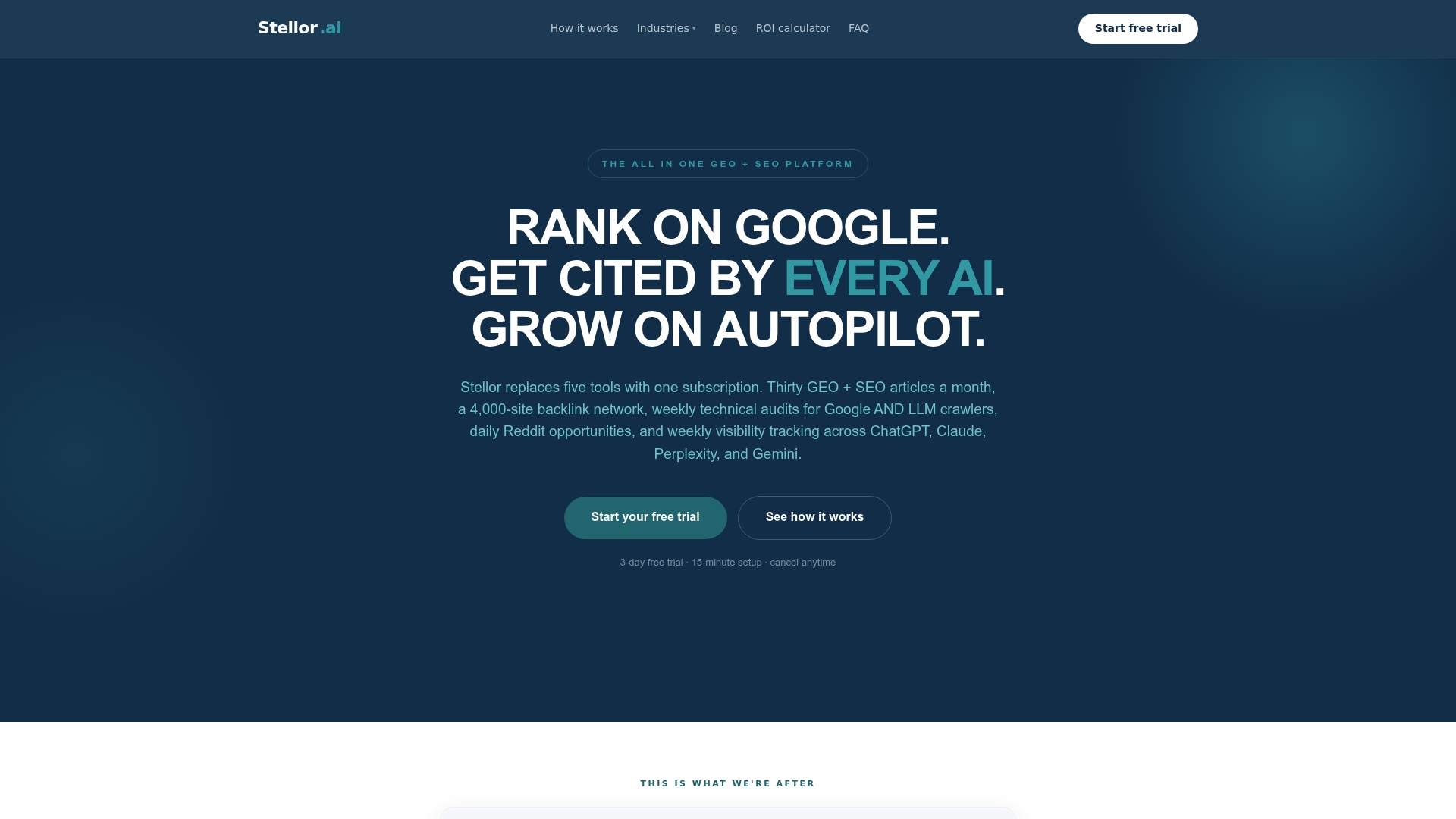
The Stellor platform is built specifically for local service businesses that want measurable outcomes without the complexity of managing multiple tools. Stellor tracks map pack rankings, monitors review velocity, audits your technical site health, and gives you real-time visibility into how your brand appears in AI-generated answers across platforms like ChatGPT. You get a single dashboard that connects SEO activity to business results, with onboarding designed to get you up and running fast. Stop guessing. Start measuring what moves the needle.
Frequently asked questions
How do AI-driven zero-click searches affect SEO results for local businesses?
Zero-click searches reduce direct website traffic but increase brand authority and visibility, particularly when your business appears in AI-generated snippets or map results without requiring a click.
Why should review velocity matter more than total review count for local SEO?
Recent and frequent reviews signal active reputation management to Google, making them more influential for local rankings than a large but stagnant review total.
What are “vanity metrics” and why should they be retired?
Vanity metrics like DA and bounce rate don’t have a direct connection to leads, calls, or bookings, and tracking them distracts from the signals that actually predict business growth.
How does seasonality impact SEO measurement for local services?
Seasonality affects traffic significantly for local service businesses, so tracking trends over time rather than reacting to monthly absolute numbers gives you a far more accurate picture of your actual SEO performance.