Google Search Console feels like a live dashboard until you realize the data you’re reading is already two days old. For local service businesses competing in fast-moving search markets, that lag is not just inconvenient, it’s a genuine competitive liability. Real-time SEO tracking tools fill that gap by giving you immediate visibility into ranking shifts the moment they happen, so you can react, adjust, and protect your position before a competitor claims it. This guide breaks down exactly why that speed matters, how these tools compare to GSC, and how to build a daily tracking routine that drives measurable local growth.
Table of Contents
- Why real-time SEO tracking matters for local businesses
- Comparing Google Search Console and real-time SEO trackers
- Managing volatility and edge cases in SEO tracking
- How to apply real-time SEO tracking for growth
- Why most local businesses undervalue real-time tracking
- Next steps: Automate your real-time SEO tracking
- Frequently asked questions
Key Takeaways
| Point | Details |
|---|---|
| GSC data is delayed | Google Search Console reports can take 1-3 days to update, limiting timely SEO decisions. |
| Real-time tools are crucial | Real-time SEO tracking enables immediate post-change verification and daily monitoring for local rankings. |
| Edge cases require care | Manual verification is needed to avoid mistakes due to tool biases or inflated impressions. |
| Daily routines drive results | Regular rank checks and AI-based recommendations maximize visibility and growth. |
| Automation accelerates growth | Automating SEO tracking saves time and helps local businesses stay competitive. |
Why real-time SEO tracking matters for local businesses
Local search is not a stable environment. A plumber in Phoenix, a landscaper in Austin, or an HVAC company in Atlanta can wake up to find their Google Business Profile has slipped three spots overnight because a competitor earned a batch of new reviews, updated their service area, or published a fresh batch of location-specific content. If you’re relying solely on Google Search Console, you won’t see that shift clearly for one to three days, and even then, the data is flagged as preliminary.
The core problem with delayed data is that it compresses your reaction window. By the time GSC confirms a ranking drop, you’ve already lost days of potential leads. Real-time trackers like AccuRanker offer on-demand ranking refreshes that let you verify changes immediately after you publish new content, earn a backlink, or update your Google Business Profile. That immediate feedback loop is what separates businesses that optimize proactively from those that are always playing catch-up.
Here’s why local businesses feel this pain more acutely than national brands:
- Hyper-local competition: Ranking for “roof repair near me” in a mid-sized city means competing against dozens of local contractors, all making SEO moves daily.
- Review velocity matters: A sudden spike in competitor reviews can shift map pack rankings within 24 hours, well before GSC reflects any change.
- Seasonal demand spikes: Home service businesses often experience rapid search volume surges tied to weather events or seasonal needs. Missing a ranking opportunity during peak demand is costly.
- Google algorithm micro-updates: Google pushes small, localized algorithm tweaks frequently. Real-time tools catch these faster than any weekly or monthly report.
Monitoring search visibility in real time also helps you understand which SEO actions actually moved the needle. When you publish a new service page and see a ranking improvement within hours rather than days, you build a clearer picture of what works for your specific market. That knowledge compounds over time into a genuine competitive advantage.
“The businesses winning in local search aren’t the ones with the biggest budgets. They’re the ones who know what’s working fastest and double down on it immediately.”
Checking local rankings daily rather than weekly is the single habit shift that separates reactive SEO from proactive growth. It sounds simple, but most local business owners still treat SEO as a monthly activity rather than an ongoing operational function.
Comparing Google Search Console and real-time SEO trackers

Both tools serve important but distinct roles. Treating them as competitors misses the point. They are complementary, and understanding what each does well helps you use both more effectively.
| Feature | Google Search Console | Real-time SEO trackers |
|---|---|---|
| Data refresh speed | 1 to 3 day lag | On-demand or hourly |
| Local rank tracking | Limited, not position-specific | Precise, location-targeted |
| Historical data | Up to 16 months | Varies by plan |
| Technical SEO insights | Strong (crawl errors, indexing) | Minimal |
| Keyword-level granularity | Moderate | High |
| Map pack tracking | Not available | Available in most tools |
| Cost | Free | Paid subscription |
| Best use case | Technical audits, trend analysis | Daily rank monitoring, A/B testing SEO changes |
The 1-3 day data lag in GSC is not a flaw in the platform. It’s a structural reality of how Google aggregates and anonymizes search data. GSC is built for strategic analysis, not tactical daily decisions. Real-time trackers are built for exactly the opposite purpose.
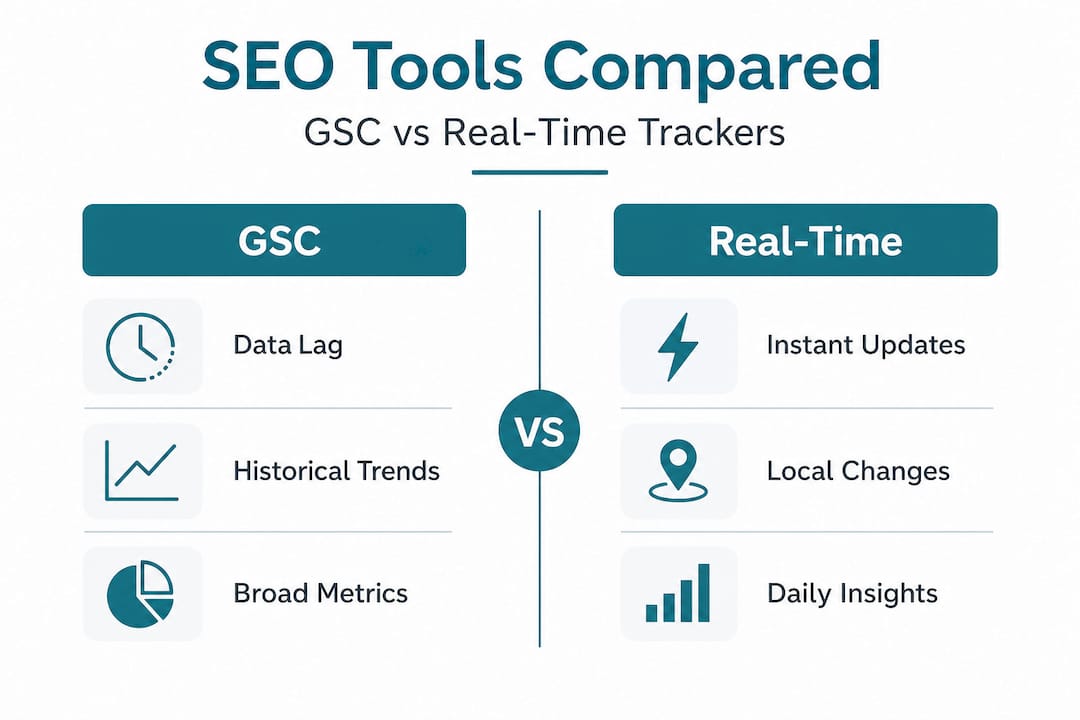
There’s another issue worth knowing. After Google limited third-party scrapers in 2025, some tracking tools reported impression drops of 20 to 50 percent in GSC data. That kind of swing can look alarming, but it often reflects a change in how data is collected rather than a real drop in your search performance. This is why cross-referencing tools is essential rather than optional.
Key advantages of real-time trackers over GSC alone:
- Immediate post-update verification: Publish a new page, check your ranking within the hour.
- Competitor rank monitoring: Track where your competitors sit for the same keywords, updated frequently.
- Frequent ranking checks for map pack positions: GSC doesn’t show map pack data at all. Real-time tools do.
- Location-specific tracking: Set your tracker to pull results from a specific zip code or city, mimicking exactly what a local customer would see.
- Alert systems: Get notified automatically when a key ranking drops below a threshold, so you don’t have to check manually every hour.
Optimizing service efficiency in your SEO workflow means using each tool for what it does best. Use GSC for your monthly technical health reviews, indexing checks, and long-term trend analysis. Use real-time trackers for your daily operational decisions.
Managing volatility and edge cases in SEO tracking
Real-time tracking is powerful, but it introduces its own set of complications that you need to understand before you start making aggressive decisions based on the data.
The biggest issue is personalization. Google personalizes search results based on location, browsing history, device type, and even time of day. When a tracking tool pulls ranking data, it’s using proxy servers or API calls that may not perfectly replicate what a real customer in your city sees. This means your “rank 3” result might actually appear as rank 5 or rank 7 for a significant portion of your actual audience.
After Google restricted scraper access in 2025, several popular tracking tools began showing inflated or deflated impression counts in their dashboards. A 20 to 50 percent swing in reported impressions doesn’t mean your SEO fell apart overnight. It often means the tool’s data collection method was affected by Google’s policy change. Acting on that data without verification could lead you to make changes that actually hurt your rankings.
Common edge cases you need to account for:
- Rank volatility without real cause: Rankings can swing 5 to 10 positions in a single day due to Google testing different results, not because your SEO changed.
- AI-generated answer appearances: If your content appears in AI Overviews or featured snippets, your click-through rate may drop even while your ranking holds steady.
- Localization errors: A tracker set to the wrong city or zip code will give you data that’s completely irrelevant to your actual customers.
- Device type discrepancies: Mobile and desktop rankings often differ significantly for local searches. Always check both.
- Seasonal algorithm sensitivity: Google tends to run more experiments during high-traffic periods like holidays, making rankings appear more volatile than they actually are.
AI tracking benefits extend beyond just knowing where you rank. Understanding whether your brand appears in AI-generated answers adds another layer of visibility that traditional rank trackers don’t capture at all.
Pro Tip: Never make a major SEO decision, like removing a page, changing a URL structure, or cutting content, based solely on a single day’s real-time tracking data. Always cross-reference with GSC, check map pack rankings manually using an incognito browser, and look at at least three to five days of tracker history before drawing conclusions.
How to apply real-time SEO tracking for growth
Knowing that real-time tracking matters is one thing. Building it into your actual workflow is where most local businesses fall short. Here’s a practical daily and weekly routine that turns tracking data into ranking improvements.
Daily routine:
- Open your rank tracker first thing in the morning. Check your top 10 to 15 priority keywords. Look for any position changes of three or more spots. Flag them for investigation.
- Cross-reference flagged keywords in GSC. If your tracker shows a drop but GSC shows stable impressions, the drop may be a data artifact. If both show a decline, it’s real.
- Check your Google Business Profile. Look for any new reviews, Q&A activity, or suggested edits from users. These can affect map pack rankings within 24 hours.
- Review competitor positions for your top three keywords. If a competitor jumped above you, look at what they changed. New content, new reviews, or a fresh backlink are the most common causes.
- Log your findings in a simple spreadsheet. Date, keyword, your position, competitor position, and any action taken. This log becomes invaluable for pattern recognition over time.
Weekly routine:
- Run a GSC performance report for the past 7 days. Compare impressions and clicks to the previous week. Look for trends, not single-day spikes.
- Audit your top-performing pages. If a page that was ranking well has started to slip, check for technical issues like slow load speed, broken links, or thin content.
- Review autopilot SEO growth opportunities. Look at which keywords are sitting in positions 8 to 15. These are your best candidates for a targeted content or backlink push to break into the top 5.
The efficiency gains from a structured tracking routine are significant. Businesses that check rankings daily and act on data within 48 hours consistently outperform those running monthly audits, particularly in competitive local markets where rankings shift frequently.
Pro Tip: Use AI-powered SEO recommendations to prioritize which keywords deserve your attention first. Instead of treating all ranking drops equally, let AI flag the keywords with the highest conversion potential so you focus your energy where it generates the most revenue.
After volatile local rankings cost you a week of leads, you’ll understand why daily checks aren’t obsessive. They’re simply good business practice.
Why most local businesses undervalue real-time tracking
Here’s our honest take: the businesses that dismiss real-time SEO tracking as “overkill” are usually the same ones running monthly reports and wondering why their rankings keep slipping despite consistent effort.
The conventional wisdom in local SEO is that you publish good content, build some links, and check your results every month. That approach worked reasonably well in 2018. It’s genuinely insufficient now. Local search markets in 2026 are faster, more competitive, and more influenced by AI-generated results than they were even two years ago. Monthly reviews are like checking your bank account once a month and wondering why you’re overdrawn.
What we’ve observed across local service businesses is a clear pattern. The ones growing fastest are not necessarily spending more on SEO. They’re simply reacting faster. They see a competitor jump into the map pack, investigate within 24 hours, identify the cause, and respond with a targeted action within 48 hours. By the time a monthly-review business even notices the change, the window to respond effectively has closed.
There’s also a psychological barrier worth naming. Many business owners avoid daily tracking because they find the data anxiety-inducing. Rankings fluctuate, and seeing those fluctuations can feel stressful if you don’t understand what’s normal. The solution is not to check less often. It’s to build enough context that normal volatility stops feeling alarming. That context only comes from consistent daily observation over weeks and months.
The businesses that build real-time SEO solutions into their operational rhythm stop treating SEO as a mysterious black box and start treating it as a measurable business function. That mindset shift is worth more than any single tactic.
Next steps: Automate your real-time SEO tracking
Tracking rankings manually every day is better than not tracking at all, but it’s still time-consuming. The next level is automation, where your tools monitor, alert, and even recommend actions without requiring you to log in and check every morning.
Stellor is built specifically for local service businesses that want that level of automation without hiring an agency or managing five separate tools. The Stellor SEO platform combines real-time rank tracking, AI citation monitoring, content creation, backlink building, and technical site audits into a single subscription. You get daily ranking data, automatic alerts when positions shift, and AI-driven recommendations that tell you exactly which pages to update and which keywords to target next. For businesses that want to compete in local search without dedicating hours each week to manual analysis, Stellor turns a complex, time-intensive process into a manageable daily workflow.
Frequently asked questions
How often should I check my local search rankings?
Local search rankings can change daily, so checking them every day with real-time tools is the recommended practice for staying competitive. Daily rank checks help you catch and respond to shifts before they cost you significant lead volume.
Can real-time SEO trackers replace Google Search Console?
No. Real-time trackers supplement GSC by providing immediate ranking data, but GSC remains essential for historical and technical insights like crawl errors, indexing status, and long-term impression trends that trackers don’t capture.
Are there risks with real-time tracking tools?
Yes. Inflated impressions and personalization bias can distort the data you see, especially after Google’s 2025 scraper restrictions. Always manually verify critical ranking changes before taking major action.
What is a good routine for using real-time SEO trackers?
Check rankings daily, cross-reference significant changes with GSC, and use AI-powered insights to prioritize which volatile local rankings deserve immediate attention versus which reflect normal daily fluctuation.