TL;DR:
- Choosing the right SEO services aligned with your business model is crucial to avoid wasted budget and ineffective strategies. Technical SEO, local SEO, content creation, and link building should be prioritized based on your site’s current gaps and goals. A hybrid approach, starting with a comprehensive audit followed by strategic advisory, optimizes resource use and long-term growth.
Picking the wrong SEO consultant service is one of the most expensive mistakes a business can make. You pay for months of work, see minimal results, and eventually discover the service was never matched to your actual needs. Understanding the core SEO consultant service offering types before you sign a contract is what separates businesses that grow their organic traffic from those that burn budget on tactics built for someone else’s goals. This guide breaks down each service type, helps you compare them clearly, and shows you exactly how to match the right offering to your business stage, model, and market.
Table of Contents
- Key Takeaways
- Key criteria for evaluating SEO consultant service offerings
- Detailed overview of common SEO consultant service offering types
- 1. SEO audit services
- 2. Technical SEO services
- 3. On-page SEO optimization
- 4. Content SEO services
- 5. Local SEO services
- 6. Link building and digital PR
- 7. Ecommerce SEO
- 8. SaaS and B2B SEO
- 9. Conversion rate optimization for SEO landing pages
- SEO service comparison at a glance
- How to decide which SEO service types are right for your business
- My take on choosing SEO consultant packages without wasting money
- How Trystellor covers multiple SEO service types in one platform
- FAQ
Key Takeaways
| Point | Details |
|---|---|
| Match services to your business model | Local, ecommerce, SaaS, and B2B each need a different prioritized mix of SEO services. |
| Fix technical issues first | Crawlability and indexation problems block all ranking gains, no matter how strong your content is. |
| Hybrid pricing saves money | Starting with a fixed-bid audit then moving to hourly advisory yields the best ROI and budget control. |
| Avoid buying every service at once | Prioritizing the right SEO services for your context prevents wasted spend and strategic confusion. |
| Ongoing technical SEO matters | Technical SEO is a continuous foundation, not a one-time project, for lasting ranking performance. |
Key criteria for evaluating SEO consultant service offerings
Before comparing specific SEO service types, you need a framework for evaluating any offering you consider. Without it, you are choosing from a menu that keeps changing with no idea what you actually ordered.
Here are the factors that matter most:
- Scope clarity: Is the service a fixed-bid project with defined deliverables, or hourly advisory work? Hourly models suit diagnostics and uncertain scopes, while fixed-bid projects work best when timelines and outputs are clear.
- Business model alignment: A local plumber and a SaaS company need completely different SEO strategies. The service must fit your revenue model and customer acquisition path.
- Emphasis area: Does the offering focus on technical fixes, content creation, link acquisition, or local visibility? Each serves a different gap.
- Measurable deliverables: Look for specific KPIs. “Improved rankings” is not a deliverable. “Top 5 ranking for three target keywords within 90 days” is.
- Engagement model: One-off projects work for audits and migrations. Ongoing retainers are better for content and link building, which compound over time.
- Budget flexibility: SEO consulting packages vary from $500 one-time audits to $10, 000 per month retainers. Know what you are paying for before you compare prices.
Pro Tip: Before you talk to any SEO consultant, write down your three biggest traffic or revenue problems. A quality consultant will map their service type directly to those problems. If they can’t, walk away.
Detailed overview of common SEO consultant service offering types
This is where most business owners get overwhelmed. There are dozens of labels, and many consultants package the same core activities under different names. Here are the types that actually matter, with clear definitions and real examples of when each one applies.
1. SEO audit services
An SEO audit is the diagnostic layer of any SEO engagement. It maps everything that is currently blocking or limiting your search performance. A comprehensive technical audit covers eight core dimensions: crawl analysis, indexation review, Core Web Vitals, mobile usability, structured data, internal linking, HTTPS security, and AI search readiness.

Audits are typically fixed-bid and delivered as a prioritized roadmap. They are the right starting point for new sites, brands recovering from traffic drops, or businesses that have never invested in SEO before.
2. Technical SEO services
Technical SEO is the plumbing behind the walls of your digital presence. You can publish great content, but if search engines cannot crawl and index your pages correctly, none of it ranks. Crawlability and indexation issues are considered the highest-priority problems in any technical engagement and must be resolved before anything else.
Tools used in a technical engagement typically include Google Search Console, Screaming Frog, PageSpeed Insights, Sitebulb, and a combined audit stack that no single tool covers alone. Technical SEO should be treated as an ongoing foundation rather than a project you complete once and forget.
3. On-page SEO optimization
On-page SEO focuses on what is visible and readable on each individual page. This includes title tags, meta descriptions, header structure, keyword placement, internal linking, image alt text, and schema markup. It also includes optimizing existing content to better match search intent.
This service type is well-suited for businesses that have traffic but poor click-through rates, or sites where pages rank on page two and need a push to page one. It is rarely expensive as a standalone service and delivers fast wins when technical issues are already resolved.
4. Content SEO services
Content SEO covers strategy, creation, and optimization of written assets designed to rank. This is not generic blogging. It means building topic clusters, targeting specific buyer queries, and producing pages that satisfy search intent at the right funnel stage.
For a local HVAC company, this might mean a series of pages targeting “how to fix AC not cooling” queries that funnel readers toward a service booking. For a B2B software firm, it means comparison guides and feature breakdown pages. Content SEO compounds over time, making it better suited to retainer models than one-off projects.
5. Local SEO services
Local SEO is purpose-built for businesses that serve customers in a defined geographic area. It covers Google Business Profile optimization, local citation building, review velocity management, local map pack rankings, and location-specific on-page content.
Local service businesses get the strongest ROI from prioritizing local SEO alongside on-page optimization and technical basics. A plumber in Denver who ranks in the local map pack for “emergency plumber near me” will generate more leads than one who ranks organically on page two for the same query.
Pro Tip: For local businesses, your Google Business Profile is as important as your website. Optimize the services section, post weekly updates, and respond to every review within 24 hours. These actions directly influence map pack rankings.
6. Link building and digital PR
Link building is the process of earning inbound links from other websites to signal authority to search engines. Digital PR takes this further by placing your business or content in publications that generate both links and brand awareness.
Link campaigns without a technical and content foundation often waste budget. Links from authoritative sites do amplify rankings, but only when the receiving pages are crawlable, indexed, and optimized. This service type is most effective after audits and on-page work are complete.
7. Ecommerce SEO
Ecommerce SEO is a specialized subset that focuses on category pages, product pages, faceted navigation, crawl budget management, and internal linking strategy. The goal is to help search engines understand your product catalog and help shoppers find what they need.
Category page strategy and internal linking are the two highest-leverage activities for ecommerce brands. A well-structured category page targeting “women’s running shoes under $100” can outrank individual product pages and drive significantly higher conversion volume.
8. SaaS and B2B SEO
SaaS and B2B companies need SEO that aligns with a longer sales cycle and a pipeline-oriented revenue model. The focus is on comparison pages and content SEO that capture buyers researching solutions, not just buyers ready to purchase today.
A comparison page targeting “HubSpot vs Salesforce for small teams” attracts high-intent readers who are two to three weeks away from a buying decision. That is the kind of content SaaS SEO is built around. Link building and conversion rate optimization are layered on after the content foundation is solid.
9. Conversion rate optimization for SEO landing pages
CRO for SEO is often overlooked but is one of the highest-return services available. It focuses on improving the actions visitors take after landing on your organic pages. This means testing headlines, CTAs, page layouts, and trust signals to turn existing traffic into revenue.
This service type is best for businesses that already rank and have meaningful traffic but struggle to convert visitors into leads or sales. It works as a standalone engagement or as part of a broader retainer.
SEO service comparison at a glance
| Service type | Best for | Pricing model | Main deliverable | Engagement length |
|---|---|---|---|---|
| SEO audit | All business types starting SEO | Fixed bid | Prioritized roadmap | One-time project |
| Technical SEO | Sites with crawl or speed issues | Retainer or fixed bid | Issue fixes and monthly reports | Ongoing quarterly |
| On-page SEO | Sites with weak page-level optimization | Fixed bid or hourly | Optimized pages and metadata | Project or retainer |
| Content SEO | Brands building topical authority | Retainer | Published articles and topic clusters | Ongoing 6 to 12 months |
| Local SEO | Local service businesses | Retainer | Map pack visibility, citations, reviews | Ongoing |
| Link building | Sites ready to amplify authority | Retainer or project | Earned backlinks from relevant publishers | Ongoing 3 to 6 months |
| Ecommerce SEO | Online retailers | Retainer | Category and product page rankings | Ongoing |
| SaaS and B2B SEO | Software and professional services firms | Retainer | Comparison pages, pipeline content | Ongoing |
| CRO for SEO | Brands with traffic but low conversion | Fixed bid or hourly | Tested and improved landing pages | Project |
Potential misalignment risk: buying link building before completing a technical audit, or investing in content SEO when the site has critical crawl errors, both lead to wasted spend.
How to decide which SEO service types are right for your business
Businesses should not buy every SEO tactic like items from a buffet. The right approach is to match your service selection to your business model, current maturity, and specific growth goal.
Here is how to think about it by business type:
- Local service businesses (plumbers, electricians, dentists, law firms): Start with a technical audit, then local SEO, then on-page optimization. Reviews and local ranking tactics move the needle faster here than content or links.
- Ecommerce brands: Prioritize technical SEO first to fix crawl budget and indexation, then category page strategy, then internal linking. Content and PR come after the catalog foundation is solid.
- SaaS and B2B companies: Lead with content SEO and comparison pages. Add technical SEO to keep the site healthy, then layer in link building once you have pages worth amplifying.
- New brands or brand-new websites: An SEO audit checklist plus foundational technical setup and content SEO is the correct starting sequence. Do not spend on link building before you have indexed, optimized pages.
- Businesses facing traffic drops or SEO emergencies: Start with a technical triage audit using Google Search Console and Screaming Frog. Identify and fix crawl or indexation errors before anything else.
Pro Tip: If a consultant recommends link building as your first investment and you have not done a technical audit yet, that is a red flag. Links pointing to broken or unindexed pages deliver zero ranking benefit.
My take on choosing SEO consultant packages without wasting money
I have watched businesses spend six months and $30, 000 on content production for websites where the blog was accidentally set to “noindex.” Every article they published was invisible to Google. The content was good. The strategy was completely wasted.
The most consistent pattern I see in misallocated SEO spend is buying the service that sounds exciting rather than the service that solves the actual constraint. Link building sounds powerful. Content sounds productive. But neither works if the technical infrastructure is broken.
What I have found actually works is the hybrid engagement model: start with a fixed-bid audit to diagnose the site, then move to hourly advisory as you implement fixes. This approach gives you budget control in the first phase and strategic flexibility in the second. It also gives you real data before committing to a long retainer.
The other mistake I see constantly is treating digital marketing consultancy as a one-size offering. A senior specialist charging $250 per hour for a technical migration audit is worth every dollar. That same rate for routine content optimization tasks is a poor trade. Match the consultant’s seniority to the complexity of the task.
My honest advice: before you compare pricing, write down your current organic traffic number, your biggest gap (visibility, traffic, or conversion), and the last time someone looked at your site technically. Those three answers will tell you exactly which SEO service type to buy first.
, Cole
How Trystellor covers multiple SEO service types in one platform
Most businesses exploring SEO service types quickly realize they need several of them at once. That means managing multiple vendors, reconciling conflicting reports, and paying separately for content, links, audits, and tracking.
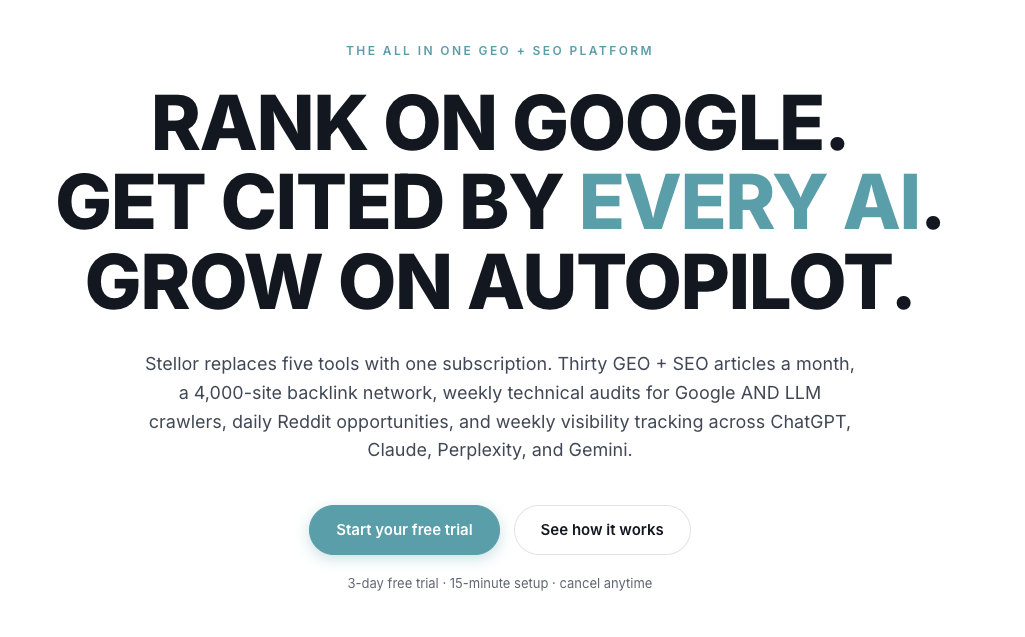
Trystellar consolidates what used to require five separate subscriptions into one fully managed platform starting at $199 per month. You get 30 GEO and SEO-optimized articles published to your CMS every month, a 4, 000-site backlink network, weekly technical audits covering 11 distinct ranking factors, daily Reddit engagement opportunities, and weekly LLM visibility tracking across ChatGPT, Claude, Perplexity, and Gemini. For professional services firms and local businesses, this replaces the fragmented vendor stack with a single system that actually feeds itself. Start with a free 3-day trial. No credit card required.
FAQ
What are the main SEO consultant service offering types?
The main types are technical SEO, on-page optimization, content SEO, local SEO, link building, ecommerce SEO, SaaS and B2B SEO, and CRO for SEO landing pages. Each serves a different business need and should be selected based on your current gaps and goals.
Which SEO service type should a local business prioritize?
Local service businesses should start with a technical audit, then local SEO covering Google Business Profile and citations, then on-page optimization. Local SEO and reviews deliver faster ROI for location-based businesses than content or link building alone.
What is the difference between hourly and fixed-bid SEO consulting?
Fixed-bid pricing works best for defined projects like audits or on-page optimization with clear deliverables. Hourly pricing suits advisory support, diagnostics, or ongoing guidance where the scope shifts. A hybrid model starting with a fixed audit and moving to hourly advisory often delivers the best value.
Why does technical SEO need to come before link building?
Crawlability and indexation issues block ranking gains regardless of how many links point to your site. If search engines cannot properly find and index your pages, inbound links deliver no ranking benefit. Resolving technical issues first makes every other SEO investment more effective.
How do SEO consulting packages typically differ between agencies and freelancers?
Agencies bundle process, team depth, and reporting infrastructure into their packages, which suits larger or more complex engagements. Freelancers offer direct, flexible support and often lower rates. Senior specialists command higher fees for complex technical strategy, while junior consultants are better matched to routine optimization tasks.