A high SEO health score feels like proof you’re winning online. You run an audit, see 91 out of 100, and assume Google is about to reward you with a flood of new customers. But that assumption has cost more than a few local service businesses real money and real time. The truth is that an SEO health score is a useful diagnostic tool, not a ranking guarantee, and for local businesses it captures only a fraction of what actually drives customers to call, book, or walk through the door. This guide breaks down what the score really measures, what it misses, and how to use it as part of a broader local SEO strategy that produces results.
Table of Contents
- Understanding the SEO health score
- What matters most for local service businesses
- How to check and improve your SEO health score
- Pitfalls to avoid and what really moves the needle
- Why most local businesses misuse SEO health scores and what actually works
- Need expert help growing your local SEO health?
- Frequently asked questions
Key Takeaways
| Point | Details |
|---|---|
| SEO health score explained | It’s an overall measure of your website’s technical and content quality, not a direct ranking factor. |
| Local SEO priorities | For local businesses, reviews, ratings, and citations often matter more than technical health alone. |
| Practical improvement steps | Regularly check both your technical SEO and Google Business Profile reviews for continuous growth. |
| Avoid common traps | Don’t chase a perfect score, focus on fixes that actually drive more local business. |
Understanding the SEO health score
An SEO health score is a numeric grade, usually expressed as a percentage or a number out of 100, that summarizes the technical condition of your website. Most audit tools calculate it by scanning your site for a set of known issues and then weighting each one by its potential impact on search performance.
Common factors that influence the score include:
- Crawlability: Can search engine bots access and read your pages without hitting dead ends or blocked resources?
- Broken links: Do any internal or external links return 404 errors that frustrate both users and crawlers?
- Page speed: How quickly do your pages load, especially on mobile connections?
- Mobile readiness: Does your site display properly and function well on smartphones?
- Duplicate content: Are there pages with identical or near-identical text that could confuse search engines?
- Missing meta tags: Are title tags, meta descriptions, and header tags present and properly formatted?
Here is a quick reference for how these factors typically break down in a standard audit:
| Factor | Typical weight in score | Direct impact on local rankings |
|---|---|---|
| Crawlability | High | Moderate |
| Page speed | High | Moderate |
| Mobile readiness | High | Moderate |
| Broken links | Medium | Low to moderate |
| Meta tags | Medium | Low to moderate |
| Local citations | Low or absent | Very high |
| GBP reviews/ratings | Low or absent | Very high |
Notice what’s missing from the bottom rows. Most generic audit tools assign very little weight to local presence signals, and some ignore them entirely. That’s because these tools are built for all websites, not specifically for service businesses competing in a specific city or neighborhood.
Understanding the SEO health score meaning in the context of your local market requires knowing which key SEO terminology actually applies to your situation. A score that looks great on paper can still belong to a site that ranks on page three because the owner never claimed their Google Business Profile.
It’s also worth being clear about one important fact: SEO health scores are not a direct Google ranking factor. Google does not receive your audit score and adjust your position accordingly. What the score does is reflect technical qualities, like crawlability, indexing ease, and user experience, that correlate with better performance. Think of it as a report card on your site’s foundation, not a leaderboard position.
What matters most for local service businesses
With a basic understanding of SEO health scores, it’s important to see why local businesses must focus on the most relevant metrics.
Standard audit tools were designed for e-commerce sites, media publishers, and enterprise brands. When a plumber in Phoenix or a landscaper in Charlotte runs the same audit as a national retailer, the results are technically accurate but strategically incomplete.
“For local businesses, some tools assign as little as 15% weight to local presence signals because those signals are simply irrelevant for non-local websites. But for a service business, local presence is everything.”
That 15% weight problem is real. Local SEO benchmarks show that for local businesses, Google Business Profile metrics like star ratings in the 4.0 to 4.5 range and a baseline of 10 to 20 recent reviews carry far more ranking weight than most technical factors. Yet most health score tools barely register these signals.
Here is a comparison of what generic tools measure versus what actually drives local rankings:
| Metric | Generic SEO tool | Local SEO priority |
|---|---|---|
| Page speed | Heavily weighted | Important but not #1 |
| GBP star rating | Usually ignored | Critical |
| Review count and recency | Usually ignored | Critical |
| Citation consistency (NAP) | Sometimes included | Very high |
| Local keyword optimization | Partially included | High |
| Schema markup for local | Sometimes flagged | High |
| Backlink quality | Included | Moderate |
The local SEO ranking factors that move the needle for a service business are largely relationship-based and reputation-based. A roofing company with a technically imperfect website but 47 five-star reviews will almost always outrank a competitor with a flawless audit score and only 3 reviews.

Pro Tip: Before you spend hours fixing every technical warning in your audit report, check your Google Business Profile first. If your rating is below 4.0 or you have fewer than 10 reviews, addressing those gaps will likely produce faster ranking improvements than fixing minor meta tag issues.
When optimizing for local SEO, the goal is to build a complete picture that includes both technical health and local reputation. Neither alone is enough.
How to check and improve your SEO health score
Once you know the right metrics, you’re ready to take practical steps toward improvement. Here is a straightforward process designed specifically for local service businesses.

Step 1: Run a technical site audit. Use a reputable audit tool to scan your site and generate a baseline score. Note the issues flagged as critical or high priority. Don’t panic if the list is long. Most sites have dozens of minor issues that have almost no real-world impact.
Step 2: Separate critical issues from noise. Focus on errors that directly affect user experience or crawlability. Broken internal links, pages blocked from indexing, missing canonical tags on duplicate pages, and slow load times on mobile are worth fixing promptly. Warnings about image alt text or minor schema gaps can wait.
Step 3: Audit your Google Business Profile separately. Log into your GBP dashboard and check your current star rating, total review count, and how recently reviews have come in. Also verify that your business name, address, and phone number (NAP) match exactly what appears on your website and in any online directories.
Step 4: Check citation consistency across directories. Your NAP information should be identical everywhere it appears, including Yelp, Bing Places, Apple Maps, and any industry-specific directories. Inconsistencies confuse search engines and can suppress your local rankings even when your technical health score looks fine. As local SEO research consistently shows, site health alone misses the citations and reviews that matter most for local performance.
Step 5: Build a review acquisition process. Ask every satisfied customer for a Google review, ideally within 24 hours of completing a job. A simple follow-up text or email with a direct link to your review page removes friction and dramatically increases response rates.
Step 6: Set realistic improvement goals. Aim for continuous progress rather than a perfect score. Moving from 65 to 80 on your technical audit while also growing from 8 reviews to 25 reviews over three months is a meaningful, measurable win. Chasing 100 out of 100 on a generic audit while ignoring your GBP is not.
Using the right SEO audit tools makes this process faster and more actionable. Pair your audit data with actionable SEO steps designed for your specific service area and business type to see the fastest results.
Pitfalls to avoid and what really moves the needle
No plan is complete without knowing what to avoid and the tactics that offer the highest return for your local service business.
The most common mistake is treating the health score as a finish line. Businesses spend weeks chasing a perfect score, fixing every minor warning, and then wonder why their phone still isn’t ringing. A score of 100 on a generic audit does not mean you rank number one in your city. It means your website is technically clean. Those are very different things.
Here are the most damaging pitfalls to watch for:
- Obsessing over the number without context. A score of 78 on a site with 40 strong reviews and consistent citations will outperform a site scoring 95 with no GBP activity.
- Ignoring review acquisition. Reviews are one of the most powerful local ranking signals, yet many business owners treat them as optional. They are not.
- Letting citation inconsistencies slide. A single address variation across directories, like “Suite 4” versus “#4,” can create confusion that suppresses your local pack visibility.
- Running one audit and never revisiting it. Websites change constantly. New pages get added, plugins update, links break. A single snapshot gives you a moment in time, not an ongoing picture of your site’s health.
- Fixing low-impact issues first. Audit tools often list issues by type rather than by business impact. A missing alt tag on a stock photo is not more urgent than a broken contact form.
A useful stat to keep in mind: businesses that actively manage their Google Business Profile and maintain citation consistency see measurably stronger local pack performance than those who focus exclusively on technical SEO. The research on local SEO success makes this clear, technical health correlates with better crawlability and indexing, but it does not replace the local signals that Google uses to determine relevance and trust in a specific geography.
Integrating AI for local SEO into your monitoring process can help you catch issues faster and identify which fixes will have the most impact in your specific market.
Why most local businesses misuse SEO health scores and what actually works
Here is the uncomfortable reality we see repeatedly: local service businesses invest significant time and sometimes real money into technical SEO audits, then neglect the two things that Google actually uses to rank them locally, reputation and relevance.
A spotless technical audit is table stakes. It tells Google your site is functional and trustworthy enough to index. That matters. But once you cross a reasonable threshold, around 75 to 80 on most tools, the marginal return on additional technical improvements drops sharply. Meanwhile, a business that goes from 8 reviews to 30 reviews, or fixes inconsistent citations across 40 directories, often sees ranking movement within weeks.
The businesses that win in local search are not the ones with the highest audit scores. They are the ones that have built genuine digital credibility in their service area. That means consistent NAP data, a steady flow of authentic reviews, relevant local content, and a technically sound website that does not get in the way.
We have seen this pattern enough times to say it plainly: the measurable SEO results that actually grow a local service business come from treating technical health and local reputation as equal partners, not from optimizing one while ignoring the other. As local SEO data confirms, the score correlates with better crawlability and user experience, but for local services it must be combined with GBP benchmarks to reflect what Google actually values.
Think of your SEO health score as the foundation of a building. You need a solid foundation, but nobody moves into a foundation. The reviews, citations, local content, and GBP activity are the structure built on top of it. Both have to be there.
Need expert help growing your local SEO health?
Keeping up with technical audits, citation management, review strategy, and content creation is a lot to handle alongside running a service business.
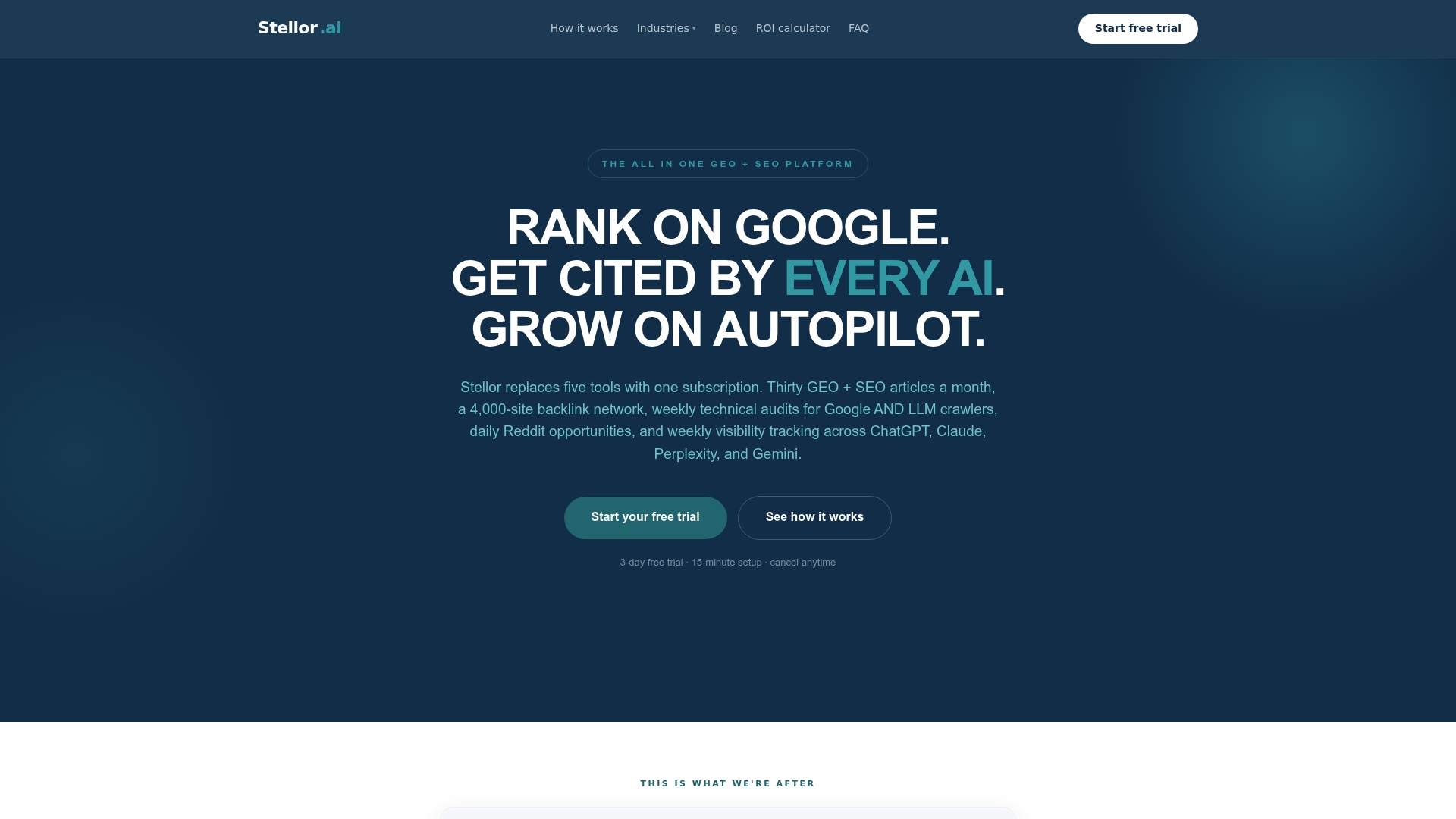
Stellor’s full-service SEO platform was built specifically for local service businesses that need real results without hiring an entire agency. From automated technical audits and backlink building to AI visibility tracking and content publishing, everything runs from one dashboard. If you want a clear picture of where your local SEO stands and a specific plan to improve it, explore Stellor’s SEO solutions for professional services and see how quickly you can close the gap on your local competitors.
Frequently asked questions
Is SEO health score a Google ranking factor?
No, the SEO health score itself is not a direct ranking factor, but it reflects technical website quality which supports better Google indexing and crawlability.
What is a good SEO health score for a local business?
Scores above 80% are generally strong, but for local success you should prioritize GBP metrics like 4.0 to 4.5 star ratings and at least 10 to 20 reviews rather than chasing a perfect technical score.
Which SEO tools are best for checking site health for service businesses?
Choose tools that audit both technical factors and local listings together, so you can see site errors and local review or citation gaps in a single report rather than managing two separate workflows.
How often should I check my SEO health score?
Quarterly checks are a reasonable minimum, but monthly monitoring is the smarter move in competitive local markets where a new competitor or a site update can shift your rankings quickly.