TL;DR:
- Switching SEO platforms without a proper plan risks losing valuable rankings and traffic built over months.
- Key steps include creating a comprehensive redirect map, verifying technical compatibility, and maintaining data continuity through parallel tracking.
Switching SEO platforms without a structured plan is one of the fastest ways to lose rankings you spent months building. The SEO platform switching considerations checklist exists precisely to prevent that. Done right, a platform change preserves your search equity, maintains data continuity, and positions your site to perform better on the new stack. Done wrong, you can spend 90 days recovering traffic you never needed to lose.
Table of Contents
- Key takeaways
- 1. The SEO platform switching considerations checklist starts with URL integrity
- 2. Technical compatibility checks before committing to a new platform
- 3. Data continuity and operational planning
- 4. Redirect and migration best practices checklist
- 5. Matching your migration strategy to your risk level
- 6. A post-migration recovery approach most checklists skip
- My take on what most SEO migration checklists get wrong
- Simplify your next platform switch with Trystellor
- FAQ
Key takeaways
| Point | Details |
|---|---|
| Redirect maps are non-negotiable | A complete 1:1 URL redirect map with 301 redirects is the single most important deliverable before any platform cutover. |
| Export data before you cancel | Archive keyword rankings, historical reports, and methodology notes at least 30 days before ending your current subscription. |
| Phase your migration | Separating pre-launch, cutover, and post-launch into distinct phases reduces risk and makes troubleshooting far faster. |
| Machine-facing files get missed | Files like robots.txt, sitemap.xml, and llms.txt are frequently broken during cutover and cause immediate visibility drops. |
| Recovery takes up to 90 days | Expect 2 to 4 weeks of fluctuation and a full return to baseline by weeks 6 to 8 when the migration is clean. |
1. The SEO platform switching considerations checklist starts with URL integrity
Before you touch a single setting on your new platform, you need a complete picture of every URL that currently earns traffic or carries link equity. Run a full site crawl using a tool like Screaming Frog and export all URLs returning HTTP 200 status codes. Then layer in your top Google Search Console pages and your most-linked URLs from a backlink analysis tool. The union of those three sources becomes your redirect map.
Redirect maps are the single most critical deliverable in any migration project. A missing redirect on a high-authority page is not a minor oversight. It is a direct transfer of ranking equity to a 404 error. Every old URL must map to its closest equivalent on the new platform using a permanent 301 redirect, not a temporary 302. Redirect chains, where URL A points to URL B which points to URL C, dilute authority and slow crawling. Keep every path direct.
Pro Tip: Build your redirect map in a shared spreadsheet with columns for the old URL, the new URL, the HTTP status code, and a post-launch validation checkbox. This single document becomes your source of truth throughout the project.
2. Technical compatibility checks before committing to a new platform
Not every SEO platform handles rendering the same way. If your current site relies on server-side rendering and the new platform defaults to client-side JavaScript rendering, Googlebot may struggle to index your content at launch. Confirm the new platform’s rendering model before you migrate, and test it on a staging environment.

Check whether the new platform supports the full set of machine-facing files your site currently uses. Accidental blocking of robots.txt, sitemap.xml, llms.txt, and ai.txt during cutover is one of the most common and costly migration mistakes. These files are the first thing crawlers read. If they are missing or misconfigured on launch day, you can expect an immediate drop in indexing coverage.
Also confirm the new platform can replicate your existing schema markup, canonical tags, hreflang attributes, and metadata structure. Schema completeness matters not just for Google but for AI answer engines like ChatGPT and Perplexity that increasingly cite structured, well-tagged content. If you want to go deeper on the technical side, the local SEO audit checklist covers the core technical signals worth preserving through any platform change.
3. Data continuity and operational planning
Switching platforms means leaving behind a history of keyword rankings, rank tracking baselines, and report archives. If you cancel your current subscription before exporting everything, that data is gone. This is one of the most underestimated risks in any SEO platform comparison checklist.
Here is a practical sequence to follow before canceling your current tool:
- Export all keyword ranking data, including historical position trends.
- Download every scheduled and saved report in your account.
- Document the rank tracking methodology your current platform uses, including data sources, update frequency, and location targeting.
- Set up your new platform and run both tools in parallel for at least 30 days.
- Compare results on the same keyword sets to identify methodology differences before drawing conclusions.
- Archive everything in a shared folder labeled by date and platform name.
The parallel tracking window matters more than most people realize. Running parallel rank tracking for 30 to 60 days lets you reconcile differences in how platforms measure position before you commit to one baseline. What looks like a ranking drop in your new tool may simply be a methodology variance.
Pro Tip: Time your platform cutover to avoid high-traffic periods for your business. If you run an e-commerce site, do not switch platforms in November. If you are a tax services firm, avoid March and April. A clean migration during a slow period is far easier to monitor.
4. Redirect and migration best practices checklist
Here is where the seo migration checklist gets concrete. Use this as your pre-launch and post-launch audit framework.
Pre-launch checklist:
- Crawl the staging site to confirm all URLs are indexable, not blocked by noindex headers or robots.txt. A staging audit must confirm the site is crawlable and rendering accurately before any cutover.
- Validate redirect logic across all URL families, not just the homepage.
- Confirm all redirects use 301 or 308 status codes, not 302.
- Submit an updated XML sitemap to Google Search Console before launch.
- If you are changing domains, use the Change of Address tool in Google Search Console to accelerate signal transfer. Note: this tool applies only to full domain moves, not URL restructures within the same domain.
Post-launch monitoring checklist:
- Monitor Google Search Console daily for crawl errors, coverage drops, and manual actions during the first two weeks.
- Check Core Web Vitals immediately after launch. Performance shifts can surface faster than the commonly cited 28-day reporting window, so monitor Core Web Vitals closely from day one.
- Audit internal links to confirm they point to new URLs, not old ones that are now redirecting.
- Verify backlink profiles in Ahrefs or a similar tool to spot any links pointing to broken destinations.
SEO migration recovery typically takes 2 to 4 weeks for initial stabilization, with a full return to baseline by weeks 6 to 8. If recovery has not happened by 90 days, something deeper needs investigation.
5. Matching your migration strategy to your risk level
Not every platform change carries the same risk. A simple hosting migration with no URL changes is a low-risk operation. A full CMS switch combined with a domain change and a site redesign is the highest-risk scenario you can attempt. Treating both the same way is where companies get into trouble.
Classify your migration before you build your plan:
- Low risk: Hosting change only, same domain, same URLs, same CMS. Minimal redirect work needed.
- Medium risk: CMS change with URL structure changes on the same domain. Full redirect map required, plus sitemap and schema audits.
- High risk: Domain change, URL restructure, or shift in rendering model. Requires the Change of Address tool, a complete technical audit, a staging validation, and a monitoring window of at least 60 days.
The most important principle in any platform change guide is to sequence changes rather than stack them. If you need to change your domain AND restructure your URLs AND switch your CMS, do those in separate phases. Each combined variable makes it exponentially harder to diagnose what caused a traffic drop. Separating migrations into pre-audit, cutover, and post-launch phases is how experienced SEOs keep projects controllable.
For businesses managing professional services sites with multiple service and location pages, the SEO optimization guide for service businesses is a useful reference for the types of pages that carry the most migration risk.
6. A post-migration recovery approach most checklists skip
Most platform change guides focus heavily on pre-migration prep and then leave you with generic advice like “monitor rankings.” Here is something more specific and far more useful.
After launch, group your URLs into route families, meaning clusters of pages that share the same URL pattern. Product pages, blog posts, location pages, and service pages each represent a route family. If you see a crawl error or indexing gap, check it by family rather than page by page. Route-family triage turns passive waiting into an active fix queue, which meaningfully speeds recovery.
Also, build your redirect map using a union of crawl data, Search Console pages, and backlink data rather than a crawl alone. Pages that are not crawlable but still receive inbound links will be missed if you rely on a single data source. That combination catches the URLs that matter most even when they do not surface in a standard crawl.
My take on what most SEO migration checklists get wrong
I have watched enough platform migrations go sideways to say with confidence that the failure mode is almost never the big, obvious stuff. Nobody forgets to set up redirects entirely. What people miss are the details that sit just below the surface.
The machine-facing files are the clearest example. In my experience, robots.txt and sitemap.xml get checked. The llms.txt file almost never does. And as AI crawlers become a more significant source of traffic and citations, a missing llms.txt at launch is not a minor issue. It is a signal to every AI answer engine that your content is not configured for them to read.
The second thing I see consistently underestimated is the parallel tracking period. Marketers switch platforms, see different numbers, and immediately assume something is wrong with their rankings. Sometimes it is. More often, it is just a methodology difference between tools. Running both platforms for 30 days before making any decisions is the single best way to avoid a false alarm that wastes weeks of investigation.
My honest advice: treat the redirect map and the machine-facing file audit as your two non-negotiable deliverables. Everything else can be iterated after launch. Those two cannot.
— Cole
Simplify your next platform switch with Trystellor
Switching SEO platforms is complicated enough without managing five separate tools at the same time. Trystellar consolidates what most businesses currently handle across multiple subscriptions, including content production, backlink building, technical audits, Reddit visibility, and LLM tracking across ChatGPT, Claude, Perplexity, and Gemini, into one platform at $199 per month.
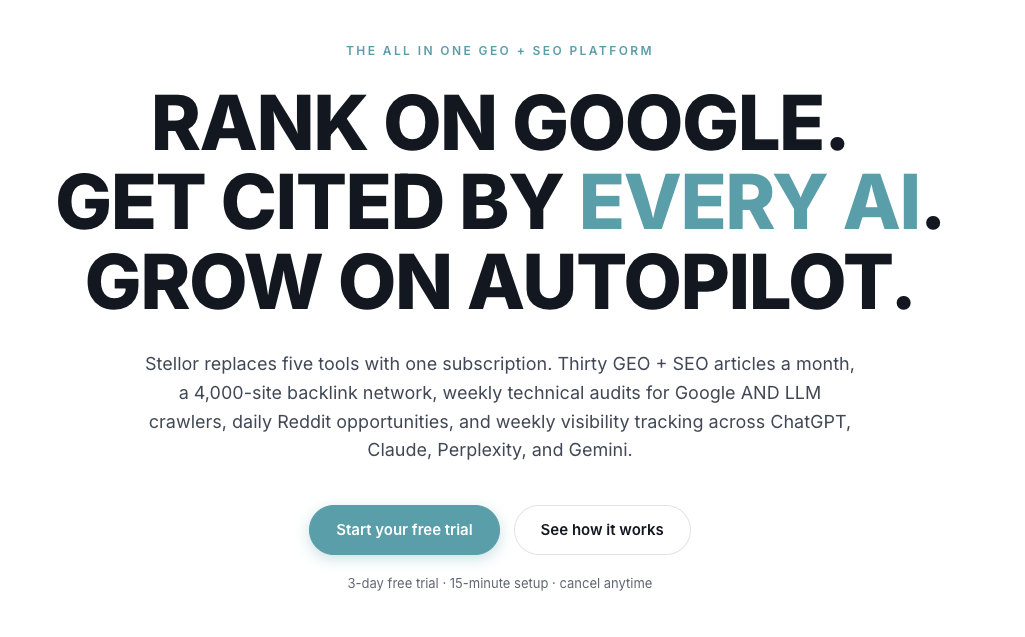
When you move to Trystellar, you are not just swapping one SEO tool for another. You get 30 GEO and SEO-optimized articles published to your CMS every month, weekly technical audits with one-click fixes, and a product built for both Google and AI visibility. The free AI Visibility Audit gives you a full picture of where you stand across 25 buyer prompts before you commit to anything. Three-day free trial, no credit card required.
FAQ
What is the most important step in an SEO platform migration?
Building a complete 1:1 URL redirect map using permanent 301 redirects is the single most critical step. Missing redirects on high-authority pages transfers ranking equity directly to 404 errors.
How long does SEO recovery take after switching platforms?
Expect 2 to 4 weeks of ranking fluctuation after launch, with full recovery to pre-migration baseline typically by weeks 6 to 8. Recovery beyond 90 days usually signals an unresolved technical issue.
Should I run two SEO platforms at the same time during a switch?
Yes. Running parallel rank tracking for 30 to 60 days lets you reconcile methodology differences between platforms before drawing conclusions about ranking changes.
What files are most often broken during a platform cutover?
Robots.txt, sitemap.xml, llms.txt, and ai.txt are the most frequently misconfigured machine-facing files during platform migrations. Auditing these on your staging site before launch is a mandatory step.
When should I use the Google Search Console Change of Address tool?
Use it only for full domain moves, not for URL restructures within the same domain. It accelerates Google’s recognition of the domain change and helps preserve rankings during the transition.