Picking the right SEO strategy feels like choosing from a menu that keeps changing every few months. Google rolls out AI Overviews, your competitors pile onto Google Business Profile (GBP), and every marketing vendor promises overnight rankings. For local service business owners, this noise creates a real problem: where do you put your time and money to get measurable results? This guide cuts through the confusion with a structured framework to assess, compare, and select the SEO tactics that deliver the strongest local impact in 2026.
Table of Contents
- How to choose the right SEO strategy for your local business
- The six main types of SEO strategies explained
- Comparison table: Which SEO strategy suits your business best?
- Winning combinations and overlooked strategies for 2026
- What most business owners miss about SEO in 2026
- Take your local SEO to the next level with Stellor
- Frequently asked questions
Key Takeaways
| Point | Details |
|---|---|
| Prioritize GBP and reviews | Optimizing your Google Business Profile and requesting client reviews is the fastest path to local SEO wins. |
| Integrate AI readiness | Prepare your SEO for AI Overviews since these drive a quarter of search impressions. |
| Measure what matters | Track AI citations, conversions, and review velocity to prove genuine SEO impact. |
| Layer strategies for ROI | Combining GBP, reviews, and AI optimization delivers scalable, lasting results for service businesses. |
How to choose the right SEO strategy for your local business
Before you invest a dollar in SEO, you need a clear picture of what success actually looks like for a local service business. It is not just page views or keyword rankings. In 2026, the right metrics tell a richer story.
What measurable impact looks like for local businesses:
- AI citations: Is your business name appearing in ChatGPT, Gemini, or Google AI Overviews when someone asks “best plumber near me”?
- Conversion rate: Are website visitors calling, booking, or filling out a contact form?
- Review velocity: How fast are you accumulating new Google reviews compared to competitors?
- Local map pack rankings: Are you showing up in the top 3 positions on Google Maps for your core service keywords?
- Organic call volume: Are more people finding your phone number through search and calling directly?
Understanding these metrics before you choose a strategy prevents you from chasing vanity numbers. Local service owners should prioritize GBP, local pages, and reviews for quick wins, then layer AI optimization for content scale and visibility, since over 25% of 2026 searches now include AI Overviews. That means measuring beyond traffic: AI citations, conversions, and review velocity are now the real scoreboard.
Google Business Profile optimization is not optional anymore. A fully completed, regularly updated GBP listing with photos, service descriptions, Q&A sections, and weekly posts signals trust to both Google’s algorithm and potential customers. Pair that with dedicated local landing pages for each service area you cover, and you create a compounding visibility effect that generic website traffic can never match.

The ROI calculation also shifts when you think local. A single booked job from a plumber or HVAC contractor is worth hundreds or even thousands of dollars. That means even a modest improvement in local rankings or measurable SEO results translates directly to revenue, not just impressions.
Technical health matters too. Slow pages with poor site speed and Core Web Vitals push potential customers away before they even see your offer. A single second of extra load time can reduce conversions noticeably.
Pro Tip: Build a structured review request process. After every completed job, send a text message with a direct link to your Google review page. Businesses that systematize this step collect reviews three to five times faster than those who rely on customers doing it voluntarily.
The six main types of SEO strategies explained
Not all SEO works the same way. Each type of strategy has a different job, a different timeline, and a different level of effort. Understanding what you are buying, or building, prevents wasted investment.
The main types of SEO strategies include Technical SEO, On-Page SEO, Off-Page SEO, Local SEO, Content SEO, and the emerging category of AI/GEO/AEO. Here is what each one means for a service business owner.
Technical SEO covers the foundation your website runs on. Crawlability (whether Google can read your site), site speed, mobile responsiveness, and Core Web Vitals all fall here. If Google cannot crawl your pages, nothing else matters. Think of it as the plumbing behind the walls of your digital presence.
On-Page SEO is about what you say and how you say it on each page. Keyword placement in headings, meta titles, service descriptions, and image alt text all signal relevance to Google. A local electrician in Phoenix should use “Phoenix electrician” in the page title, the first paragraph, and the H1 heading rather than just “electrician.”
Off-Page SEO builds authority through external signals. Backlinks (other sites linking to yours) and local citations (your business name, address, and phone number listed consistently across directories) tell Google that your business is real, trusted, and relevant to your area.
Local SEO is the most directly valuable category for service businesses. This includes GBP optimization, NAP (name, address, phone) consistency across directories, local keyword targeting, and earning reviews. Explore detailed local SEO tactics to see how this category alone can move rankings faster than any other strategy when done right.
Content SEO involves creating pillar pages and topic clusters that establish your business as an authority in your service niche. A roofing company might write a pillar page on “roof replacement in Denver” and then support it with cluster articles on costs, timelines, material types, and insurance claims. This strategy takes longer but creates lasting visibility.
AI/GEO/AEO is the newest category and growing fast. GEO stands for Generative Engine Optimization, and AEO stands for Answer Engine Optimization. Both involve structuring your content and data so that AI tools like ChatGPT, Perplexity, and Google’s AI Overviews pull from your business when answering queries. Learn more about AI-powered SEO for locals to understand how schema markup, FAQ sections, and structured data help AI systems recognize and cite your business. If you are new to these concepts, a solid SEO terminology guide explains them in plain language.
“The businesses that dominate local search in 2026 are not just optimizing for Google’s ten blue links. They are structuring their entire online presence to be readable by AI, trusted by algorithms, and compelling to humans all at once.”
Pro Tip: Pair your GBP listing with structured FAQ content on your website. When Google’s AI Overviews scan for answers to local queries, FAQ-formatted content is one of the most frequently cited formats. This combination drives both traditional and AI-powered visibility simultaneously.
Comparison table: Which SEO strategy suits your business best?
Here is how the six strategies stack up across the metrics that matter most to service business owners.
| Strategy | Local visibility impact | AI-readiness | Ease of implementation | Speed of results | Measurability |
|---|---|---|---|---|---|
| Technical SEO | Medium | High | Moderate | Slow (3-6 months) | High |
| On-Page SEO | Medium | High | Easy | Medium (2-4 months) | High |
| Off-Page SEO | High | Medium | Hard | Slow (4-8 months) | Medium |
| Local SEO | Very High | Medium | Easy | Fast (1-2 months) | Very High |
| Content SEO | High | High | Moderate | Slow (4-9 months) | High |
| AI/GEO/AEO | High | Very High | Moderate | Medium (2-4 months) | Medium |
The four main SEO types each serve a different phase of your growth. Local SEO wins on speed and measurability, making it the obvious starting point. AI/GEO/AEO wins on future-readiness. Combining them creates a compounding effect.
Best-fit scenarios by strategy:
- Just starting out? Lead with Local SEO and fix Technical SEO basics first.
- Already ranking locally but plateauing? Add Content SEO and Off-Page SEO to build domain authority.
- Trying to appear in AI-generated answers? Focus on AI/GEO/AEO with structured data and FAQ pages.
- Losing to competitors with more reviews? Treat review velocity as a Local SEO priority and systematize your request process.
- Running multiple service area locations? Combine Local SEO with dedicated location pages and consistent citation building.
You can also use location tracking and SEO tools together to identify which service zones are underperforming and where to concentrate your content and citation efforts.
For a deeper look at how these strategies translate into a practical plan, the local SEO guide and AI search insights together provide a solid starting framework for 2026 planning. AI-powered business tracking tools can help you layer geographic performance data on top of your SEO results for sharper decisions.
When to stack strategies: If you launch GBP optimization alongside a review velocity push while also adding FAQ-structured content to your service pages, you hit three ranking signals at once. That kind of layering is what separates fast-moving local businesses from those stuck in single-tactic loops.
Winning combinations and overlooked strategies for 2026
Most local service businesses treat SEO as a one-thing-at-a-time project. Pick a strategy, wait three months, evaluate, then pick another. That linear approach is too slow for the pace of change in 2026.
The smarter move is intentional stacking. Here are the combinations that produce the strongest ROI:
Top combinations to prioritize:
- GBP + reviews + AI Overview optimization: This trio covers the three fastest-moving ranking factors in local search right now. GBP signals your location and service categories. Reviews build trust signals. AI Overview optimization ensures you appear in the growing percentage of searches that return AI-generated answers at the top of the results page.
- Technical SEO + On-Page SEO: Fix crawlability and speed first, then optimize your content. Publishing great content on a broken site is like printing flyers that no one can read.
- Content SEO + Off-Page SEO: Publishing strong pillar content creates assets worth linking to. Outreach for backlinks becomes far more effective when you have genuinely useful resources to promote.
Overlooked but high-ROI tactics:
- Review velocity: Most business owners think they have a “good enough” review count. But review velocity and ranking research shows that the businesses climbing fastest in local packs are not just those with the most reviews. They are the ones earning new reviews consistently every week. Recency matters as much as volume.
- Conversion tracking: Far too many service businesses track keyword rankings but never connect those rankings to actual calls, form fills, or booked jobs. Setting up call tracking and form submission tracking gives you real accountability for your SEO spend.
- AI citation tracking: Over 25% of searches now include AI Overviews. Knowing whether your business is being cited inside those answers is critical data that most owners do not even know to look for. Use real-time SEO tracking tools to monitor this alongside traditional rank tracking.
Pro Tip: Automate your review requests. Set up a system that fires a text message or email to every customer within two hours of a completed job. Automated systems double review velocity compared to manual follow-up, and that directly translates into faster local ranking gains.
Statistic callout: With more than 25% of searches now delivering AI-powered answers at the top of the results page, businesses that have not structured their content for AI readability are effectively invisible for a large and growing segment of search traffic. That gap widens every quarter.
What most business owners miss about SEO in 2026
Here is something most SEO guides will not tell you outright: chasing website traffic as your primary metric is now an outdated strategy for local service businesses. Traffic numbers look good in a report, but a plumber who gets 500 visits per month and converts 8% of them into calls is outperforming a competitor with 2, 000 visits and a 1% conversion rate.
The businesses we see winning in local search are not just doing more SEO. They are doing smarter SEO by combining GBP with AI readiness, stacking reviews with structured content, and tracking what actually matters. AI-readiness is not a luxury for enterprise brands anymore. It is table stakes for any local service company that wants to stay competitive as search behavior continues shifting toward AI-generated answers.
The hardest lesson from field experience is this: most business owners delay AI optimization because it feels abstract or technical. But AI SEO for local is not complicated when you break it down to its practical elements: structured data markup, FAQ-formatted content, consistent NAP data, and a strong review profile. Those are all things you can start building today.
The businesses that will look back at 2026 as a turning point are the ones who stopped measuring vanity metrics and started stacking the strategies that produce actual booked jobs.
Take your local SEO to the next level with Stellor
Applying all of these strategies manually across GBP, review platforms, AI optimization, content creation, and tracking tools can overwhelm even the most organized business owner. That is the gap Stellor was built to fill.
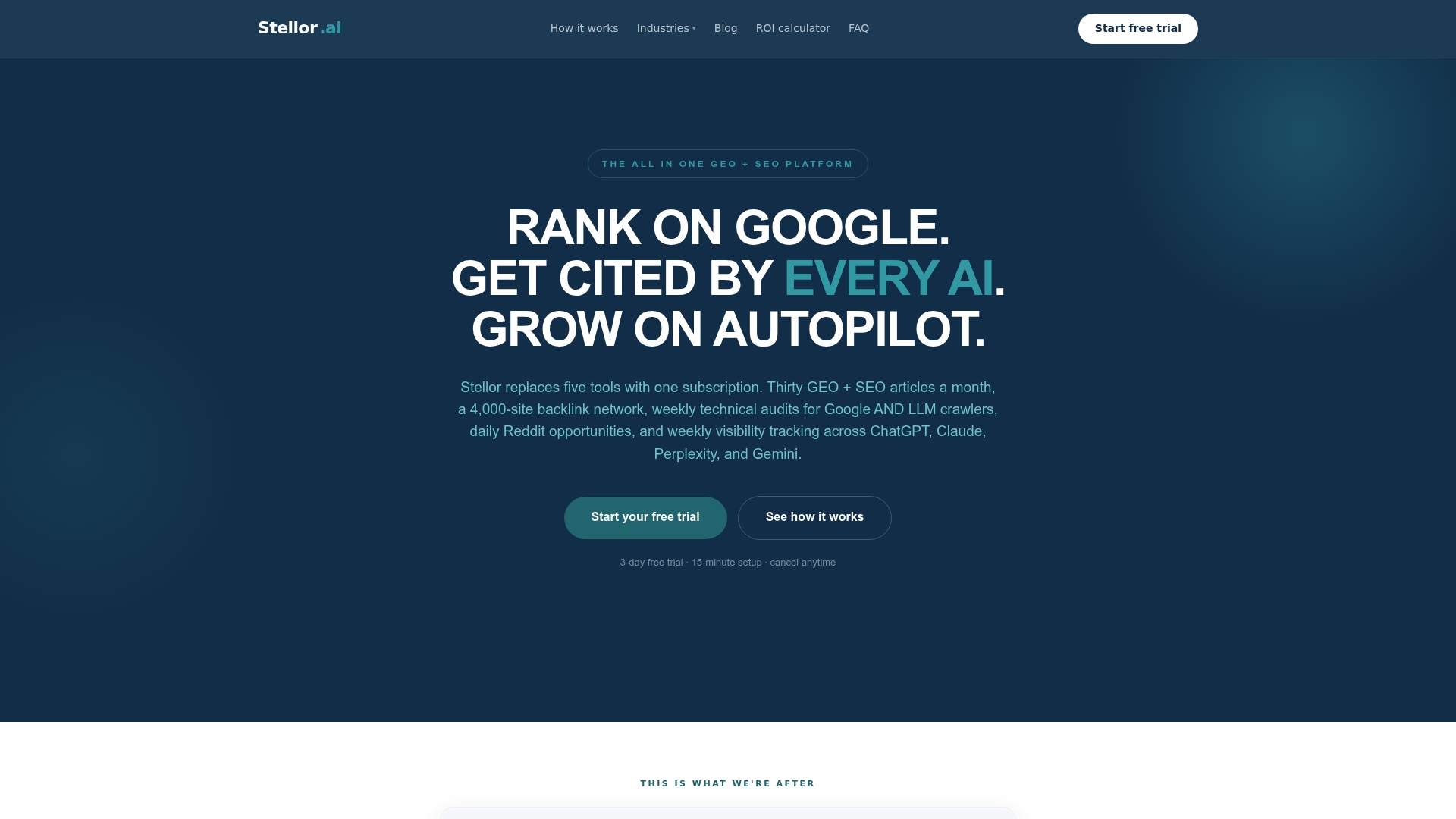
Stellor’s GEO + SEO solutions connect every element covered in this guide into one streamlined platform. From automated backlink building and technical site audits to real-time AI citation tracking and content publishing, the Stellor platform gives local service businesses the firepower of a full-service agency at a fraction of the cost. Explore the SEO blog insights to see exactly how businesses like yours are using these tools to move faster and measure what actually drives growth.
Frequently asked questions
What is the fastest SEO strategy for local service businesses?
Optimizing your Google Business Profile, building local pages, and actively requesting reviews deliver the quickest results, as GBP plus reviews consistently produce measurable ranking gains within one to two months.
How can I track my SEO results beyond website traffic?
Track AI search citations, conversion rates, and review velocity to measure true SEO impact, since AI citations and review velocity reveal how your business performs in the channels that drive actual bookings.
Is AI optimization really necessary for small local businesses?
Yes, because over 25% of searches now include AI Overviews, meaning businesses that skip AI optimization miss a large and growing slice of search visibility.
What are the core types of SEO strategies for service businesses?
Technical SEO, On-Page SEO, Off-Page SEO, Local SEO, Content SEO, and AI/GEO/AEO are the main SEO types that offer measurable impact for local service companies.