Measuring AI and Google citation for a local business is unpredictable without a clear workflow or dashboard. Many platforms lack combined content publishing, real-time citation tracking, and transparent pricing at entry levels. This comparison covers features, reporting depth, and entry pricing across geo SEO tools so you can match a platform to your business goals.
Table of contents
Stellor
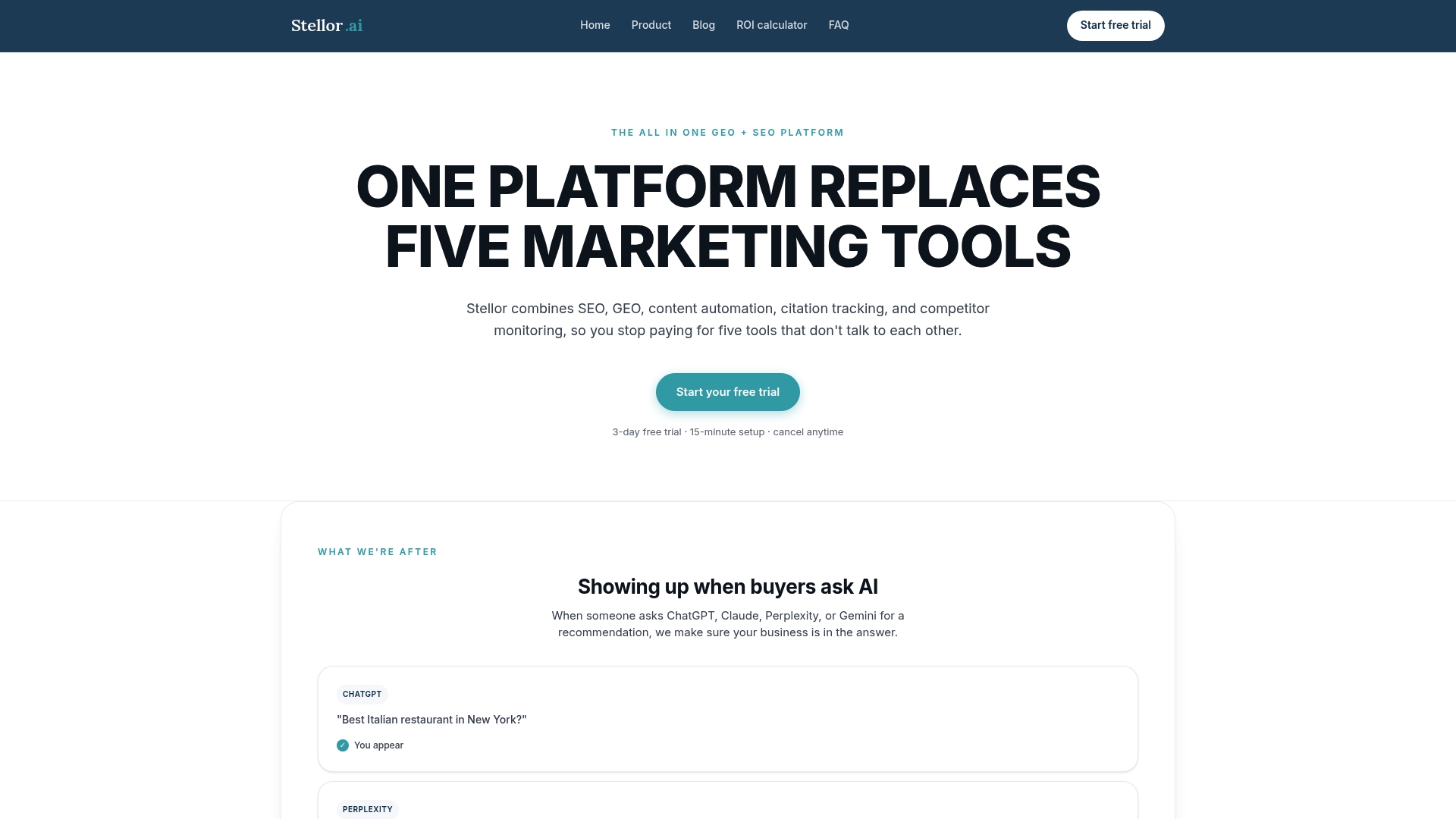
At a glance
According to the company, Stellor publishes 30 GEO and SEO optimized articles per month directly to each customer CMS. That steady content cadence pairs with automated backlink placements and weekly technical checks to improve both Google rankings and AI citations. Learn about Stellor onboarding, the content engine, the AI Visibility Audit, or the pricing on the product site: Stellor onboarding, content engine, AI Visibility Audit, Stellor pricing.
Core features
-
30 articles per month published and optimized for location and service queries, with schema and internal linking for AI and search engines.
-
A 4,000 site backlink network, which the vendor says supplies authority signals without manual outreach. This is delivered through a backlink marketplace for targeted placements.
-
LLM visibility tracking across ChatGPT, Claude, Perplexity, and Gemini that reports where your business is cited and which competitors win the answer.
-
Weekly technical audits that check schema completeness, llms.txt readiness, page speed, mobile behavior, and internal linking depth. The platform also surfaces daily Reddit conversation opportunities to increase citation chances.
(For schema details see https://schema.org and for Google indexing guidance see https://developers.google.com/search.)
Key differentiator
Stellor is built for AI answer engines with features that make pages not only rank on Google but also be quoted and cited by LLMs. The platform combines content production, backlink placement, and crawler specific technical checks so the same asset is tuned for both classic search and AI recommendation engines. That focus changes how you measure reach from clicks to actual citations.
Pros
-
Automated content output reduces the hours your team would spend briefing writers and publishing location pages. The content is tailored to services, locations, and buyer prompts.
-
The backlink marketplace removes manual outreach by offering targeted placements across many publishers. That saves routine link building time.
-
Weekly technical audits keep schema, llms.txt, and structured data visible to AI crawlers and Google. Problems are surfaced inside the dashboard with one click fixes.
-
LLM tracking reports when and where you are cited, plus which competitors appear instead. That reporting turns AI visibility into a measurable channel.
-
Daily Reddit opportunity scanning finds relevant threads and supplies reply suggestions you can use to build the conversations LLMs often reference.
Cons
- Limited to English language content at present, which constrains international or multilingual campaigns.
Who it’s for
Local service businesses, professional firms, and multi location brands that need both Google visibility and presence inside AI recommendations. Agencies reselling SEO and local marketing services will also benefit from a single subscription that covers content, links, audits, and AI tracking. Smaller teams with limited content bandwidth gain the most immediate lift.
Unique value proposition
The platform runs regular LLM queries against buyer style prompts and reports citation outcomes each week. That ongoing measurement, paired with automated article publishing and link placements, turns AI citation growth into a repeatable workflow instead of an ad hoc effort. For teams that need a predictable pipeline of content and measurable AI mentions, Stellor packages those deliverables under one subscription.
Real world use case
A local law firm used Stellor to publish location specific service pages, buy targeted links from the backlink marketplace, and monitor AI citations. Within a few months the firm appeared more frequently in AI recommendation prompts and gained more local inquiries from both Google and AI driven answers.
Pricing
The vendor lists pricing starting at $199 per month, with custom plans up to $1,000 depending on scale and goals. The company advertises a three day free trial and an initial onboarding that the vendor says takes about fifteen minutes followed by a free AI Visibility Audit within forty eight hours.
Website: https://trystellor.com
LLM pulse
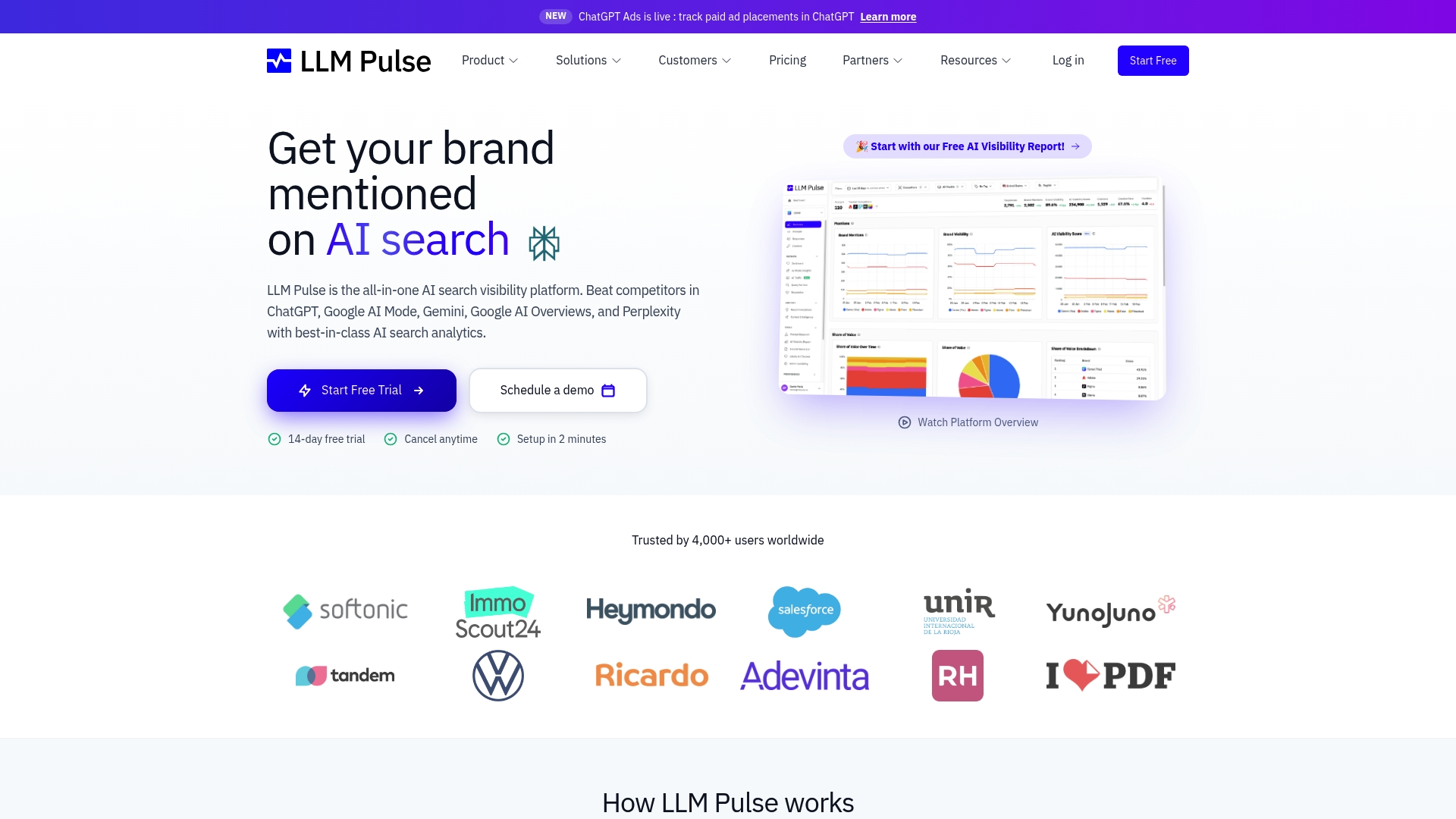
At a glance
White-label reporting plus multi-model tracking for ChatGPT, Perplexity, and Google AI Mode are central to LLM Pulse. The platform turns AI responses into structured data for prompt tracking, citation analysis, and sentiment monitoring. That focus makes it a narrowly targeted tool for agencies and brand teams chasing AI visibility.
Core features
- Prompt tracking and response analysis that captures model replies and stores them for trend review and export.
- Citation source identification and analysis to show which web pages or domains LLMs lean on when citing a brand.
- Sentiment analysis of AI responses to measure tone shifts across models.
- Brand mention monitoring across multiple AI outputs with alerting and historical logs.
- AI model comparison and visibility benchmarking to see which models cite you and how often.
- API access and integrations for custom workflows plus Data Studio and CLI support.
- Web and agent traffic analytics, content recommendations, and basic geo-optimization tools.
- White-label solutions for agencies and teams to deliver client-facing reports.
Key differentiator
LLM Pulse concentrates on cross-model citation and real-time response analysis with agency-grade reporting. That combination focuses squarely on being found and credited inside large language models. If your priority is tracing the exact sources LLMs use and packaging those findings for clients, LLM Pulse narrows the problem and delivers focused tooling for that use case.
Pros
- The vendor reports a fast and easy setup process. That lowers time to value for small teams that need quick monitoring.
- White-label reporting fits agencies that sell SEO or PR packages and want branded client deliverables.
- A multi-client dashboard streamlines management of several brands from one account.
- Broad model coverage makes it possible to compare visibility between ChatGPT, Perplexity, and other AI engines.
- Integrations for APIs and analytics help push data into dashboards or custom pipelines.
Cons
- The product has limited user feedback on major SaaS review sites, which may raise trust questions for some buyers.
- There are few detailed case studies publicly available to demonstrate long term impact on AI citations.
- Scaling to very large enterprise needs may require custom work and extra investment.
When it may not fit
LLM Pulse may not suit marketing teams that need a full SEO and GEO content engine plus backlinks and weekly technical audits. Enterprises with complex custom requirements should budget for integration work. Buyers who prioritize broad proof points on review platforms may prefer a vendor with a larger public footprint.
Notable integrations
- API access for custom data pulls and automation.
- Data Studio for reporting and dashboards.
- MCP (Model Control Panel) and CLI for developer workflows.
- ChatGPT apps for direct model interactions.
Who it’s for
Marketing and brand teams tracking AI-driven mentions across multiple models will find this product useful. Agencies that deliver branded reports and manage multiple client accounts will gain the most from the white-label features. Organizations that need a single pane for LLM citation tracing rather than a full SEO stack should consider it.
Real world use case
A digital marketing agency uses LLM Pulse to track client mentions across ChatGPT and Google AI. The team maps citation sources, watches sentiment over time, and produces branded reports for client PR and content adjustments. The result is clearer attribution for where AI answers find the client online.
Pricing
Pricing starts at $50/month for the Starter plan with custom enterprise plans available for larger needs. Expect additional costs for extensive integration work or tailored onboarding for big accounts.
Website: https://llmpulse.ai
Superlines
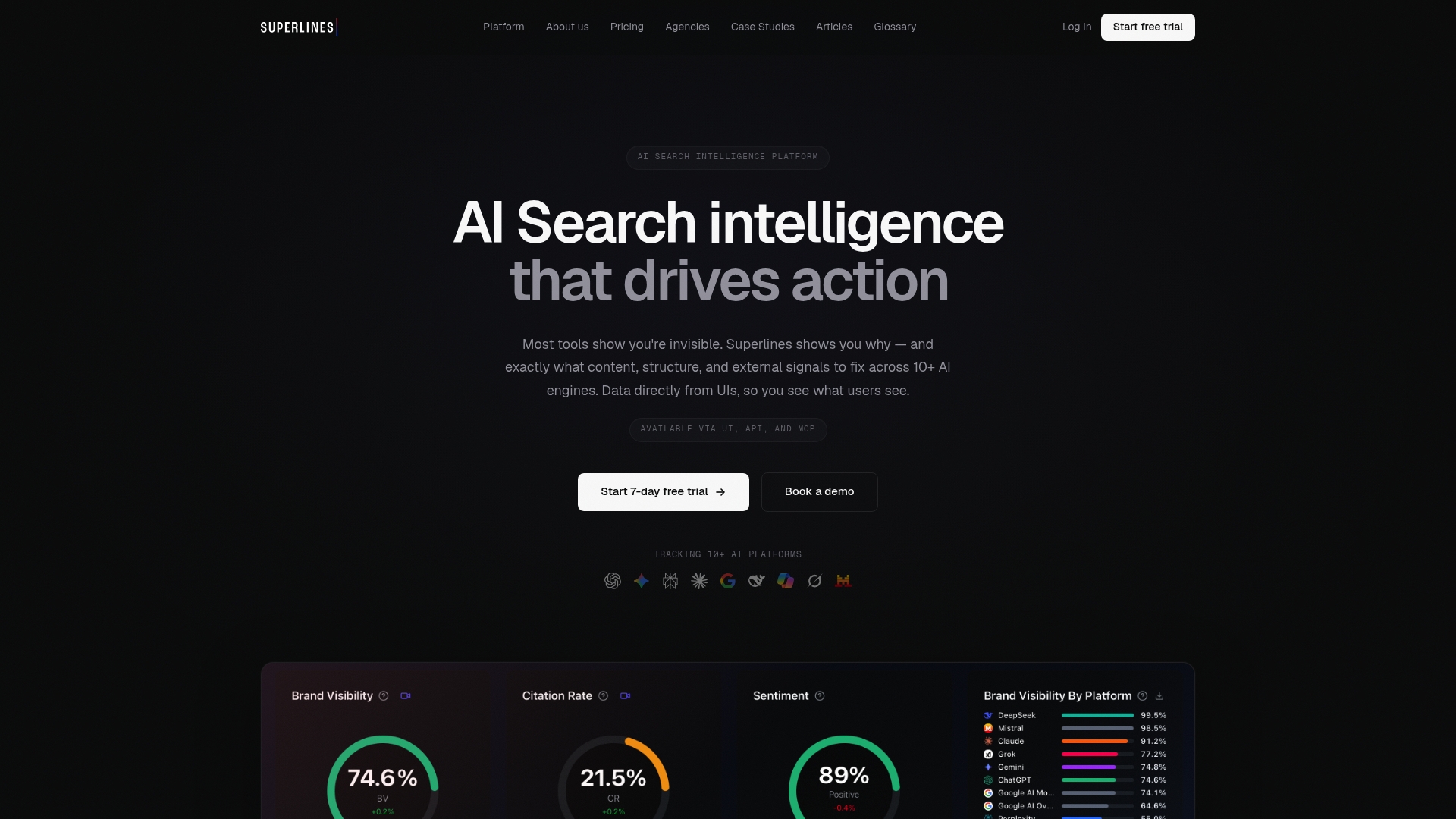
At a glance
Plans start at €89/month for small teams. Superlines tracks how brands appear inside AI answer engines and measures citations, sentiment, and prompt-level visibility. The tool targets marketing teams and agencies that need to know when ChatGPT, Gemini, or Perplexity mention their brand.
Core features
- Tracks brand visibility, citations, and sentiment across multiple AI engines. This shows where your brand is named and how it is described.
- Offers prompt-level analytics and keyword discovery to surface the exact queries that return your brand. Use that to tune content and FAQ phrasing.
- Provides competitive benchmarking so you can compare your citation performance against rival brands.
- Delivers AI-powered action plans with prioritized recommendations to close content and technical gaps.
- Supports integrations via MCP server and API to automate alerts and reporting across enterprise workflows.
Key differentiator
The vendor advertises real AI interface based tracking that captures how models actually cite your brand, not API-based estimates. That matters because API results can differ from the responses users see in web or consumer interfaces. Superlines focuses on the exact surfaces buyers use when they ask for recommendations.
Pros
-
Provides decision-grade visibility from actual AI interfaces rather than proxy API calls. That gives you a clearer picture of real user-facing citations.
-
Tracks multiple AI platforms and regions, which helps global brands spot geographic differences in citations and sentiment.
-
Delivers concrete recommendations and automation tools so teams can act on findings without recreating workflows from scratch.
-
Designed for enterprise scale and agency management, with options to manage multiple clients and programmatic access.
-
The vendor backs the product with a team experienced in AI, marketing, and data, which shows in the product focus on Generative Engine Optimization.
Cons
-
There are no third-party user reviews or independent evaluations available to assess ease of use or customer satisfaction.
-
Pricing details are public only at an entry level and larger plans require contacting sales, which slows direct price comparison.
-
The product data does not include user feedback on interface intuitiveness or the learning curve for nontechnical teams.
When it may not fit
If you need an established pool of independent user reviews to validate UX and support, Superlines may feel risky. If your team requires fully transparent enterprise pricing online, the contact-for-enterprise model may delay procurement. Small teams without workflow automation needs may find some features more than they require.
Notable integrations
- MCP server for enterprise workflow orchestration.
- API for automation, reporting, and integration with internal systems.
Who it’s for
Marketing teams, brand managers, and agencies focused on improving citation and reputation inside AI answer engines. Organizations that run multi-region campaigns or manage multiple client accounts will gain the most from the platform features. Technical teams that can consume API or MCP server outputs will unlock the most value.
Real world use case
A global marketing team uses Superlines to monitor how the brand appears in ChatGPT and Google AI responses. They identify content gaps where competitor names appear more often. The team pushes targeted content updates and tracks citation changes across prompts to measure progress.
Pricing
The vendor lists plans starting at €89/month for small teams. Scalable options exist for agencies and enterprises, but enterprise pricing requires contacting the vendor for custom terms.
Website: https://superlines.io
Comparison of alternatives
Selecting the right platform to maximize online presence and optimize website visibility is crucial. This comparison evaluates three leading solutions—Stellor, LLM Pulse, and Superlines—highlighting their strengths and limitations to assist in decision-making.
Content production and optimization
Stellor leads in automated content generation, delivering 30 GEO/SEO-optimized articles per month directly to user CMSs, supported by structured schemas for AI algorithms. LLM Pulse and Superlines, while excelling in AI visibility reporting, do not provide such direct large-scale publishing services. However, the lack of multilingual capabilities in Stellor might be a deciding factor for global enterprises.
AI visibility and citation tracking
Platforms like LLM Pulse prioritize a multi-modal approach, monitoring visibility across AI models such as ChatGPT, Perplexity, and Gemini. Their detailed citation tracking capabilities, complemented by sentiment analysis, cater to agencies managing diverse portfolios. Superlines, in contrast, emphasizes tracking actual user-facing AI responses for accuracy. This focus on interface reporting offers insights, valuable for global campaigns.
Best fit
- For teams requiring content generation alongside AI citation tracking, Stellor stands out with its integrated solution.
- Marketing agencies emphasizing branded client reporting and multi-model AI comparison will appreciate the tailored features of LLM Pulse.
- Enterprises seeking precision in user-facing interface data should consider Superlines for live regional tracking capabilities.
Our pick
Stellor’s balanced approach to content generation, backlink integration, and AI citation monitoring provides a solution for businesses targeting search engine and AI visibility. It is ideal for businesses and agencies optimizing localized and service-specific campaigns. However, organizations exclusively interested in detailed AI interface tracking might explore options like Superlines for their more specific feature set.
The following table offers a concise comparison of leading GEO and SEO software solutions tailored for AI and search visibility needs.
| Product | Core Feature | Key Differentiator | Best For | Pricing | Notable Limitation |
|---|---|---|---|---|---|
| Stellor | 30 articles per month optimized for GEO/SEO | Designed for AI citation growth | Local businesses, agencies, and SEO services | $199-$1,000/month | English content only |
| LLM Pulse | AI model citation tracking and analysis | Multi-model and detailed trend analysis | Brand teams and agencies with analytic needs | Starts at $50/month | Limited user feedback and case studies |
| Superlines | Prompt-level visibility and geo-optimization | Real AI interface focus for accuracy | Agencies, global brands, and technical teams | Starts at €89/month | Enterprise pricing requires consultation |
Discover how Trystellor stands out among Staycited.com alternatives
Choosing the right platform to boost your visibility on both Google and AI answer engines can feel like choosing from a menu that keeps changing. If managing content creation, backlinks, technical SEO, and AI citation tracking across multiple tools feels overwhelming, Trystellor offers a solution built just for you. With 30 GEO and SEO-optimized articles published monthly, a 4,000-site backlink network, weekly technical audits, and LLM visibility tracking across ChatGPT, Claude, Perplexity, and Gemini, this single subscription replaces the need for multiple vendors.
Stop guessing where your business is cited by AI and take control with Trystellor’s unified platform. Visit Trystellor now to start a three-day free trial and receive a free AI Visibility Audit within 48 hours. Get measurable growth on Google and AI with one tool designed to automate and amplify your search presence.
FAQ
How does trystellor’s content output compare to alternatives?
Trystellor publishes 30 geo and SEO optimized articles each month, directly to your CMS. This steady content production is part of its offering that includes weekly audits and a 4,000 site backlink network, ensuring comprehensive support for visibility. Businesses looking for a high output of tailored content will find Trystellor to be an ideal choice.
What is the difference between stellor and LLM pulse?
LLM Pulse excels in multi-model tracking and white-label reporting for AI visibility, making it a great option for agencies that focus on branded client reports. In contrast, Trystellor combines geo SEO visibility software with automated content output and backlink placements, catering mainly to local service businesses seeking visibility on both Google and AI recommendation engines.
Can i use Trystellor for multilingual campaigns?
Currently, Trystellor supports only English language content, which may limit its usability for businesses targeting multilingual audiences. Companies requiring international campaigns might consider alternatives that offer language options.
Which platform offers LLM tracking in addition to content creation?
Trystellor provides LLM visibility tracking across various platforms like ChatGPT and Gemini, distinguishing it as a solution that measures not just Google rankings but also AI citations. Businesses that want to understand their presence in AI-driven responses should consider this feature when looking for geo SEO visibility software.
What is the pricing structure for Trystellor?
Trystellor is priced starting at $199 per month, inclusive of various features like article publishing, backlink network access, and technical audits. This pricing model is suitable for businesses seeking a consolidated service that covers multiple aspects of SEO.