The majority of buyers never scroll past the first three Google results, which means your phone calls, quote requests, and new customer reviews are almost entirely decided before someone ever visits your website. For local service businesses, plumbers, landscapers, HVAC technicians, and cleaners alike, Google rankings aren’t a marketing nicety. They’re the gatekeeper to your revenue. This guide breaks down exactly how Google’s ranking system works for local businesses, why slow and steady SEO investment consistently outperforms quick fixes, and what specific steps you can take this week to start climbing toward the positions that actually drive calls and growth.
Table of Contents
- How Google ranks local businesses: The three pillars explained
- Why a multi-signal approach beats one-off SEO tricks
- The real-world benefits: Trust, visibility, and growth
- Action steps: How to start prioritizing Google rankings today
- The hidden compounding advantage most overlook
- Ready to accelerate your rankings? Stellor makes it simple
- Frequently asked questions
Key Takeaways
| Point | Details |
|---|---|
| Pillars of local SEO | Google ranks local businesses based on relevance, distance, and prominence. |
| Signal diversity wins | A multi-signal, ongoing approach drives stronger and sustained search results. |
| Reviews drive trust | Customer reviews are key to building prominence and winning more leads. |
| Compounding gains | Small, consistent ranking improvements can add up to major business growth. |
| AI streamlines SEO | Integrating AI tools simplifies and accelerates smart Google ranking strategies. |
How Google ranks local businesses: The three pillars explained
When someone searches “roof repair near me” or “best electrician in Austin,” Google doesn’t just guess which business to show first. Google’s local visibility is largely driven by three pillars: relevance, distance, and prominence. Understanding how each works gives you a real edge, because most competitors are guessing.
Relevance is about how well your business listing matches what the searcher actually wants. If someone types “emergency plumber,” Google checks whether your profile, website, and content clearly signal that you handle emergency plumbing work. Vague or incomplete business descriptions hurt here. The more precisely you describe your services, the more likely you are to match what people are searching for, and that connection happens at the data level, not just the keyword level.
Distance measures how physically close your business is to the searcher or to the location mentioned in the search. This is the pillar you have the least direct control over, but you’re not completely powerless. Setting your service area accurately in your Google Business Profile, using location-specific landing pages, and earning citations from local directories all send distance-relevant signals to Google.
Prominence is where most local businesses have the biggest opportunity. It reflects how well-known and trusted your business is, both online and offline. Reviews are the most visible measure of prominence, but it also includes the number and quality of backlinks pointing to your site, mentions across the web, and your activity level on your Google Business Profile. Businesses with hundreds of detailed reviews, regular posts, and strong local press coverage consistently outrank competitors with thin profiles.
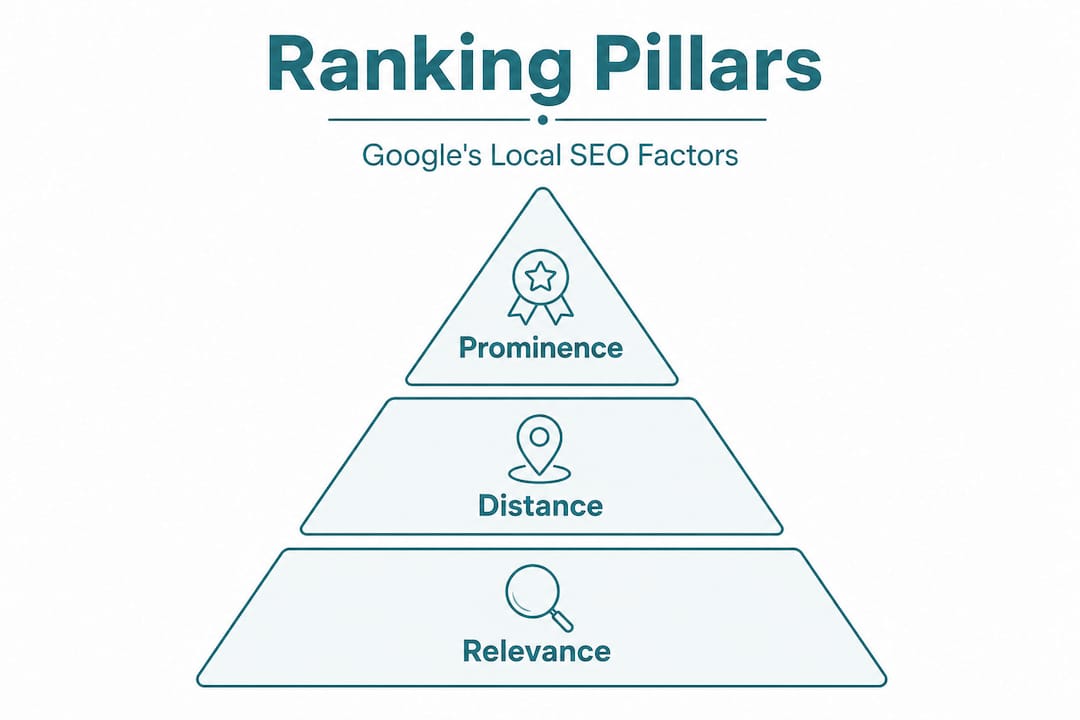
Here’s a quick comparison of how the three pillars work together:
| Pillar | Definition | Key factors | Practical impact |
|---|---|---|---|
| Relevance | Match between listing and search intent | Categories, business description, services listed | Determines if you appear at all |
| Distance | Physical proximity to the searcher | Service area settings, physical address | Affects ranking position within a local area |
| Prominence | Reputation and online authority | Reviews, backlinks, citations, GBP activity | Lifts rankings above similarly relevant competitors |
The good news? Relevance and prominence are both highly actionable. And smart use of AI-powered business tools is making it faster and cheaper to address both at the same time.
“Your ranking in search results isn’t fixed. It shifts based on the strength of signals you send to Google over time. Businesses that consistently build relevance and prominence see compounding gains that shortcuts simply can’t replicate.”, Local SEO practitioner insight
Why a multi-signal approach beats one-off SEO tricks
Now that we understand the pillars of ranking, it’s critical to know why treating SEO as an ongoing process wins out over shortcuts. This is where many local business owners get tripped up. They optimize their Google Business Profile once, get a small bump in visibility, then go quiet. Weeks later, they wonder why the gains faded.
The reason is simple. Google’s ranking is based on multiple signals and systems, not a single algorithm, which means local businesses benefit from consistent, compounding improvements rather than one-off tactics. Think of it like your credit score. One on-time payment helps a little. But twelve months of consistent on-time payments builds a strong, durable score that opens better opportunities.
Common ranking signals that local businesses often underestimate:
- Website content quality and how often it’s updated
- Page loading speed on mobile devices
- Consistency of your business name, address, and phone number across directories
- Number and recency of Google reviews
- How often you post updates to your Google Business Profile
- Local citations from authoritative sources like Yelp, Angi, and local chambers of commerce
- Backlinks from relevant local websites, news outlets, or industry blogs
- User engagement signals like click-through rates and time spent on your site
Here’s a breakdown of primary versus advanced signals:
| Signal type | Examples | Difficulty | Compounding effect |
|---|---|---|---|
| Primary | Reviews, GBP completeness, citations | Low to medium | High |
| Primary | Website relevance, page speed | Medium | Medium to high |
| Advanced | Backlink quality, content depth | Medium to high | Very high |
| Advanced | AI citations, structured data | High | Emerging |
Notice that primary signals are accessible to any local business owner willing to invest consistent effort. Advanced signals take more time but pay dividends for years, especially as SEO for service businesses becomes more competitive with AI-driven tools reshaping the search landscape.
How signals work together over time:
- You complete and optimize your Google Business Profile with accurate categories, service descriptions, photos, and your service area.
- You start requesting reviews from satisfied customers regularly. Each new review boosts your prominence score.
- You add location-specific content to your website, connecting your services to local neighborhoods and landmarks.
- You earn a handful of local citations from directories and a mention in a local publication.
- Google’s systems start treating you as a more authoritative, relevant result. Your ranking improves.
- Higher rankings lead to more clicks, more calls, and more reviews. The cycle accelerates.
Pro Tip: Avoid the temptation to chase fast wins like review gating (filtering customers before asking for reviews) or buying backlinks. Google’s systems are designed to detect artificial signals, and penalties can push you below where you started. Slow, steady, and legitimate always outlasts shortcuts when you’re trying to boost your business ROI over the long term.
The real-world benefits: Trust, visibility, and growth
Understanding why rankings matter helps clarify exactly how better positioning benefits your business in ways you can measure. This isn’t just about showing up higher on a screen. It’s about what that visibility triggers in the minds of the people who find you.
When someone searches for a local service and sees your business in the top three results, something psychological happens immediately. They assume you’re the best option. Higher-ranked businesses are perceived as more trustworthy, more established, and more reliable, even before a potential customer reads a single review. That trust shortcut is enormously valuable in a world where buyers make decisions in seconds.

There’s also a virtuous cycle at work. Reviews affect prominence, and higher prominence brings more visibility. More visibility means more customers, and more customers means more opportunities to collect reviews. Each new review makes your profile more compelling and your ranking more durable. Over time, businesses that invest in this cycle build a local reputation that becomes genuinely hard to dislodge.
How top Google rankings translate into measurable business outcomes:
- More inbound calls without paying for ads
- Higher conversion rates because trust is pre-established before the first contact
- Increased review volume from the larger customer base visibility creates
- Better retention because customers who found you through organic search tend to have stronger intent
- Greater local brand recognition, which drives word-of-mouth referrals alongside digital growth
- Reduced dependency on paid advertising, which cuts long-term customer acquisition costs
- Competitive insulation, meaning competitors have a much harder time overtaking an established ranking position
Pro Tip: Integrating AI tools for reputation management can dramatically shorten the time it takes to collect and respond to reviews, which directly feeds your prominence score. Platforms that automate review requests and track mentions across the web keep you active in Google’s eyes without requiring hours of manual effort each week.
The businesses that win local search aren’t necessarily the best in their trade. They’re the ones who show up consistently, earn trust signals regularly, and make it easy for satisfied customers to leave public feedback. That’s a system anyone can build.
Action steps: How to start prioritizing Google rankings today
So, what concrete steps should you take next? Here’s how local leaders start seeing results.
-
Audit your Google Business Profile completely. Check that your business name, address, and phone number are accurate. Select the most specific primary category for your business. Add every relevant secondary category. Write a description that clearly explains what you do, who you serve, and where you operate. Upload recent, high-quality photos.
-
Set your service area accurately. If you serve a 25-mile radius, define it precisely. Don’t leave it blank or set it too broadly. Google uses this to determine relevance, distance, and prominence signals for local searches, and a well-defined area improves your visibility in the communities you actually serve.
-
Create a simple system for requesting reviews. After every completed job, send a follow-up text or email with a direct link to your Google review page. Make it frictionless. Even getting 5 to 10 new reviews each month compounds significantly over a year.
-
Update your business information across all major directories. Inconsistent citations, different phone numbers or address formats, hurt your credibility with Google. Use tools that scan and correct these inconsistencies across Yelp, Bing Places, Apple Maps, and industry-specific directories.
-
Publish location-specific content regularly. A short blog post about a job you completed in a nearby neighborhood, a seasonal service reminder for local customers, or an FAQ page answering common questions in your area all build relevance signals over time.
-
Leverage an automated SEO platform to maintain consistency. Managing all of this manually is time-consuming. Platforms built for local service businesses handle content publishing, citation monitoring, backlink building, and AI citation tracking simultaneously, so you’re building ranking signals across every pillar without burning hours you don’t have.
These steps aren’t complicated in isolation. The challenge is doing them consistently over months, not just once. That consistency is exactly what separates businesses that hold strong rankings from those that drift back down.
The hidden compounding advantage most overlook
Here’s the honest truth most SEO guides won’t tell you: the businesses winning local search right now aren’t necessarily doing dramatically more work than their competitors. They started earlier and kept going.
Google uses many ranking signals including predictive machine learning signals alongside traditional signals, which means its systems get smarter about recognizing businesses that demonstrate sustained authority over time. Every review, every updated post, every new backlink adds a small weight to your side of the scale. The scale tips slowly, then suddenly.
Most local business owners treat Google rankings like a checklist item. Claim the profile, add some photos, done. They return to the day-to-day grind and expect rankings to hold. They don’t. Google rewards ongoing activity, not past effort. A business that earned 50 reviews two years ago and went quiet will lose ground to a competitor that earned 30 reviews in the last six months and posts weekly.
The mindset shift that matters most is treating SEO as an investment in infrastructure, not a marketing campaign with a start and end date. Your ranking is a business asset. Like any asset, it needs maintenance and ongoing investment to appreciate in value.
The businesses we see outperform their markets consistently are the ones who stop asking “did we do SEO?” and start asking “how are our ranking signals improving this month?” That question changes everything about how you allocate time and resources. Visibility that compounds over 12 to 24 months creates a kind of unfair advantage that late starters can’t easily buy their way into.
Luck brings occasional spikes. Momentum in ranking signals creates durable, defensible growth.
Ready to accelerate your rankings? Stellor makes it simple
If you’re serious about putting these action steps on autopilot and building the kind of ranking momentum that grows your business month over month, Stellor was built exactly for that.
Rank on Google with Stellor by using a platform that handles content creation, backlink building, citation management, technical site audits, and AI citation tracking inside a single subscription. You don’t need to hire an agency, juggle five different tools, or figure out the technical pieces yourself. Stellor automates the compounding work so your visibility improves steadily while you focus on serving customers. For local service businesses ready to stop leaving leads on the table, it’s the fastest path from invisible to undeniable.
Frequently asked questions
Does updating my website really help local Google rankings?
Yes, consistent updates signal relevance and quality, both of which are core to Google’s local search pillars of relevance, distance, and prominence.
Is getting new reviews more important than adding keywords to my site?
For local service businesses, reviews are crucial for prominence and tend to influence customer trust more directly than on-page keywords, especially because reviews affect prominence in Google’s local ranking model.
How long does it take to see improvements in Google rankings?
Local ranking progress is gradual, often taking weeks to months, because Google’s ranking systems are built on multiple compounding signals rather than a single immediate factor.
Can AI tools really make a difference for my Google rankings?
AI-powered tools streamline content creation, review collection, and listing management, making it much faster to strengthen all three ranking pillars at a scale most small business owners couldn’t reach manually.