TL;DR:
- Traditional SEO optimizes entire web pages for search rankings, whereas GEO focuses on earning citations within AI-generated answers at the section level. Successful digital strategy requires treating both as complementary, with off-site mentions, schema accuracy, and answer-first content boosting AI citations alongside rankings. Measuring citation rates per AI engine and ensuring consistent entity signals are essential for maximizing visibility in the evolving search landscape.
If you’re trying to understand the geo vs seo differences explained in practical terms, here’s the short version: traditional SEO optimizes entire web pages to rank on Google, while Generative Engine Optimization (GEO) optimizes specific content sections to earn citations inside AI-generated answers from ChatGPT, Perplexity, Claude, and Gemini. They share some foundation, but they measure success differently, target different outputs, and require different content strategies. Running both together is now the baseline for any serious local search optimization effort.
Table of Contents
- Key Takeaways
- GEO vs SEO differences explained: the core concepts
- How AI search engines changed the game
- Practical strategies and measurement for GEO alongside SEO
- Common misconceptions that cost local businesses
- My honest take after watching this evolve
- How Trystellar handles both GEO and SEO for you
- FAQ
Key Takeaways
| Point | Details |
|---|---|
| Different optimization targets | SEO ranks full pages; GEO earns citations in AI answers at the section level. |
| Distinct success metrics | Track organic sessions for SEO and citation frequency per AI engine for GEO. |
| Content structure matters | Declarative, answer-first content blocks increase AI citation rates by measurable margins. |
| Local businesses need off-site authority | Around 50 independent web mentions are needed before AI engines cite a local business consistently. |
| Dual optimization is required | Treating GEO and SEO as competing priorities leaves visibility gaps in both channels. |
GEO vs SEO differences explained: the core concepts
The clearest way to understand GEO vs SEO is to look at what each one actually optimizes. SEO works at the page level. You target a keyword, build the page around it, earn backlinks, and climb the Google results page until you capture clicks. Success is a ranking position and the organic sessions that come with it.
GEO, which stands for Generative Engine Optimization, works at the section level. An AI model reading your page is not ranking it against ten competitors. It is deciding whether a specific paragraph answers a user’s question clearly enough to quote or paraphrase in a synthesized response. Declarative structure increased citation rates from 37% to 61% in controlled experiments, and shifting to declarative content blocks produced a 24 percentage point citation lift in January 2026 tests. That gap is not trivial.
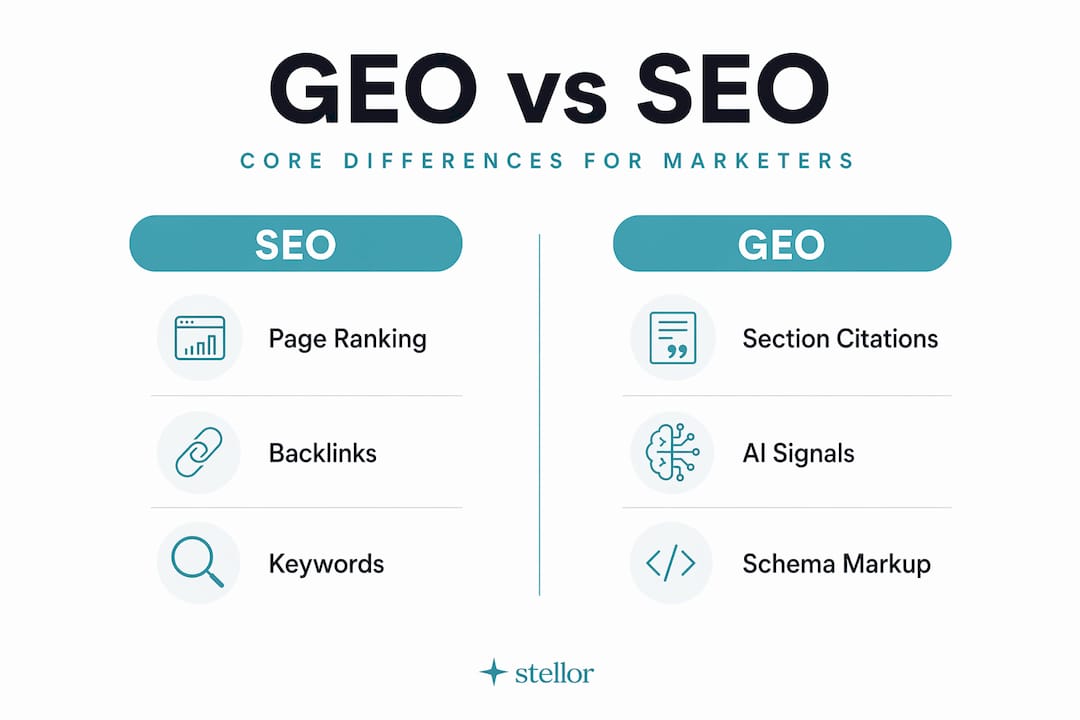
The signals that drive each approach also diverge. SEO still relies heavily on backlinks, keyword targeting, and technical factors like Core Web Vitals. GEO relies on extractability, entity clarity, and structured data to earn citations. Schema markup, consistent entity naming, and answer-first formatting matter far more to an AI crawler than anchor text density.
Here is a side-by-side comparison of the key dimensions:
| Dimension | Traditional SEO | GEO |
|---|---|---|
| Optimization unit | Full page | Individual content section |
| Primary goal | Rank on search results page | Earn citation in AI answer |
| Success metric | Rankings, organic sessions | Citation frequency, AI mention rate |
| Core signals | Backlinks, keywords, technical health | Entity clarity, schema, structured data |
| Content style | Narrative, keyword-rich | Declarative, answer-first |
| Audience | Google’s algorithm | AI language model crawlers |
Pro Tip: Write at least one paragraph per topic as a direct answer block. Start the paragraph with a clear statement of fact, then support it with data or an example. This structure serves both Google’s featured snippets and AI citation logic at the same time.
How AI search engines changed the game
Search has split into two distinct discovery channels. Google still processes billions of queries a day and those results drive real traffic. But AI-generated answers appear on 47% of informational queries as of early 2026, meaning nearly half of the questions your potential customers ask are now answered by a machine that never sends them to a search results page at all.

This shift created GEO as a discipline. When ChatGPT answers “best HVAC contractor in Denver” or Perplexity explains “what does a contract review attorney actually do,” it is synthesizing content from pages it found credible, structured, and citable. That is a fundamentally different mechanism than a ranking algorithm.
Here is what AI systems prioritize when deciding what to cite:
- Answer-first structure. Content that states the conclusion before the explanation gets extracted more reliably than narrative prose that builds to a point.
- Entity authority. The AI needs to know who you are before it trusts what you say. Consistent business names, linked author profiles, and verified citations across the web all signal entity trustworthiness.
- Schema markup completeness. Structured data tells AI crawlers exactly what type of content they are reading, what organization produced it, and how that organization maps to known authoritative profiles.
- Topical depth. A page that thoroughly covers a subject from multiple angles gives the AI more to extract and cite than a thin overview.
For digital marketers helping local service businesses, this means your legacy SEO strategy is necessary but no longer sufficient. GEO extends visibility into the AI channel. Both must run together for full digital coverage.
Pro Tip: Format your most important service and location pages with an FAQ section at the bottom. AI engines frequently pull from FAQ blocks because they are already structured as question-and-answer pairs, which matches exactly how generative answers are assembled.
Practical strategies and measurement for GEO alongside SEO
Knowing the difference conceptually is only useful if you can apply it. Here is a sequential approach to integrating both disciplines without abandoning what already works in your traditional SEO practice.
- Audit your entity footprint first. Before writing a single new page, confirm that your business name, address, and category are consistent across your Google Business Profile, LinkedIn, industry directories, and any major press mentions. Inconsistent entity naming confuses AI models and reduces citation probability.
- Build off-site mentions to the citation threshold. Research shows local businesses need roughly 50 independent web mentions before AI engines cite them consistently. Focus on local news coverage, chamber listings, and review platforms before pouring budget into new content.
- Implement schema with sameAs chains. Your schema markup should include a sameAs array linking to 12 to 15 verified external profiles. This gives AI crawlers a map connecting your website to your authoritative presence across the web. Common schema errors cause trust penalties that suppress citations even when your content quality is high.
- Restructure informational content for declarative extraction. Take your existing service pages and add answer-first summary paragraphs at the top of each major section. These become the blocks AI models pull from when generating answers.
- Separate your KPIs by channel. SEO success measures rankings and organic sessions; GEO success measures citation frequency and AI answer presence. Google Analytics 4 now surfaces AI Assistant channel groups in Q2 2026 data, which means you can finally track these as separate performance lines rather than collapsing them into one organic bucket.
- Track citations per engine, not as an aggregate score. Perplexity and Gemini cite differently, especially in multilingual queries. Measuring a blended citation rate hides which platforms are underperforming and which content types are resonating.
For deeper guidance on running a technical baseline before you build, the SEO audit checklist for local businesses at Trystellor is a useful starting point.
Pro Tip: For informational content, prioritize GEO signals. For transactional content like service pages and location pages, prioritize traditional SEO signals first. The user intent is different and the optimization emphasis should follow.
Common misconceptions that cost local businesses
The most expensive mistake you can make right now is assuming GEO is just SEO with a different name. GEO is a distinct discipline that prioritizes entity authority and content extractability for generative AI, not ranking position. Treating it like SEO with extra steps produces content that ranks adequately on Google but never earns a single AI citation.
Several specific misconceptions show up repeatedly in client work:
- “More backlinks will fix my GEO.” Backlinks help SEO. For GEO, what moves the needle is entity clarity and off-site mentions from credible sources, which is not the same as a link-building campaign targeting domain authority.
- “Schema is optional plumbing.” Schema errors are among the most common causes of AI citation suppression. Incomplete or incorrect schema markup sends trust signals that cause AI engines to skip your content even when it is factually accurate and well written.
- “One citation number tells me how I’m doing.” AI engines differ significantly in citation patterns, and language localization amplifies those differences further. A business that earns strong Perplexity citations may be invisible on Gemini.
- “Expert authorship doesn’t matter for local businesses.” It does. Strong brand signals and real human authorship increasingly influence GEO success, especially in categories where AI must gauge credibility before recommending a vendor.
GEO is a citation and entity authority challenge, not a ranking challenge. Businesses that treat it as the latter spend budget on the wrong signals and wonder why their AI visibility never improves.
The businesses that get this right sequence their work correctly: off-site mentions and schema come before new content investment. Most agencies do it in reverse, and local business owners pay for that mistake.
My honest take after watching this evolve
I’ve spent time watching local service businesses get this wrong in the exact same way, repeatedly. An agency delivers a ranking report showing green across the board, and the business owner is happy. Meanwhile, every person who asks ChatGPT “best electrician near me” gets a list that does not include them. The metrics look fine. The actual visibility is eroding.
What I’ve found works is treating GEO and SEO as two separate performance channels with two separate accountability frameworks. Not two strategies, two dashboards. When you measure them separately, you see clearly where you are winning and where you are invisible. That separation forces the right strategic conversations.
The other lesson I keep coming back to is that schema implementation quality is a durable competitive advantage most local businesses leave on the table entirely. Getting the sameAs chains right, verifying your entity across 12 to 15 authoritative profiles, and keeping that data consistent is tedious work. That is exactly why doing it well separates the businesses AI cites from the ones it never discovers. It is the plumbing behind the walls of your digital presence: invisible when it works, catastrophic when it does not.
One more thing I want to name directly. Many agencies are not yet measuring AI citation rates by engine. They offer a generic “AI visibility score” that papers over real gaps. Push for per-engine data. If your provider cannot show you how your citation rate differs between Perplexity and Gemini, they are not measuring what actually matters in 2026.
— Cole
How Trystellar handles both GEO and SEO for you
Running GEO and SEO together is not simple. It requires content production at volume, technical audits calibrated for AI crawlers, entity and schema management, backlink authority, and weekly tracking of citation rates across multiple AI engines. Doing all of that manually across five separate tools is how visibility gaps form.
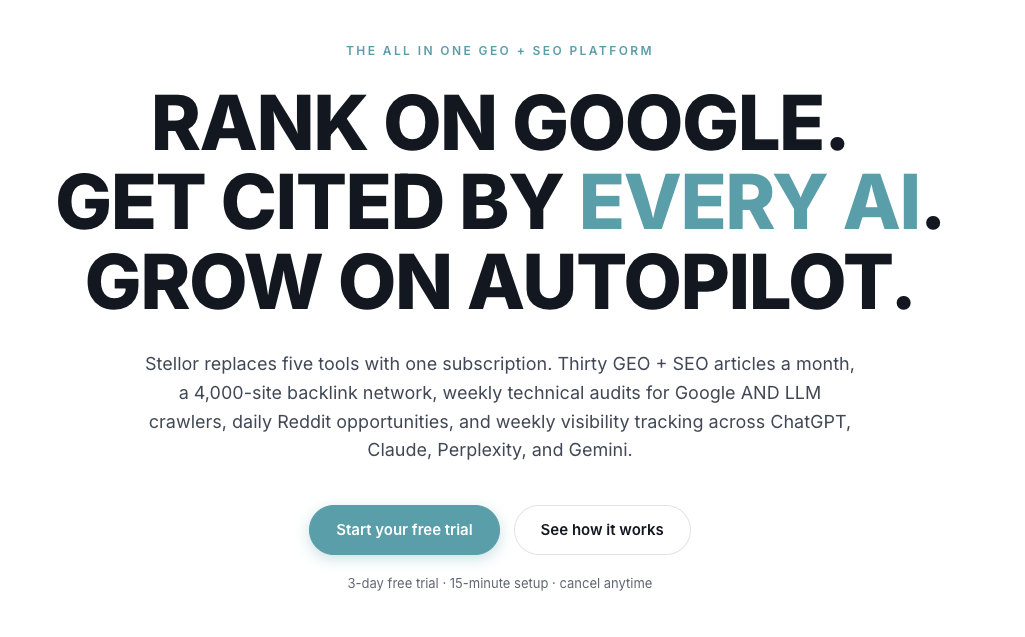
Trystellor is built specifically for this. The platform publishes 30 GEO and SEO-optimized articles per month to your CMS, runs weekly technical audits across 11 checks, manages a 4,000-site backlink network, and tracks your citation rates on ChatGPT, Claude, Perplexity, and Gemini every week using the exact prompts your buyers type. The full platform features replace what most businesses are stitching together across five vendors, starting at $199 per month. You can explore everything with a three-day free trial and no credit card required. Your content stays with you even if you cancel.
FAQ
What is the core difference between GEO and SEO?
SEO optimizes full web pages to rank on search results pages. GEO optimizes specific content sections to earn citations inside AI-generated answers from platforms like ChatGPT, Perplexity, and Gemini.
Does GEO replace traditional SEO?
No. GEO extends SEO into the AI answer channel but does not replace it. Google still drives enormous traffic, so both disciplines need to run in parallel for complete search visibility.
How do you measure GEO success?
Measure citation frequency and AI mention rates per engine, tracked separately from organic sessions and rankings. Google Analytics 4 now includes AI Assistant channel groups to help separate this traffic in reporting.
How many web mentions does a local business need for AI citations?
Research shows local businesses need around 50 independent web mentions before AI engines begin citing them consistently. Off-site presence and correct schema markup are prerequisites before new content investment pays off.
Why does schema markup matter for GEO?
Schema tells AI crawlers what type of content a page contains, who produced it, and how that entity maps to verified external profiles. Errors in schema cause trust penalties that suppress citations regardless of content quality.