TL;DR:
- In 2026, local search rankings depend on Google and AI signals, including relevance, proximity, prominence, and AI entity recognition. Achieving over 50 independent citations, optimizing Google Business Profiles, managing reviews, and using validated schema are essential for ranking success. Monitoring Local Pack and AI mention rates provides a comprehensive view of local visibility beyond traditional website analytics.
Local search ranking factors in 2026 are defined as the signals Google and AI answer engines use to decide which businesses appear in local map pack results, AI Overviews, and LLM-generated recommendations. The three foundational pillars remain relevance, proximity, and prominence, but a fourth dimension has arrived: AI entity recognition, which requires your business to be independently cited across 50 or more sources before ChatGPT, Perplexity, or Gemini will reliably name you. Google Business Profile (GBP) is still the single strongest ranking surface for local businesses, but in 2026, winning local search means optimizing for both Google’s algorithm and the LLMs that millions of buyers now consult before they ever click a link.
1. What are the top local search ranking factors in 2026?
The local search ranking factors that matter most in 2026 combine proven Google signals with emerging AI-driven requirements. Understanding which factors to prioritize first saves you months of wasted effort.

Google Business Profile completeness is the strongest individual ranking signal available to any local business. A fully completed GBP, including business category, hours, services, attributes, and a minimum of ten photos covering exterior, interior, products, and team, directly affects your local map pack position. GBP photos increase clicks by 35%, which means an incomplete photo gallery is leaving real traffic on the table.
NAP consistency (Name, Address, Phone) across every directory, citation, and listing is the plumbing behind your digital presence. Inconsistent formatting like “123 Main St” on Google and “123 Main Street” on Yelp creates conflicting signals that suppress your rankings. Audit every listing with a tool like Moz Local or BrightLocal and standardize the format once, then protect it.
Review quantity, quality, and recency form the trust layer that converts rankings into actual customers. Aim for 50 or more Google reviews in your first year, maintain a 4.5-star average, and respond to every review within 48 hours. Review velocity, meaning how frequently new reviews arrive, signals to Google that your business is active and trusted.
Backlinks from local sources carry more weight than generic directory links. Local backlinks from chambers of commerce and local news outlets build prominence in ways that national link farms cannot replicate. One link from your city’s business journal outweighs ten links from unrelated directories.
Localized landing pages for each service area or location give Google the geographic relevance signals it needs. Templated city-swap pages, where you simply replace the city name across identical copy, are ineffective and increasingly penalized.
Structured data and schema markup using JSON-LD with the correct LocalBusiness subtype and full sameAs chains tell both Google and AI crawlers exactly what your business is and where it operates.
AI entity citations across 50 or more independent sources are the newest requirement. Below that threshold, LLMs like ChatGPT and Perplexity will not reliably name your business when a buyer asks for a recommendation.
Pro Tip: Run your GBP audit before touching your website. Most local businesses lose rankings at the profile level, not the page level.
2. How does review management impact local search rankings?
Reviews are not just a reputation tool. They are a direct ranking signal that Google weights for both map pack position and AI Overview inclusion.
The mechanics work like this:
- Volume: Target 50 or more Google reviews in year one. Businesses with fewer reviews are consistently outranked by competitors with more, even when other signals are equal.
- Rating: A 4.5-star average or higher is the threshold where conversion rates improve meaningfully alongside rankings.
- Recency: A business with 200 reviews but none in the past six months ranks below a competitor with 60 reviews and consistent monthly additions.
- Owner responses: Responding within 48 hours to every review is tracked as a behavioral signal. Google interprets prompt responses as evidence of an active, engaged business.
- Negative review handling: Calm, professional responses to negative reviews improve credibility with both Google and prospective customers reading your profile.
Automation tools like Birdeye or Podium make consistent review requests manageable at scale. Review request automation paired with thoughtful owner responses creates a compounding prominence signal that is very difficult for competitors to replicate quickly. Avoid any form of review fraud or incentivized reviews. Google’s detection systems have become precise, and penalties are severe.
Pro Tip: Set a calendar reminder to respond to every new review within 24 hours. Consistency matters more than the length of your response.
3. Why unique location pages and structured data win local rankings
Google treats each business location as a distinct entity. That means each location needs its own page with genuinely unique content, not a template where only the city name changes.
| Page type | What Google sees | Ranking outcome |
|---|---|---|
| Templated city-swap page | Duplicate content, weak entity signal | Suppressed or penalized |
| Unique location page | Local landmarks, directions, testimonials | Strong relevance signal |
| Schema-validated location page | Correct LocalBusiness subtype, full sameAs chain | Maximum entity recognition |
Unique location pages should include references to local landmarks, neighborhood-specific service details, directions from recognizable points, and customer testimonials from that specific area. This is not just a copywriting task. Google understands unique location content as an entity relevance signal, meaning it is telling the algorithm that your business genuinely serves that geography.
JSON-LD schema must use the correct LocalBusiness subtype (for example, Plumber, Dentist, or LegalService rather than the generic LocalBusiness) and include a full sameAs chain linking to authoritative sources like your GBP, Yelp profile, and industry directories. Incorrect or broken schema harms trust scoring and ranking rather than helping it. Schema implementation is a one-time infrastructure investment. Get it audited and validated correctly once, then protect it.
Structured data that does not match the visible content on the page creates a trust penalty. If your schema says you serve Austin but your page content only mentions Texas, Google and AI crawlers both flag the inconsistency.
4. How AI-driven entity mentions shape local SEO strategies in 2026
AI answer engines including ChatGPT, Claude, Perplexity, and Gemini do not rank businesses the way Google does. They recognize entities based on the volume and consistency of independent mentions across the web. This is the most significant shift in local search optimization for 2026.
Below 50 independent brand mentions across the web, AI engines will not reliably cite your business when a buyer asks for a recommendation in your category. That threshold is not a soft guideline. It is the practical floor below which AI visibility is unpredictable. This means that citation building, through local PR, chamber of commerce listings, sponsorships, and partnerships, is now a prerequisite for AI-driven local search visibility, not an optional add-on.
Key points every local marketer needs to understand about AI citation strategy:
- Per-engine audits are required. AI engines differ in citation recognition, so an aggregate citation count does not tell you where you are failing. Audit ChatGPT, Perplexity, Claude, and Gemini separately.
- Schema and citations work together. Strong citation volume with broken schema produces inconsistent AI recognition. Both must be correct simultaneously.
- Local PR is the fastest path to new citations. A single feature in a local news outlet can generate five to ten independent mentions across syndicated outlets.
- Mention rate is a measurable KPI. Track how often each AI engine names your business week over week. This is now a performance metric alongside traditional rankings.
Understanding how AI search changes local discovery is no longer optional for businesses that want to compete in 2026. The buyers who ask ChatGPT “best HVAC company in Denver” and never open Google are a real and growing segment of your market.
5. Local SEO measurement: why traditional analytics miss the picture
Standard website analytics tools like Google Analytics 4 measure traffic after a user clicks through to your site. They do not capture what happens in the local map pack, inside GBP, or within an AI answer engine. This gap causes businesses to misread their own performance.
Local SEO measurement should focus on Local Pack position, GBP behavior metrics (calls, direction requests, photo views), and AI mention rate per engine. These surfaces are where local buyers make decisions, and they are invisible to traditional web analytics. Tools like BrightLocal and Whitespark track Local Pack rankings by zip code, which is the level of precision you need to understand your true competitive position.
AI visibility tracking adds a new measurement layer. You need to know which prompts your business wins, which it loses, and which competitors are being cited in your place. That data tells you exactly where to build more citations and which content gaps to close. Local SEO for service businesses that rank faster are the ones measuring the right surfaces, not just organic traffic.
Key takeaways
Winning local search in 2026 requires a layered strategy: a complete Google Business Profile, consistent NAP citations, high-volume reviews with prompt responses, unique location pages with validated schema, and at least 50 independent brand mentions to earn AI engine recognition.
| Point | Details |
|---|---|
| GBP completeness drives map pack rank | Add 10+ photos and complete every profile field to maximize click-through and ranking. |
| NAP consistency is non-negotiable | Standardize your name, address, and phone format across every listing and directory. |
| 50+ citations unlock AI visibility | Build independent brand mentions through local PR and partnerships to cross the LLM recognition threshold. |
| Schema must be validated, not assumed | Use the correct LocalBusiness subtype and full sameAs chains; broken schema harms rankings. |
| Measure Local Pack and AI mentions | Track GBP behavior and per-engine AI citation rates, not just website traffic. |
What I’ve learned about sequencing local SEO correctly
Most local businesses attack content production first and citation building last. That sequence is backward. AI engines need the citation foundation in place before they will recognize your business as a real entity worth naming. Publishing thirty great blog posts to a site with twelve total citations produces almost no AI visibility gain.
The order that actually works is: audit citations and fix NAP consistency, build to the 50-mention threshold through local PR and directory placements, then layer in location-specific content and schema validation. Review management runs in parallel from day one because review velocity compounds over time and cannot be rushed.
Schema is the piece I see done wrong most often. Business owners install a generic LocalBusiness schema plugin and assume it works. It usually does not. The subtype is wrong, the sameAs chain is incomplete, and the visible content does not match the structured data. A proper SEO audit for local businesses will surface these issues immediately. Fix them once, validate them with Google’s Rich Results Test, and then protect the implementation.
The businesses that will dominate local search in 2026 are the ones measuring AI citation rate alongside Local Pack position. If you are only watching organic traffic, you are watching the wrong scoreboard.
— Cole
How Trystellor helps you execute every 2026 ranking factor
Local search optimization in 2026 requires managing GBP, citations, reviews, schema, backlinks, and AI visibility simultaneously. Most businesses cannot do that with five separate tools and a part-time marketer.
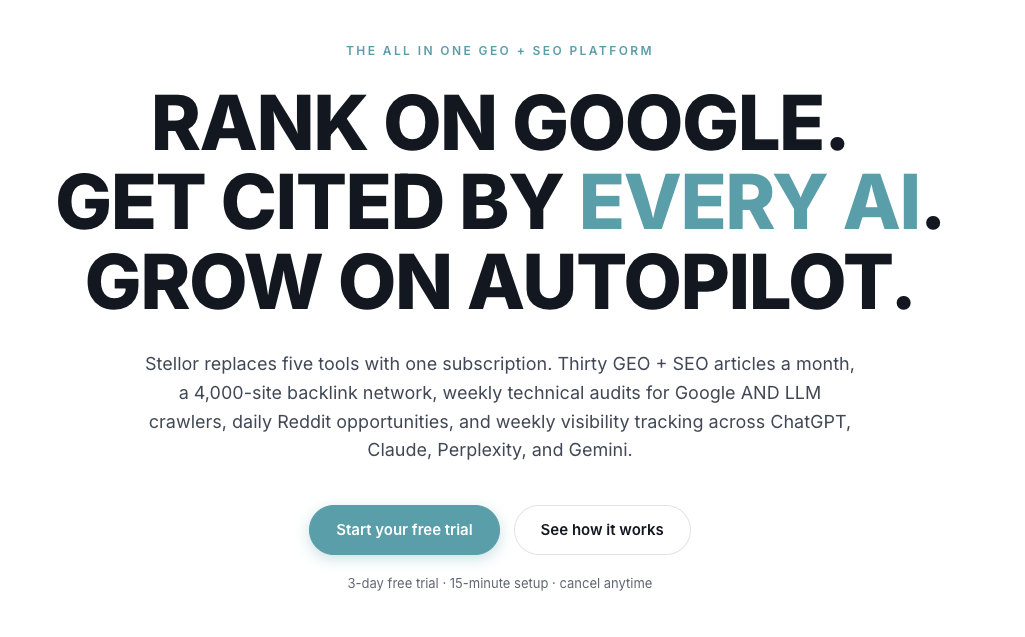
Trystellor consolidates all of it into one platform for $199 per month. The platform publishes 30 GEO and SEO-optimized articles monthly, runs weekly technical audits across eleven ranking checks, and tracks your citation rate inside ChatGPT, Claude, Perplexity, and Gemini every week. The Stellor product includes a 4,000-site backlink network, automated review monitoring, and a Reddit presence module that builds the independent mentions AI engines require. A free AI Visibility Audit, delivered within 48 hours of signup, shows exactly which prompts you are winning and which competitors are taking your citations. No credit card required for the three-day trial.
FAQ
What is the strongest local search ranking factor in 2026?
Google Business Profile completeness is the single strongest ranking signal for local search in 2026. A fully optimized GBP with complete categories, services, photos, and consistent NAP data directly determines your local map pack position.
How many reviews does a local business need to rank well?
Targeting 50 or more Google reviews in your first year, with a 4.5-star average and consistent monthly additions, gives your business the review volume and velocity needed to compete in most local markets.
Why does NAP consistency matter for local rankings?
Inconsistent NAP formatting across directories sends conflicting signals to Google, which suppresses local rankings. Standardizing your business name, address, and phone number in an identical format across every listing resolves this.
How do AI engines like ChatGPT rank local businesses?
AI engines recognize businesses based on independent brand mentions across the web. Businesses with fewer than 50 independent citations are not reliably named by ChatGPT, Perplexity, Claude, or Gemini when buyers ask for local recommendations.
What local SEO metrics should I track in 2026?
Track Local Pack position by zip code using tools like BrightLocal, GBP behavior metrics including calls and direction requests, and AI citation rate per engine. Website traffic alone does not capture where local buying decisions are made.