TL;DR:
- Google reviews are a critical and direct factor in local SEO, influencing 20% of map pack rankings and strengthening your business’s prominence. A steady, recent flow of high-quality reviews improves visibility, boosts customer trust, and enhances your reputation, making ongoing review collection essential. It is important to follow Google’s policies by requesting honest reviews ethically, responding promptly, and integrating reviews into your overall marketing strategy.
Google reviews are a direct ranking signal that determines whether your business appears in the local map pack, Google Maps, and localized organic results. The role of Google reviews in local SEO is not indirect or peripheral. Review quantity, quality, and recency feed Google’s prominence signal, one of the three core factors in the local ranking algorithm alongside relevance and distance. For any local business competing for visibility in 2026, your Google Business Profile review strategy is as important as your website content.
How do Google reviews affect local SEO rankings?
Review signals account for about 20% of Local Pack ranking factors and roughly 6% of localized organic results, according to Whitespark’s industry surveys. That means nearly one in five ranking decisions in the map pack traces back to your review profile. No other single off-page signal carries that weight at the local level.

Google’s local ranking algorithm evaluates three factors: relevance (does your business match the query?), distance (how close are you to the searcher?), and prominence (how well-known and trusted is your business?). Reviews feed directly into prominence. More reviews and higher ratings strengthen that prominence signal, pushing your listing higher in Google Maps and local search results. A plumbing company with 200 reviews averaging 4.7 stars will consistently outrank a competitor with 30 reviews at 4.2 stars, even if the second business has a better website.
The table below shows how review-related factors contribute to local ranking weight, based on industry research:
| Review factor | Estimated ranking influence |
|---|---|
| Review quantity (total count) | High. More reviews signal active, trusted business. |
| Average star rating | High. Ratings below 4.0 reduce click-through and ranking. |
| Review recency | Medium-high. Fresh reviews signal an active, current business. |
| Review response rate | Medium. Responses reinforce relevance and engagement signals. |
| Keyword presence in reviews | Medium. Natural mentions of services and locations add context. |
The practical implication is clear: a business with a steady stream of recent, high-quality reviews will outperform a competitor with a stagnant profile, even if that competitor has more total reviews accumulated years ago.
Pro Tip: When responding to reviews, mention your service type and city naturally. “Thanks for trusting us with your HVAC repair in Denver” reinforces your local relevance to Google without keyword stuffing.

Why are recent and consistent Google reviews critical for local SEO?
74% of consumers care about reviews from the last three months. That statistic reflects both consumer psychology and Google’s ranking behavior. A review from 2022 carries far less weight than one posted last week, because recency signals that your business is still active, still serving customers, and still earning trust.
Google does not reward sudden spikes in review volume. A business that collects 50 reviews in a week after a promotional push, then goes quiet for six months, will see diminishing returns. The algorithm favors what practitioners call review velocity: a consistent, predictable flow of new reviews over time. Think of it as the difference between a restaurant that’s always busy versus one that only fills up during a special event. Google reads steady activity as a sign of a healthy, operating business.
Here is what a sustainable review strategy looks like in practice:
- Ask every customer at the point of service completion, not days later when the experience has faded.
- Use multiple channels: follow-up SMS, email, and in-person NFC tap cards or QR codes at your counter or on receipts.
- Set a realistic monthly target. For a service business completing 40 jobs per month, even a 15% conversion rate produces 6 new reviews every month, which compounds quickly.
- Assign review follow-up to a specific team member or automate it through your CRM so it never falls through the cracks.
- Track your review velocity monthly and compare it against your local map pack rankings to spot correlations.
Viewing review generation as a one-time push rather than ongoing engagement is one of the most common mistakes local businesses make. The businesses that dominate local search in competitive markets treat reviews the same way they treat payroll: it happens every month, without exception.
Pro Tip: Build your review request into your service completion workflow. A technician who says “We’d really appreciate a Google review before you go” at job completion converts at a higher rate than any automated email sent 48 hours later.
How do Google reviews influence customer trust and business reputation?
54% of consumers trust online reviews more than personal recommendations or brand claims. That figure reframes how you should think about your review profile. It is not just a ranking tool. It is your most persuasive sales asset, and it works around the clock without any additional effort from you.
Higher star ratings produce measurable behavior changes. Businesses with ratings above 4.5 stars see higher click-through rates from search results, more calls from Google Maps, and stronger conversion rates on their websites. A rating below 4.0 functions as a filter that removes your business from consideration before a potential customer ever visits your site. The impact of reviews on SEO and on revenue are inseparable at this level.
The reputation benefits extend well beyond search rankings:
- Embed reviews on your website. Displaying Google reviews on your homepage or service pages adds social proof at the exact moment a visitor is deciding whether to contact you.
- Use review language in your marketing copy. If customers repeatedly describe your team as “on time” and “professional,” those phrases belong in your ad copy and service descriptions.
- Respond to every review, including negative ones. Responding to reviews with natural, keyword-rich language reinforces your service offerings and local relevance to both Google and prospective customers reading the exchange.
- Treat negative reviews as public trust signals. A professional, solution-focused response to a 1-star review often converts skeptical readers more effectively than five 5-star reviews with no owner response.
The businesses that treat their Google Business Profile as a living reputation asset, not a set-it-and-forget-it directory listing, consistently outperform competitors in both rankings and conversion. For a deeper look at how your full local presence stacks up, the local SEO audit checklist from Stellor covers reviews alongside every other ranking factor worth tracking.
What are Google’s policies on reviews and how to solicit them ethically?
Google strictly prohibits offering incentives in exchange for reviews. No discounts, gift cards, free services, or any other form of compensation. This rule applies whether you are offering the incentive before or after the review is written. Violating it puts your entire Google Business Profile at risk, including suspension and ranking penalties that can take months to recover from.
The ethical and compliant path to more reviews is also the most effective one. Here is a step-by-step process that works:
- Ask every eligible customer. Apply your review request process uniformly to all customers, not just the ones you think had a great experience. Filtering by sentiment, known as review gating, violates Google’s policies and produces an artificially skewed profile that Google can detect.
- Make the ask personal and specific. “Would you mind leaving us a Google review? It really helps our small business” outperforms generic automated messages because it feels human.
- Remove friction from the process. Generate a direct Google review link from your Google Business Profile dashboard and share it via SMS, email, or a QR code. The fewer taps between the ask and the review form, the higher your conversion rate.
- Time your request correctly. Ask at the moment of peak satisfaction, which is typically right after a successful service delivery, not days later.
- Respond to every review within 48 hours. Timely responses signal to Google that your profile is actively managed, and they demonstrate professionalism to every future customer who reads them.
Review-request workflows must be auditable and compliant, with standardized processes applied evenly to all eligible customers without filtering by sentiment. Documenting your process also protects you if Google ever flags your profile for review pattern anomalies.
Fake, incentivized, or gated reviews risk policy violations and can lead to profile suspensions or ranking penalties. Compliant, consistent review collection is not just safer. It produces a more authentic review profile that converts better and ranks more durably.
Pro Tip: Create a laminated card or NFC tap point at your front desk or on your service vehicle with a QR code linking directly to your Google review form. Physical prompts at the point of service consistently outperform digital follow-ups sent hours later.
Businesses that combine steady review collection with an optimized Google Business Profile see better local visibility than those relying on either signal alone. Reviews amplify every other local SEO signal you are already building. For more on how Google rankings connect to local business growth, the guide on prioritizing Google rankings explains the full picture.
Key takeaways
Google reviews are a measurable, manageable ranking factor that directly controls your visibility in the local map pack and Google Maps, making consistent review collection a non-negotiable part of any local SEO strategy.
| Point | Details |
|---|---|
| Reviews drive 20% of Local Pack rankings | Review quantity, quality, and recency together account for roughly one-fifth of map pack ranking decisions. |
| Recency matters as much as volume | 74% of consumers trust only recent reviews, and Google’s algorithm weights fresh activity over accumulated totals. |
| Incentivized reviews carry serious risk | Google prohibits compensation for reviews; violations can result in profile suspension and lasting ranking penalties. |
| Consistent velocity beats one-time pushes | A steady monthly flow of new reviews outperforms periodic spikes in both ranking impact and consumer trust. |
| Responses reinforce local relevance | Replying to every review with natural service and location language strengthens your prominence signal with Google. |
What I’ve learned from watching review strategies succeed and fail
I have seen local businesses with excellent service and well-built websites consistently lose map pack positions to competitors with weaker sites but stronger review profiles. That gap is almost always explained by one thing: the winning business treats review collection as a system, not an afterthought.
The businesses that struggle tend to make the same two mistakes. First, they ask for reviews inconsistently, usually after a particularly good job, which means their review velocity is erratic and their profile looks dormant to Google between bursts. Second, they focus entirely on getting reviews and never respond to them. A profile with 150 reviews and zero owner responses reads as neglected, both to Google and to the potential customer comparing you against a competitor who responds to every single one.
What I find genuinely interesting about 2026 is the AI dimension. AI tools increasingly use Google reviews as sources for local business recommendations. When someone asks ChatGPT or Perplexity for the best electrician in their city, those systems pull from review data to form their answer. Your review profile is no longer just a Google ranking signal. It is training data for the AI recommendations that are quickly becoming the first stop for buyers. A business with 200 detailed, recent reviews describing specific services is far more likely to be cited by an AI than one with 20 generic five-star ratings.
The practical advice I give every local business owner is this: build a review request into your service completion process today, respond to every review within 24 hours, and track your velocity monthly. That single habit, applied consistently, compounds faster than almost any other local SEO investment you can make.
— Cole
How Stellor helps you build a review-driven local SEO strategy
Managing Google reviews manually across dozens of customer touchpoints is time-consuming, and most local businesses do not have a dedicated marketing team to handle it.
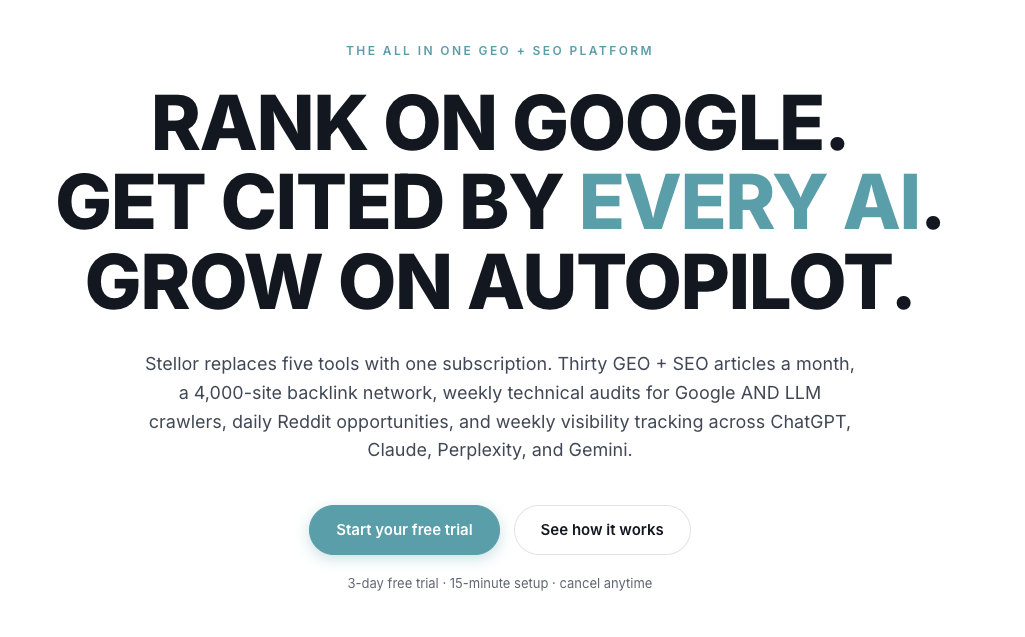
Stellor is built for exactly this situation. The platform monitors your Google Business Profile activity, surfaces review trends in your weekly audit reports, and integrates review signals into the broader local SEO picture alongside technical health, content, and backlinks. You get a clear view of how your review velocity compares to local competitors and where gaps are costing you map pack positions. Explore the full feature set on the Stellor product page and start a three-day free trial with no credit card required.
FAQ
How much do Google reviews affect local search rankings?
Review signals account for about 20% of Local Pack ranking factors and 6% of localized organic results. This makes reviews one of the highest-impact off-page signals available to local businesses.
Can I ask customers to leave Google reviews?
Yes. Google allows businesses to ask customers for honest reviews. What Google prohibits is offering incentives, filtering customers by sentiment, or posting fake reviews. Apply your request process to all customers equally.
How many Google reviews do I need to rank in the local map pack?
There is no fixed threshold. What matters is your review count and rating relative to competitors in your specific market. A business with 50 reviews at 4.8 stars can outrank one with 200 reviews at 3.9 stars in many categories.
Does responding to Google reviews help SEO?
Yes. Responding to reviews with natural, keyword-rich language reinforces your service offerings and local relevance to Google. It also signals that your profile is actively managed, which contributes to your prominence score.
How often should I be getting new Google reviews?
Aim for a consistent monthly flow rather than periodic spikes. Even four to six new reviews per month, collected steadily, will outperform a burst of 30 reviews followed by six months of silence in terms of both ranking impact and consumer trust.