TL;DR:
- E-E-A-T—comprising Experience, Expertise, Authority, and Trustworthiness—is a critical framework Google uses to evaluate content credibility and influence rankings. Trust is the most vital pillar, as lacking it can penalize even high-authority pages, especially on YMYL topics. Building genuine signals like first-hand evidence, verifiable credentials, and transparent site practices enhances both traditional and AI-driven visibility over time.
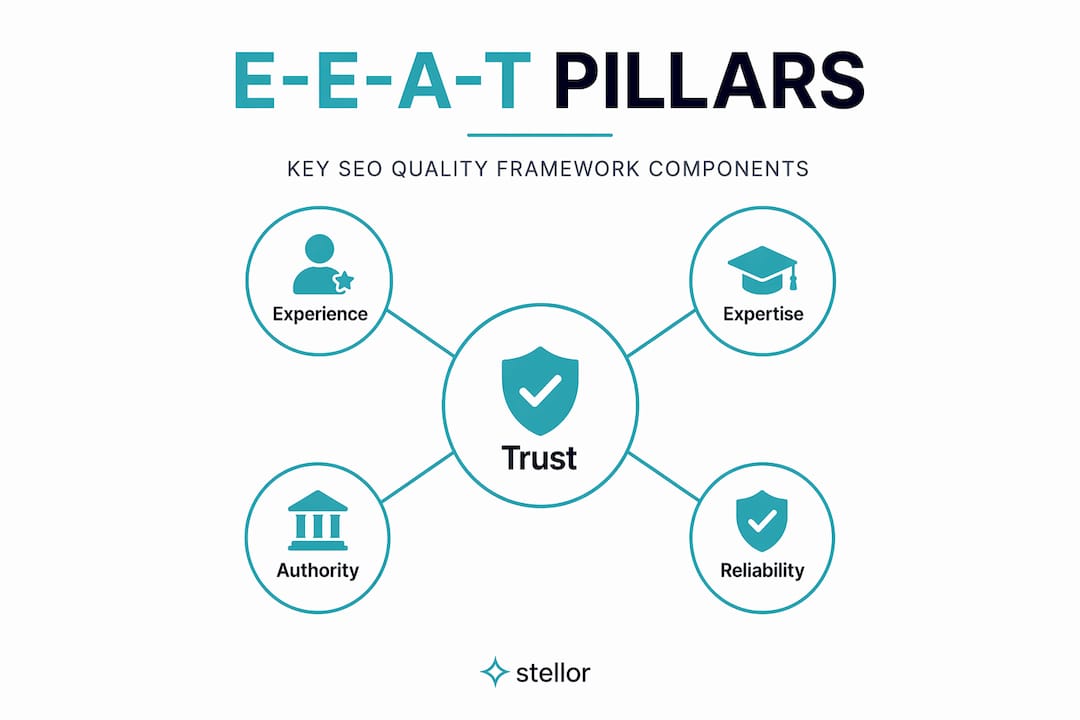
If you’ve spent time chasing Google’s quality signals, you’ve likely asked yourself what is E-E-A-T in SEO and whether it actually moves rankings. E-E-A-T stands for Experience, Expertise, Authoritativeness, and Trustworthiness. It is the quality evaluation framework Google uses to train its ranking algorithms and assess content credibility. It is not a score, not a plugin setting, and not a box you check once. Understanding E-E-A-T means understanding how Google decides which content deserves to be trusted, cited, and ranked. That understanding has become even more urgent now that AI Overviews and large language models are drawing on the same quality signals to decide which brands get mentioned when a buyer asks for a recommendation.
Table of Contents
- Key Takeaways
- The four pillars of E-E-A-T explained
- How E-E-A-T shapes AI search and traditional rankings
- Common E-E-A-T misconceptions that hurt your SEO
- Practical strategies to improve your E-E-A-T signals
- My take on E-E-A-T after years of watching it evolve
- How Stellor helps you build E-E-A-T that compounds
- FAQ
Key Takeaways
| Point | Details |
|---|---|
| E-E-A-T is a quality framework | It guides algorithm training through Search Quality Rater evaluations, not as a direct ranking score. |
| Trust is the most critical pillar | Pages that fail the trust test get penalized regardless of how strong their expertise signals are. |
| AI citations depend on E-E-A-T | Over half of AI Overview sources come from the top 10 traditional search results, so rankings and citations are linked. |
| Performative badges backfire | “Expert-reviewed” labels without real editorial processes are increasingly detected and downgraded. |
| First-hand evidence wins | Original research, case studies, and unique photos carry more weight than static author credentials alone. |
The four pillars of E-E-A-T explained
Google added the first “E” for Experience to its original E-A-T framework in December 2022. That addition was deliberate. It signals that Google now wants to see that content creators have actually done the thing they are writing about, not just read about it.
Experience
Experience is about demonstrated, first-hand involvement. A review of a hotel written by someone who stayed there carries more weight than one compiled from other reviews. A contractor explaining waterproofing from a job they completed carries more weight than an article assembled from manufacturer specs. Google’s Search Quality Raters look for concrete signals: original photos, specific observations, personal outcomes. First-hand evidence like original research and unique images impacts AI citations more than static author credentials alone.
Expertise
Expertise is your subject matter depth. For formal fields like medicine, law, and finance, credentials matter directly. For a cooking blog or a DIY home repair site, demonstrated knowledge through thorough, accurate content carries equal weight. The key is specificity. Generic overviews written to capture traffic rarely demonstrate expertise. Detailed breakdowns that anticipate real questions from real practitioners do.
Authoritativeness
Authority comes from outside your own site. Backlinks from recognized industry publications, citations in academic or news sources, mentions in expert communities, and a presence in Google’s Knowledge Graph all signal that others in your space recognize your credibility. You cannot manufacture authority by self-declaring it. It is earned through consistent publication and external recognition over time.

Trustworthiness
Trust is the most vital pillar. Google treats it as the foundation of the entire framework. A site can have strong expertise signals and a healthy backlink profile, but if it lacks HTTPS, hides contact information, uses deceptive ad layouts, or publishes inaccurate information, the trust deficit overrides everything else. Pages on YMYL topics (Your Money, Your Life, covering health, finance, and legal matters) face the sharpest trust scrutiny.
- Write detailed author bios with verifiable credentials and real professional history
- Display clear contact information, physical address (where applicable), and privacy policies
- Keep HTTPS active and your site technically clean
- Use schema markup to explicitly declare authorship, organization, and content type
Pro Tip: For YMYL content in particular, have a licensed professional review and sign off on articles before publishing. A single sentence in the author bio that says “reviewed by [Name], licensed [profession]” carries more trust weight than an entire page of generic disclaimers.
How E-E-A-T shapes AI search and traditional rankings
Understanding E-E-A-T in SEO now means understanding two search ecosystems at once. The traditional Google results page is still where most clicks happen, but AI Overviews, ChatGPT, Perplexity, and Gemini are increasingly where buyers form their first impressions of a brand.
The relationship between the two is tighter than most marketers realize. Over 52% of AI Overview sources come from the top 10 traditional search results. That means your E-E-A-T-driven efforts to rank on Google directly improve your probability of being cited by AI engines. The two are not separate strategies. They are the same strategy executed well.
“Content with verified experience and expertise is favored for AI citations.” — Search Engine Journal
AI Overviews rely on E-E-A-T-backed authority to decide what to quote. That means content that scores high on the quality signals Search Quality Raters use is precisely the content LLMs pull from when generating answers.
| Scenario | Traditional SEO outcome | AI citation outcome |
|---|---|---|
| Expert author, original research, HTTPS | Strong rankings on page 1 | High AI citation probability |
| Anonymous content, no credentials | Lower ranking potential | 40% lower AI citation rate |
| Thin content with “expert badge” | Ranking risk after core updates | Rarely cited by AI engines |
| Strong backlinks, accurate Knowledge Graph | Authority signals amplified | Increased AI mention frequency |
The E-E-A-T guidelines for SEO also inform how well your content holds rankings through algorithm updates. Sites with genuine editorial depth and real author credentials tend to recover from core updates faster than sites built primarily on volume and keyword density.
Common E-E-A-T misconceptions that hurt your SEO
This is where a lot of SEO professionals lose ground. They understand E-E-A-T conceptually but misapply it in ways that can actually create more problems than they solve.
-
E-E-A-T is not a direct ranking factor or a score. E-E-A-T is a quality evaluation framework used by Search Quality Raters to provide feedback that trains Google’s algorithms. There is no E-E-A-T metric in your analytics dashboard. Treating it like a checkbox to optimize misses the point entirely.
-
“Expert-reviewed” badges without real processes backfire. Slapping a reviewer’s name on content that was never actually reviewed is a practice search engines are increasingly good at detecting. Performative expert badges without genuine editorial oversight are downgraded, not rewarded. The badge is only as good as the process behind it.
-
Content volume without editorial oversight creates risk. Publishing high volumes of content that lacks real first-hand insights or genuine editorial depth is what practitioners call “content industrialization.” Content produced without genuine oversight risks a downgrade even when it technically claims expertise. Volume accelerates authority when it is backed by quality. Without quality, it compounds the problem.
-
Author boxes alone do not establish expertise. An author bio with a headshot and a title is a start, not a finish. What matters is whether that author’s credentials are verifiable externally, whether they publish under their name in other trusted venues, and whether the content itself reflects genuine subject matter depth.
-
E-E-A-T is not a one-time fix. Brand credibility and topical authority compound over months and years. Treating E-E-A-T as a quarterly campaign rather than an ongoing editorial standard is one of the most common mistakes in practice.
Pro Tip: When auditing a client’s site for E-E-A-T signals, look for the gap between claimed expertise (what their author bios say) and demonstrated expertise (what their content actually proves). That gap is where most of the SEO risk lives.
Practical strategies to improve your E-E-A-T signals
The importance of E-E-A-T becomes most tangible when you translate it into specific, repeatable practices. Here is how to build each pillar deliberately.
Building experience signals
Publish content that only someone with direct involvement could write. That means original case studies with real numbers, product reviews based on actual testing, and step-by-step guides that reflect hands-on practice. Include original photos, screenshots of real tools, and outcomes from real work. These are the signals that matter most for AI-driven visibility.
Building expertise and authority signals
- Use detailed author bios that link to verifiable external profiles (LinkedIn, professional association pages, published work elsewhere)
- Earn mentions and links from recognized publications in your category. A single citation in a respected industry outlet carries more authority weight than 50 links from low-relevance directories
- Publish original research, surveys, or proprietary data your audience cannot find elsewhere
- Build topical depth by covering every meaningful question in your category, not just the high-traffic ones
Building trust signals
- Keep your HTTPS certificate active and your site technically clean. Check your SEO audit checklist regularly
- Display transparent contact information, clear author credentials, and accessible privacy and editorial policies
- Claim and verify your brand in Google’s Knowledge Graph. Brands without accurate Knowledge Graph data struggle to appear in AI-generated answers even when their content quality is high
- Monitor AI-generated mentions of your brand for accuracy. Inaccurate AI summaries of your business are a trust signal problem as much as a reputation problem
| Strategy | Primary pillar strengthened | Time to see impact |
|---|---|---|
| Detailed author bios with external links | Expertise | 1 to 3 months |
| Original research and case studies | Experience, Expertise | 2 to 6 months |
| Earned backlinks from industry publications | Authoritativeness | 3 to 6 months |
| HTTPS, contact info, editorial policies | Trustworthiness | Immediate to 1 month |
| Knowledge Graph verification | Trustworthiness, Authority | 1 to 3 months |
For local and professional service businesses in particular, consistent content that demonstrates practical expertise and local credibility is the most direct path to improving E-E-A-T. The GEO + SEO approach for professional services accounts for both the traditional quality signals and the AI visibility factors that increasingly determine which businesses get recommended.
My take on E-E-A-T after years of watching it evolve
I’ve worked with enough sites to know that the biggest E-E-A-T mistakes are not technical. They are philosophical. Most teams that struggle with E-E-A-T are trying to perform credibility rather than build it.
I’ve seen clients add author bios with impressive titles, get the “expert-reviewed” badge designed, and then wonder why their traffic dropped in the next core update. The problem is always the same: the signals were cosmetic. The content underneath did not reflect genuine expertise. Search engines, and increasingly AI engines, are getting better at detecting the difference between a brand that knows its subject and one that is assembling content from secondary sources.
What actually works, in my experience, is committing to content that demonstrates real practice. That might mean publishing a case study from a client project with actual before-and-after data. It might mean getting a licensed professional to write a section of a health article rather than just review it afterward. It might mean commissioning an original survey and citing your own findings rather than regurgitating industry reports everyone else is linking to.
The future of E-E-A-T is moving in one clear direction. As AI systems get better at reading the open web and deciding what to quote, the brands that have built real editorial depth will compound their advantage. The brands that built surface-level signals will find that the tactics that worked for blue-link SEO have a shrinking return. First-hand experience signals, verifiable credentials, and transparent brand presence are not just SEO best practices. They are the table stakes for being cited by every AI engine your buyers are using right now.
— Cole
How Stellor helps you build E-E-A-T that compounds
Understanding the importance of E-E-A-T is one thing. Executing it consistently across dozens of pages every month is another problem entirely.
Stellor is a GEO + SEO platform built for exactly this. Every month, Stellor publishes 30 fully optimized articles to your CMS, each one engineered around real buyer queries and configured with the schema markup, authorship signals, and internal linking structure that Google and AI crawlers use to evaluate content credibility. Stellor’s 4,000-site backlink network builds the authority signals that underpin your E-E-A-T profile over time. Weekly technical audits surface trust signal gaps before they cost you rankings. And the LLM visibility tracker reports back which AI engines are citing your brand, so you know whether your E-E-A-T investments are translating into AI citations. Explore the full Stellor product and start a three-day free trial with no credit card required.
FAQ
What is E-E-A-T in SEO?
E-E-A-T stands for Experience, Expertise, Authoritativeness, and Trustworthiness. It is the quality evaluation framework Google uses through Search Quality Raters to assess content and inform ranking algorithm training.
Is E-E-A-T a direct Google ranking factor?
No. E-E-A-T is not a direct ranking factor or a measurable score. It is a framework that shapes how Google trains its algorithms, which in turn influences which content ranks well.
Why is E-A-T important for AI search?
AI Overview citations pull heavily from top-ranking traditional search results, and AI engines favor content with verified expertise and experience signals. Strong E-E-A-T directly increases the probability of being cited in AI-generated answers.
How do I improve E-E-A-T for my site?
Publish content with verifiable author credentials, include original research and first-hand case studies, earn backlinks from respected industry sources, maintain HTTPS and transparent editorial policies, and verify your brand in Google’s Knowledge Graph.
What is the most important pillar of E-E-A-T?
Trust is the foundational pillar. Google’s guidelines make clear that an untrustworthy page will not benefit from strong expertise or authority signals. Trust failures override every other positive quality signal on a page.