TL;DR:
- Program page SEO involves optimizing individual URLs with in-depth content, technical enhancements, and strategic structure to rank better and convert visitors. It differs from programmatic SEO, which automates large-scale page creation using templates, but both rely on core SEO principles. Regular audits, keyword research, and content updates are essential for maintaining and improving program page rankings.
Most website owners treat their program pages the same way they treat blog posts. They drop in a few keywords, write a short description, and call it done. That approach leaves real search traffic on the table. What is program page SEO optimization, exactly? It is the focused process of applying on-page SEO techniques to specific program URLs — think degree pages, certification pages, bootcamp landing pages, or service program pages — so they rank for the right queries and convert the visitors who land on them. This guide breaks down every layer of that process, from definitions to technical tactics to a step-by-step implementation plan.
Table of Contents
- Key Takeaways
- What is program page SEO optimization, defined
- Core SEO best practices for program pages
- Technical and content structure considerations
- Program page SEO vs. programmatic SEO
- Practical steps to implement program page SEO
- My honest take on program page SEO
- How Stellor helps you scale program page SEO
- FAQ
Key Takeaways
| Point | Details |
|---|---|
| Program pages need focused SEO | Each program URL requires unique, intent-matched content rather than generic keyword placement. |
| Content depth drives rankings | Targeting 750 to 1,000 words per page with structured sections outperforms thin, keyword-stuffed alternatives. |
| Technical SEO is non-negotiable | Schema markup, clean URLs, fast load times, and mobile-first design all affect how Google ranks program pages. |
| Program SEO differs from programmatic SEO | Program page SEO optimizes individual pages with depth; programmatic SEO generates many pages at scale using templates. |
| Regular audits protect rankings | Monitoring performance with Google Search Console and refreshing meta elements keeps program pages competitive over time. |
What is program page SEO optimization, defined
Program page SEO optimization is on-page SEO work applied specifically to individual program URLs. A program page could be a graduate degree page at a university, a cybersecurity certification page at a training company, or a home renovation service page at a local contractor. The defining characteristic is that the page exists to explain a specific offering and convert a specific type of visitor.
This is not the same as programmatic SEO, and the confusion between the two trips up a lot of marketers. Programmatic SEO is a template-driven approach that auto-generates hundreds or thousands of pages targeting long-tail keyword variations. Program page SEO, by contrast, focuses on a single page or a small set of pages, each built with deep, original content tailored to the intent behind that specific program.
It is also distinct from general on-page SEO in its scope and purpose. General on-page SEO is a broad discipline covering title tags, meta descriptions, headings, URLs, internal links, and images across an entire website. Program page SEO applies all of those same elements but filters every decision through one question: does this serve the person researching this specific program?
Here is what program page SEO optimization typically includes:
- Title tags written around the primary keyword a prospective student, client, or buyer would search
- Meta descriptions that match the click intent and stay under 160 characters
- Heading structure (H1, H2, H3) that organizes the page content logically
- URL slugs that are clean, descriptive, and keyword-relevant
- Content depth that answers every real question the audience has about the program
- Internal links connecting the program page to related pages on the site
- Image optimization with descriptive file names and alt text
The goal is a page that both Google and a real human can read, understand, and trust.
Core SEO best practices for program pages
Getting a program page to rank starts with the fundamentals, but the fundamentals applied with precision.
Title tags and meta descriptions are the first things a searcher sees before clicking. Your title tag should include the primary keyword naturally and stay under 60 characters. Your meta description should reflect what the page delivers and give the reader a clear reason to click. Long-tail keywords matched to audience intent outperform broad terms because they attract visitors who are closer to a decision.
Header structure is the skeleton of your page. Use one H1 that states clearly what the program is. Use H2s to break the page into major sections like curriculum, admissions, costs, career outcomes, and FAQs. Use H3s for subsections within those. This hierarchy helps Google understand what the page is about and helps readers scan quickly to find what matters to them.
URL structure matters more than most people realize. A URL like "/programs/digital-marketing-certificationtells both Google and the visitor exactly what they are getting. A URL like/page?id=4892` tells them nothing. Keep slugs short, descriptive, and keyword-relevant.
Content depth is where most program pages fall short. Comprehensive program pages that address curriculum, admissions, costs, career outcomes, and FAQs lower bounce rates and increase the page’s chance of ranking as the definitive answer for related queries. Covering those sections thoroughly also satisfies the buyer journey, which means visitors stay longer and convert at higher rates.

Multimedia elements add another layer of trust and uniqueness. Testimonials from past students or clients, short video walkthroughs, and instructor quotes all make the page harder to replicate and more engaging for real visitors.
Pro Tip: Write your program page content as if you are answering questions from someone sitting across the table from you. If a prospective student would ask “How long does this program take?” or “What jobs can I get after this?” those questions belong on the page as actual headings.
Technical and content structure considerations
Strong content alone will not carry a program page to the top of search results. The technical foundation underneath the content matters just as much.
Image optimization is one of the most commonly skipped steps. Every image on a program page should have a descriptive file name (not IMG_0042.jpg) and an alt text attribute that describes what the image shows. This helps search engines index the image correctly and improves accessibility for screen readers.
Internal linking does two jobs at once. It guides crawlers through your site architecture, distributing authority from stronger pages to newer or lower-authority program pages. It also helps visitors find related content, which keeps them on your site longer. A good rule of thumb: link each program page to at least two or three related pages, such as a category page, a blog post on a relevant topic, or a contact page.
Schema markup is the structured data layer that makes your page eligible for rich results in Google. For program pages, relevant schema types include Course, FAQPage, and LocalBusiness. Adding FAQ schema to your program page, for example, can get your questions and answers displayed directly in search results, which increases click-through rates without requiring a higher ranking position.
Mobile-first design and page speed are ranking factors, not optional extras. Technical SEO basics like fast load times, mobile responsiveness, clean URL structure, and proper sitemap configuration are the foundation that everything else rests on. If your program page takes four seconds to load on a phone, you are losing visitors before they read a single word.
Pro Tip: Run your program pages through Google’s PageSpeed Insights tool once a month. The report gives you a specific list of fixes ranked by impact, so you know exactly where to focus your effort rather than guessing.
Balancing content depth with readability is the final piece. A page that is 2,000 words of dense paragraphs will drive visitors away just as fast as a page with 200 words of thin content. Use short paragraphs, clear subheadings, and bullet points to make the page scannable. Depth and readability are not opposites. They work together.
Program page SEO vs. programmatic SEO
These two strategies are often confused, but they serve very different purposes. Here is a direct comparison:
| Factor | Program page SEO | Programmatic SEO |
|---|---|---|
| Scale | One page or a small set of pages | Hundreds or thousands of pages |
| Content approach | Deep, hand-crafted, unique per page | Template-driven with variable data |
| Primary goal | Rank and convert for a specific program | Capture long-tail keyword volume at scale |
| Risk | Low, if content is thorough | Higher risk of thin or duplicate content penalties |
| Best for | Specific offerings with real conversion intent | Broad directories, location pages, comparison tools |
| Content cost | Higher per page | Lower per page |
Programmatic SEO at scale requires substantial unique content per page to avoid thin content penalties. When done poorly, it creates hundreds of pages that say almost the same thing, which Google deprioritizes or ignores entirely.
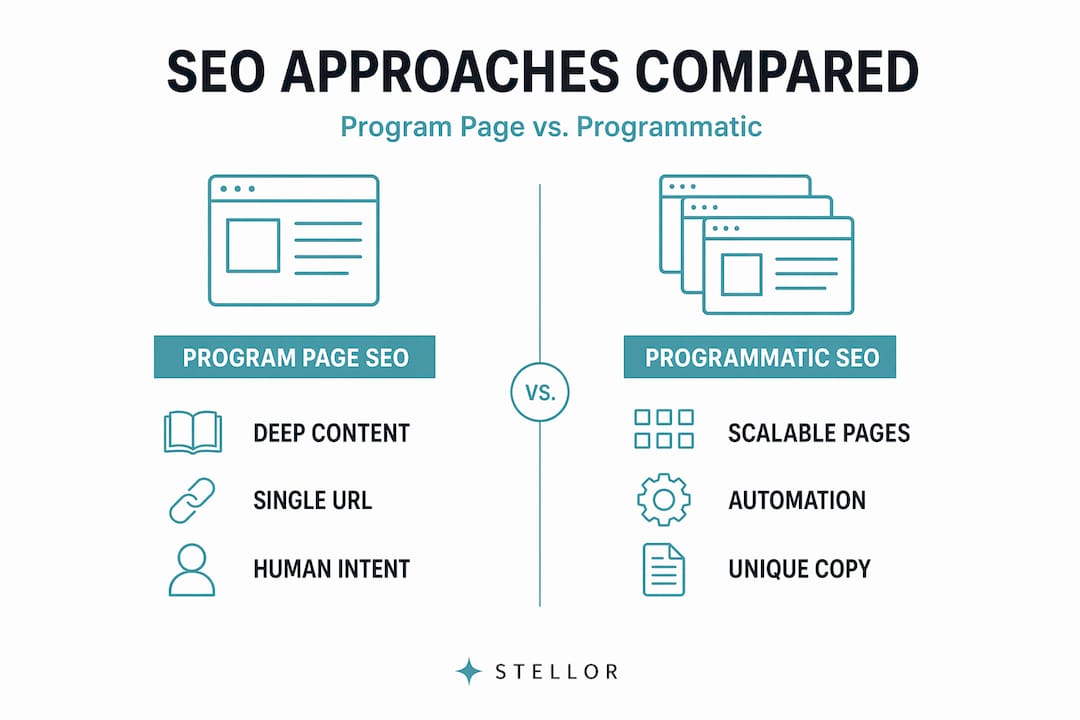
Program page SEO wins when you have a specific offering with real conversion intent behind it. If someone searches “full-stack web development bootcamp Chicago,” they want a specific answer. A deeply optimized program page built around that query will outperform a templated page every time. Both strategies share core SEO principles but differ in scale and content production method. Knowing which one fits your situation prevents wasted effort.
Practical steps to implement program page SEO
Follow this sequence to move from audit to optimized page:
-
Run a keyword research session focused on program-specific intent. Use tools like SEMrush, Ahrefs, or Google Keyword Planner to find the exact phrases your audience uses when searching for this type of program. Look for long-tail terms with clear intent, not just high-volume head terms.
-
Audit your existing program pages before writing a single new word. Check title tags, meta descriptions, heading structure, URL slugs, page speed, and internal links. An SEO audit checklist adapted for program pages will surface the highest-impact fixes quickly.
-
Rewrite or expand content to hit the depth your audience needs. Quality and relevance to the audience’s questions and intent are the key ranking factors, not just keyword and metadata tweaks. Cover curriculum, outcomes, costs, admissions, and FAQs in dedicated sections.
-
Add user-generated content where possible. Student testimonials, client reviews, and instructor quotes add unique value that Google cannot find on a competing page. They also build trust with real visitors.
-
Apply schema markup to the page. At minimum, add FAQPage schema if the page has a FAQ section. Add Course or LocalBusiness schema where applicable.
-
Set up tracking in Google Search Console and connect it to your analytics platform. Monitor impressions, clicks, average position, and click-through rate for each program page. Watch for drops that signal a need to refresh content or fix a technical issue.
-
Update the page on a regular schedule. Refresh meta descriptions when click-through rates drop. Update program details when offerings change. Add new testimonials quarterly. Keeping content current signals to Google that the page is actively maintained.
My honest take on program page SEO
I have reviewed dozens of program pages for clients across education, professional services, and local trades. The pattern I see most often is the same every time: the page ranks on page two or three, the owner blames the algorithm, and the real problem is that the page only answers half the questions a visitor actually has.
The mistake is treating SEO as a metadata exercise. You update the title tag, adjust the meta description, and wait. But search-engine readability and buyer-journey completeness are two separate requirements, and you need both. A page that Google can read but a human cannot trust will never convert. A page that converts beautifully but has no keyword structure will never get traffic.
What I have found actually works is building the page for the person first and then checking it against SEO requirements. Write the curriculum section because a prospective student genuinely needs to know what they will learn. Write the cost section because hiding pricing creates friction. Write the FAQ section because those are the questions people ask before they decide. Then go back and confirm your keyword appears in the H1, the title tag, and the first paragraph. That order produces better pages than starting with a keyword list.
The other thing I would push back on is the idea that AI and structured data are future concerns. In 2026, they are present concerns. AI answer engines pull from well-structured, authoritative pages. If your program page has clean schema, clear headings, and thorough content, it has a real chance of being cited in an AI-generated answer. That is traffic that does not show up in your organic click data but absolutely affects your pipeline.
— Cole
How Stellor helps you scale program page SEO
If you are managing multiple program pages or trying to build topical authority across a full site, doing this manually across every page is a real time commitment.
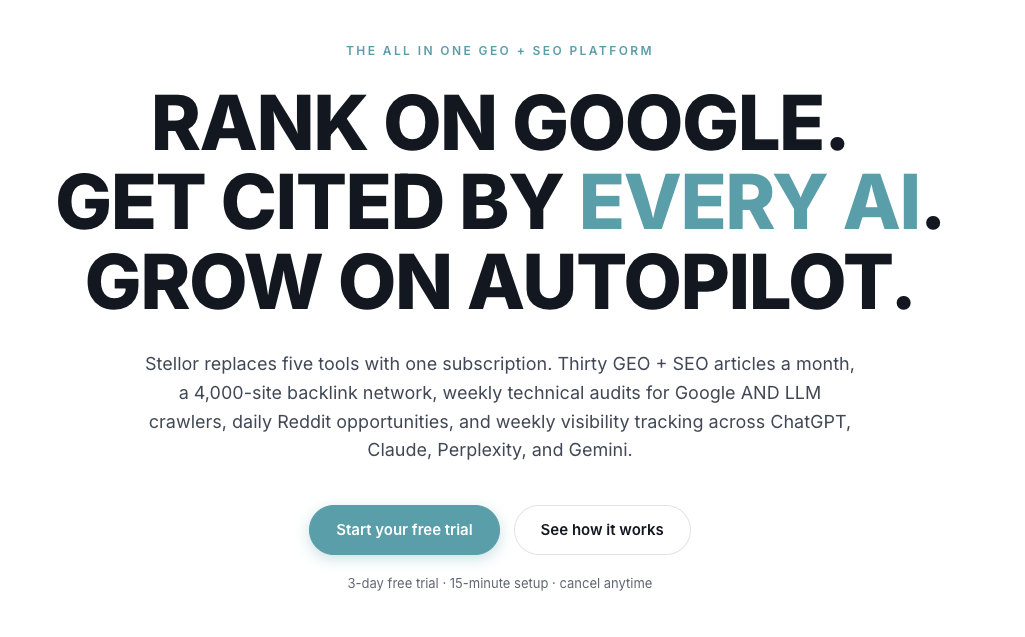
Trystellor consolidates content production, technical SEO audits, backlink building, and AI visibility tracking into one platform at $199 per month. Instead of juggling five separate tools, you get 30 SEO-optimized articles per month published directly to your CMS, weekly technical audits with one-click fixes, and weekly reports showing exactly where your pages appear across ChatGPT, Claude, Perplexity, and Gemini. The platform’s full feature set is built to handle the depth and consistency that program page SEO demands. Start with a three-day free trial, no credit card required.
FAQ
What is program page SEO optimization?
Program page SEO optimization is the process of applying on-page SEO techniques to specific program URLs, such as degree, certification, or service pages, to improve their search rankings and convert targeted visitors. It includes optimizing title tags, content depth, URL structure, schema markup, and internal linking.
How is program page SEO different from programmatic SEO?
Program page SEO focuses on deeply optimizing individual pages with unique, intent-specific content. Programmatic SEO auto-generates large numbers of pages using templates to capture long-tail keyword volume at scale. The two share core SEO principles but differ significantly in scale and content approach.
How long should a program page be for SEO?
A content depth target of roughly 750 to 1,000 words works well for most program pages, provided the content answers the real questions your audience has. Focus on completeness over arbitrary word counts.
What technical elements matter most for program page SEO?
Clean URL slugs, mobile-first design, fast load times, schema markup, and proper internal linking are the technical foundations that support program page rankings. Sitemaps and structured data also help search engines and AI crawlers index and understand the page correctly.
How do I track whether my program page SEO is working?
Use Google Search Console to monitor impressions, average position, and click-through rate for each program page. Track on-site engagement metrics like time on page and bounce rate in your analytics platform to assess whether the content is satisfying visitor intent.