TL;DR:
- SEO stack consolidation involves auditing and streamlining SEO tools into a connected system to cut costs and improve workflow efficiency. It requires a phased approach of inventory, stakeholder interviews, data dependency mapping, parallel testing, and governance to prevent fragmentation and maintain performance. Integrating AI and adopting a structured strategy enables faster, more reliable SEO decisions and operational savings.
SEO stack consolidation is defined as the process of auditing your existing SEO tools, eliminating overlapping subscriptions, and integrating the remaining systems into a connected pipeline that shares data and reduces manual work. Most marketing teams run five or more disconnected tools simultaneously, including Google Search Console, Ahrefs, Semrush, Screaming Frog, and separate content platforms, each producing siloed reports that require manual stitching. Consolidating that stack cuts recurring costs, reduces context switching, and produces faster, more reliable SEO decisions.
The industry term for this practice is “tool rationalization,” though SEO stack consolidation has become the working phrase used by marketing operations teams and SEO directors. Both terms describe the same outcome: fewer tools, tighter integration, and a workflow where data flows automatically from audit to action.
What is SEO stack consolidation and how does it work?
SEO stack consolidation is rationalizing a fragmented set of SEO tools into fewer connected systems to reduce overlapping costs and improve workflow efficiency. The process follows a repeatable audit sequence that most teams can complete in four to six weeks.
Here is how a structured consolidation works in practice:
-
Inventory every subscription. List every SEO tool your team pays for, who uses it, how often, and what specific function it serves. Include tools used by freelancers or agencies on your behalf. Most teams discover two or three tools performing identical functions, such as rank tracking in both Ahrefs and Semrush simultaneously.
-
Conduct stakeholder interviews. Talk to the people who actually use each tool daily. A tool that appears redundant on a spreadsheet may be the only system a technical SEO specialist trusts for log file analysis. Skipping this step causes consolidations to fail when key workflows break post-migration.
-
Map data dependencies. Identify which tools feed data into other tools or into dashboards like Google Looker Studio. These integration points determine your migration sequence. Break a dependency without a replacement and you lose reporting continuity.
-
Run parallel tests for 30 to 60 days. Before sunsetting any tool, run parallel data checks using the same inputs and KPIs across both the old and replacement systems. This validates that the new tool produces matching outputs and prevents subtle reporting drift that can corrupt decision-making for months.
-
Sunset redundant tools and document the new stack. Once data parity is confirmed, cancel the redundant subscriptions and publish an approved tools list for your team.
Pro Tip: Never run a big-bang switch where you cancel five tools on the same day. Migrate one function at a time, confirm stability, then move to the next. This approach keeps your reporting intact and gives your team time to adapt.
What are the benefits of SEO consolidation for businesses?
The financial case for SEO tool consolidation is concrete. A 9-month case study showed a 45% reduction in recurring SEO tool spend while maintaining content output and improving time-to-publish by 18%. Monthly tool costs dropped from $6,200 to $3,400, content output held steady at 32 pages per month, and organic performance remained stable within 5%. That is not a marginal efficiency gain. It is a budget reallocation that most mid-market teams can redirect toward paid experiments or technical fixes.
Beyond cost, the operational benefits compound over time:
- Faster publishing cycles. When your content brief tool, keyword research platform, and CMS integration all share data automatically, writers spend less time copying and pasting between tabs and more time producing output.
- Reduced employee frustration. Teams that manage eight or more SEO tools report higher cognitive load and more frequent errors from switching between interfaces. Fewer tools means fewer login credentials, fewer dashboards, and fewer conflicting data points to reconcile.
- Cleaner reporting. A consolidated stack produces one version of the truth. When Google Search Console data, GA4 traffic data, and rank tracking data all flow into a single dashboard, you stop debating which number is correct and start acting on the data.
- Budget freed for experimentation. The savings from tool rationalization can fund A/B testing on meta titles, schema markup experiments, or technical SEO fixes that were previously deprioritized due to budget constraints.
“Consolidation is not about having fewer tools. It is about having the right tools that talk to each other, so your team spends time on strategy instead of data plumbing.” This distinction separates teams that consolidate successfully from those that simply cancel subscriptions and lose capability.
For service businesses managing local SEO optimization, the benefits are even more pronounced. Local SEO requires consistent monitoring of Google Business Profile signals, map pack rankings, and review velocity across multiple locations. A fragmented stack makes that monitoring error-prone. A consolidated one makes it automatic.
How to plan and execute an effective SEO stack consolidation
Execution without a plan produces the most common consolidation failure: canceling tools before confirming replacements, then scrambling to recover lost data. A phased approach prevents that outcome.

The table below maps the five consolidation phases to their key actions and success criteria:
| Phase | Key actions | Success criteria |
|---|---|---|
| 1. Inventory | List all tools, costs, users, and functions | Complete subscription register with usage data |
| 2. Usage analysis | Stakeholder interviews, feature overlap mapping | Clear list of redundant and essential tools |
| 3. Prioritization | Rank tools by replaceability and risk | Migration sequence with dependencies noted |
| 4. Parallel testing | Run old and new tools simultaneously for 30 to 60 days | Data parity confirmed across key KPIs |
| 5. Sunsetting and governance | Cancel redundant tools, publish approved stack | Approved tools list, training completed |

The governance phase is where most teams underinvest. Publishing an approved tools list without training creates a vacuum that individual team members fill by signing up for new point solutions on their own. Within six months, the stack is fragmented again. Governance means establishing a procurement playbook: any new SEO tool requires a documented use case, a named owner, and a review against the existing stack before purchase.
Pro Tip: Align your consolidation timeline with your next technical SEO audit. The audit surfaces site issues that your new integrated stack should be equipped to track and fix. Doing both simultaneously means you enter the post-consolidation period with a clean site and a clean toolset.
A phased consolidation approach that starts with identification, moves through phased tool removal, and ends with budget reallocation consistently outperforms big-bang migrations. The savings from sunsetting redundant tools should be explicitly reallocated in your next budget cycle. Teams that let those savings disappear into general overhead lose the organizational momentum that consolidation creates.
For teams evaluating whether to switch platforms entirely, the SEO platform switching checklist covers the migration criteria and risk factors specific to 2026 tool environments.
SEO stack integration strategies and the role of AI in 2026
AI has changed what integration means for SEO teams. The old model required manual exports from Google Search Console, imports into a rank tracker, and separate uploads to a content tool. The new model uses AI agent workflows and integration layers to fuse those data sources into a single execution surface.
AI agent workflows consolidate data and action loops into a single interface, reducing context switching and errors from multi-tab workflows. In practice, this means an AI layer reads GSC data, GA4 traffic signals, and SERP crawl results simultaneously, then surfaces prioritized recommendations without requiring a human to toggle between platforms.
The key principles for AI-driven SEO stack integration in 2026 are:
- Treat AI components as read-only data sources. Managing AI stack components as read-only inputs via integration layers prevents accidental changes and keeps your data clean. An AI agent that can both read and write to your CMS introduces error risk that outweighs the convenience.
- Use MCP servers to connect tools without custom code. Model Context Protocol servers allow AI agents to pull data from GSC, GA4, and SERP crawlers into a unified context window. This eliminates the export-import cycle that consumes hours of analyst time each week.
- Centralize reporting, not tools. You do not need to cancel every specialized tool. You need one place where all tool outputs are visible together. A Google Looker Studio dashboard connected to your remaining tools achieves this without forcing you to abandon tools your technical team depends on.
- Audit AI tool outputs the same way you audit human outputs. AI-generated keyword clusters, content briefs, and technical recommendations all require validation against your actual site data. Build that validation step into your workflow from day one.
For teams exploring how AI fits into their marketing automation workflows, the integration layer is the highest-leverage starting point. It produces immediate time savings without requiring you to cancel tools or retrain your team on a new platform.
The hybrid model that most organizations land on keeps a central platform for content, reporting, and backlink tracking, while retaining one or two specialized point solutions for deep technical tasks like log file analysis or JavaScript rendering audits. That balance reflects the reality that single-pane-of-glass platforms reduce operational overhead but specialized point solutions remain necessary for technical SEO specialists.
Key takeaways
SEO stack consolidation requires a phased audit, parallel testing, and governance to cut costs without losing SEO performance or reporting accuracy.
| Point | Details |
|---|---|
| Define before you cut | Inventory every tool and map data dependencies before canceling any subscription. |
| Test in parallel | Run old and replacement tools simultaneously for 30 to 60 days to confirm data parity. |
| Governance prevents regression | Publish an approved tools list and procurement playbook to stop stack fragmentation from recurring. |
| AI integration reduces manual work | Use MCP servers and AI agent layers to fuse GSC, GA4, and SERP data into one execution surface. |
| Savings should be reallocated | Redirect tool spend reductions into technical fixes and content experiments to compound SEO gains. |
The mistake I see teams make most often with consolidation
After working through stack audits with dozens of marketing teams, the pattern that derails consolidation most often is not technical. It is definitional. Teams conflate tool consolidation with content consolidation, and the two require completely different remediation strategies.
Tool consolidation focuses on subscriptions and operational workflows. Content consolidation focuses on URL-level intent, cannibalization, and whether pages should be merged, pruned, or left alone. Mixing the two in a single project creates scope creep that stalls both efforts. My advice: run them as separate workstreams with separate owners, even if they happen on the same timeline.
The second mistake is treating consolidation as a one-time project. A stack that is clean today will fragment again within 12 months if you do not have governance in place. I have seen teams do excellent consolidation work, cancel six tools, save $2,800 per month, and then watch three new point solutions appear in the stack within a quarter because no one owned the procurement decision.
The third thing I would push back on is the assumption that a single platform always wins. For most small and mid-market businesses, a unified platform that handles content, backlinks, audits, and reporting is the right call. For enterprise SEO teams with dedicated technical specialists, a hybrid model that keeps a central platform plus one or two deep-dive tools is more realistic. The goal is not minimalism for its own sake. The goal is a stack where every tool earns its subscription by doing something no other tool in the stack does.
The teams that consolidate successfully share one behavior: they measure impact before and after each migration step, not just at the end. That controlled approach is what separates a consolidation that improves performance from one that simply reduces costs.
— Cole
How Trystellor replaces your fragmented SEO stack
If your current stack involves separate tools for content production, backlink tracking, technical audits, and AI visibility monitoring, Trystellor consolidates all of that into one platform at $199 per month.
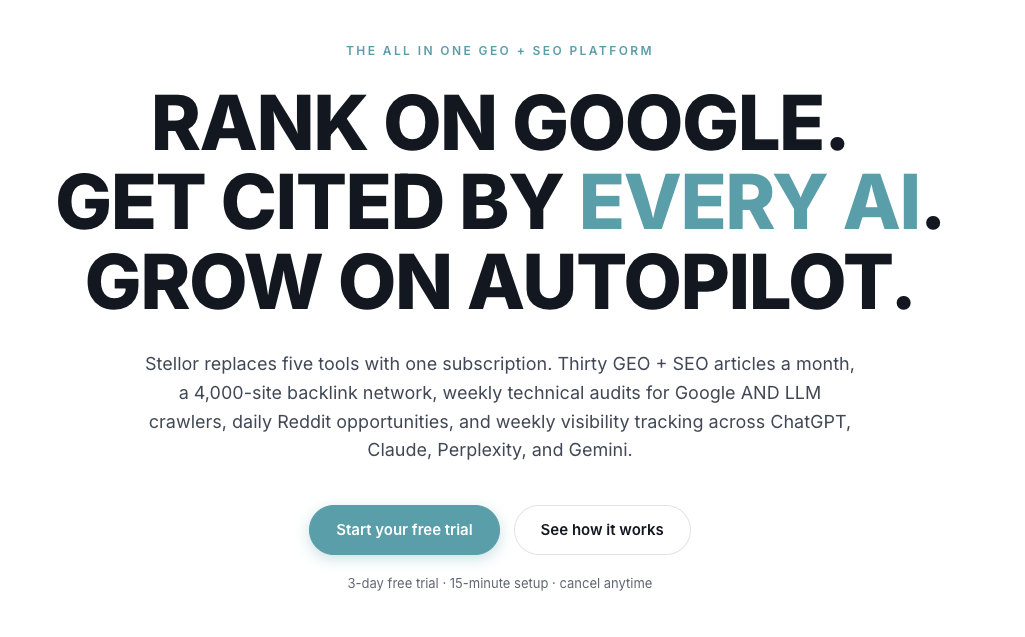
Trystellor publishes 30 SEO and GEO-optimized articles per month to your CMS, runs weekly technical audits across 11 ranking factors, delivers backlinks through a 4,000-site network, and tracks your citations across ChatGPT, Claude, Perplexity, and Gemini every week. That replaces five separate vendor subscriptions with one managed system. Explore the full platform features to see exactly which tools Trystellor replaces and how the integrated workflow produces faster ranking and AI citation results. A three-day free trial requires no credit card.
FAQ
What does SEO stack consolidation mean?
SEO stack consolidation means auditing your current set of SEO tools, identifying overlapping functions, and replacing redundant subscriptions with a smaller number of integrated systems that share data automatically.
How long does an SEO tool consolidation take?
Most teams complete a full consolidation in 8 to 12 weeks, including a 30 to 60 day parallel testing period to confirm data parity before sunsetting any tool.
What is the difference between tool consolidation and content consolidation?
Tool consolidation addresses subscriptions and operational workflows. Content consolidation addresses URL-level decisions like merging, pruning, or redirecting pages. They are separate processes that require different owners and strategies.
How much can businesses save by consolidating their SEO stack?
A documented case study showed monthly tool costs dropping from $6,200 to $3,400, a 45% reduction, while content output and organic rankings remained stable.
Do you need to cancel all specialized tools when consolidating?
No. Most organizations keep a hybrid model: one central platform for content, reporting, and backlinks, plus one or two specialized tools for deep technical tasks like log file analysis or JavaScript rendering audits.