TL;DR:
- Effective multi-location SEO requires unique, schema-optimized pages for each location, verified Google profiles, and a structured internal linking system that avoids competition. Proper management and measurement of rankings, reviews, and citations are essential to maintain visibility and adapt strategies for both Google and AI search engines in 2026. Scaling successfully depends on initial correct implementation and strict governance to prevent data drift and internal conflicts.
Managing SEO across multiple locations is defined as the practice of creating and maintaining separate, optimized digital assets — including Google Business Profiles, local landing pages, and structured internal links — for each physical location your business serves. Done correctly, this approach places each location in Google’s local map pack and gets your content cited by AI answer engines like ChatGPT, Perplexity, and Gemini. The industry term for this discipline is multi-location SEO, and it demands both traditional local ranking tactics and dual optimization for AI search to win visibility in 2026.
How to manage SEO across multiple locations: the foundation
Before you write a single page or claim a single profile, three non-negotiable prerequisites must be in place. Skip any one of them and the rest of your effort compounds on a cracked foundation.
Google Business Profile for every location. Each physical address needs its own verified Google Business Profile (GBP). Complete GBP profiles with accurate categories, service lists, and a consistent post calendar directly determine whether that location appears in the local map pack. A profile that sits at 60% completion is invisible to Google’s local algorithm.
NAP consistency across every directory. NAP stands for Name, Address, and Phone Number. Inconsistent NAP data causes ranking drops and confuses both users and search engines. If your Austin location is listed as “Suite 200” on Google but “Ste. 200” on Yelp and omitted entirely on Apple Maps, Google treats those as three different businesses. Audit every directory, including Bing Places, Yelp, and industry-specific listings, before you build anything else.
A content governance plan. This is the piece most multi-location businesses skip, and it costs them dearly. You need a clear split between what corporate marketing owns and what local teams control. Corporate handles brand-level authority content. Local teams handle geo-specific pages, reviews, and community references. Without this split, two locations end up targeting the same keyword and competing against each other in the same search results.
Here is what your prerequisite checklist should cover:
- Verify a Google Business Profile for every location with a physical address
- Audit NAP consistency across Google, Bing Places, Yelp, Apple Maps, and any industry directories
- Assign content ownership: corporate vs. local team responsibilities
- Build a centralized keyword map so no two location pages target identical primary terms
- Set up a centralized content calendar to prevent overlap and coordinate publishing
Pro Tip: Use Trystellor’s weekly technical audits to flag NAP inconsistencies and schema gaps across all your location pages in one dashboard, rather than checking each directory manually.
How to optimize local landing pages for each location
Each location needs a dedicated landing page. Not a copied template with the city name swapped in. A genuinely unique page built around what makes that location, neighborhood, or service area distinct.

Location pages built to 1,500 words or more with rich, locally relevant content rank better in Google and get cited more frequently by AI models. A plumbing company in Denver should reference local water hardness levels, common pipe materials in Denver’s older housing stock, and the specific neighborhoods it serves. That specificity signals genuine local expertise to both Googlebot and ChatGPT.
Follow these steps for each location page you build:
- Write 100% unique content. Never duplicate body text across location pages. Google penalizes thin, templated content, and AI engines ignore it entirely.
- Add LocalBusiness schema markup. Structured data tells both Google and AI crawlers exactly what your business does, where it operates, and how to contact it. Use schema.org/LocalBusiness as your reference.
- Optimize your GBP with frequent posts. Publish at least two GBP posts per month per location. Posts that reference local events, seasonal services, or neighborhood-specific offers outperform generic updates.
- Embed a location-specific FAQ section. AI search engines extract data from structured FAQ content. A question like “Does your Austin location offer same-day HVAC repair?” gives ChatGPT and Perplexity a direct, quotable answer.
- Manage reviews actively. Review velocity, meaning the rate at which new reviews arrive, is a local map pack ranking factor. Respond to every review, positive or negative, within 48 hours.
- Avoid keyword cannibalization. If your Dallas and Fort Worth pages both target “commercial electrician Dallas-Fort Worth,” they compete against each other. Assign distinct primary keywords to each page and use supporting terms to fill the gaps.
Pro Tip: Before publishing any location page, run it through a local SEO audit checklist to confirm schema, NAP, and content uniqueness are all in order.
| Element | Corporate page | Location page |
|---|---|---|
| Primary keyword focus | Brand-level service terms | City-specific service terms |
| Content ownership | Corporate marketing team | Local manager or regional SEO lead |
| Schema type | Organization | LocalBusiness |
| Review management | Brand reputation monitoring | Location-level response cadence |
| GBP posts | Not applicable | Minimum 2 per month per profile |
What internal linking structure works best for multi-location sites?
The hub-and-spoke model is the correct architecture for multi-location SEO. It preserves link equity, prevents internal competition, and gives both Google and AI crawlers a clear map of your site’s geographic coverage.
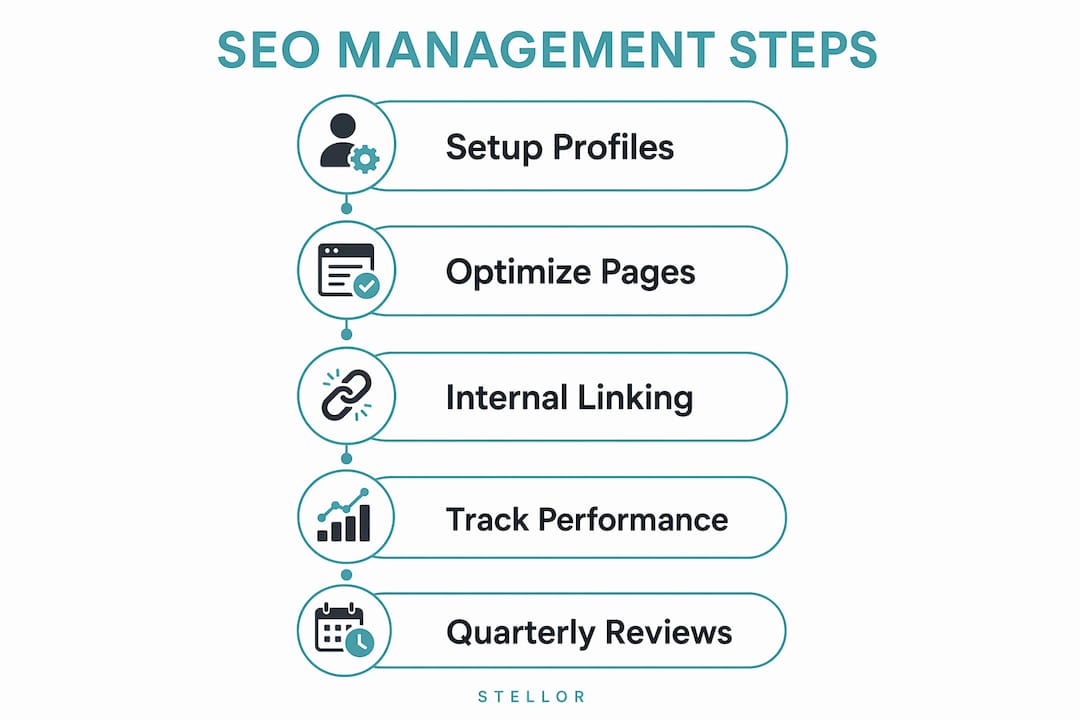
The structure works like this: your homepage links to a central "/locations/` hub page. That hub page links to every individual city or neighborhood page. Each city page links back to the hub and to two or three geographically nearby locations only. Linking each city page to only 2-3 nearby locations maintains link equity and avoids the internal competition that comes from cross-linking every location to every other.
The table below shows how governance changes at each level of this structure.
| Level | Page type | Links to | Owned by |
|---|---|---|---|
| Tier 1 | Homepage | /locations/ hub | Corporate |
| Tier 2 | /locations/ hub | All city pages | Corporate |
| Tier 3 | City page | Hub + 2-3 nearby cities | Local or regional team |
| Tier 3 | City page | Relevant service pages | Corporate or local |
Hub-and-spoke internal linking also benefits AI content understanding. When ChatGPT or Perplexity crawls your site, a clear hierarchy tells the model which page is authoritative for which geography. A flat site where every location page links to every other creates ambiguity that AI engines resolve by citing a competitor instead.
One governance rule that prevents most internal linking problems: no location page should link to another location page outside its immediate geographic cluster. A Chicago location page should not link to your Miami page. That link passes no geographic relevance and dilutes the topical authority you have built for each market. Build a local SEO strategy workflow that assigns link approval to a single owner per region, so rogue cross-links do not accumulate over time.
How do you track SEO performance across multiple locations?
Measurement is where most multi-location SEO programs break down. Businesses publish pages, claim profiles, and then check Google Analytics once a month without ever knowing which location is gaining ground and which is losing it.
Effective tracking for multi-location SEO requires three distinct data streams:
- Local map pack rankings by location. Tools like Semrush Map Rank Tracker and Trystellor monitor rankings by geo-coordinates, showing you exactly where each location appears in the local pack at the neighborhood or street level. A ranking of position 3 in one zip code and position 12 in the next tells you where to focus content and citation work.
- Google Search Console segmented by location page. Filter performance data by the URL of each location page. Track impressions, clicks, and average position for each city separately. A location page with high impressions but low clicks signals a title tag or meta description problem, not a content problem.
- AI citation tracking. Geo-specific monitoring enables precise improvements, but AI citation tracking goes one step further. Trystellor queries ChatGPT, Claude, Perplexity, and Gemini weekly using real buyer prompts like “best HVAC company in Phoenix” and reports which locations are being cited and which competitors are winning those answers instead.
The feedback loop that produces consistent improvement looks like this: identify a location page with weak rankings, audit its content for uniqueness and schema completeness, publish a revised version with a location-specific FAQ, then track the impact over the next four to six weeks. Volume-focused scaling without this feedback loop produces pages that dilute site authority rather than build it. Quality and relevance tailored to each location outperform quantity every time.
Pro Tip: Set a quarterly review cycle for every location page. Check NAP accuracy, review count, GBP post frequency, and AI citation status together. Treating these as separate tasks means problems compound before you catch them.
For a deeper look at local SEO for service businesses, the ranking factors that matter most in 2026 differ meaningfully from those that drove results three years ago.
Key takeaways
Multi-location SEO succeeds when each location has a unique, schema-optimized page, a verified Google Business Profile, and a hub-and-spoke internal linking structure that prevents internal keyword competition.
| Point | Details |
|---|---|
| Unique pages per location | Each location needs original content, not a template swap, to rank and earn AI citations. |
| NAP consistency is non-negotiable | Inconsistent name, address, and phone data across directories causes ranking drops. |
| Hub-and-spoke linking | Link each city page to only 2-3 nearby locations to preserve link equity and avoid cannibalization. |
| Dual optimization required | Winning in 2026 means ranking on Google and getting cited by ChatGPT, Perplexity, and Gemini. |
| Measure by location, not site-wide | Track map pack rankings, Search Console data, and AI citations separately for each location. |
Why most multi-location SEO programs fail before they scale
I have reviewed dozens of multi-location SEO setups, and the failure pattern is almost always the same. A business with eight locations builds eight pages in a week, each one a near-copy of the last with the city name changed. Rankings are flat for six months. The team concludes that SEO does not work for their industry. The real problem was never the industry. It was the content.
The shift I keep seeing underestimated is what I call dual optimization. Google’s local algorithm and AI answer engines like ChatGPT do not reward the same signals equally. Google still weighs GBP completeness, review velocity, and backlink authority heavily. ChatGPT and Perplexity weight structured content, FAQ depth, and citation-worthy specificity. A page that ranks well on Google may still be invisible to AI engines if it lacks the clear, quotable structure those models need to extract an answer. Understanding why ChatGPT cites Reddit over your location page is the first step toward fixing it.
The governance piece is equally underestimated. When local managers can edit any page at any time without a review process, NAP data drifts, keyword targets shift, and the internal linking structure gets broken by well-meaning but uncoordinated updates. The businesses that scale multi-location SEO successfully treat their location pages like product pages: versioned, owned, and changed only through a defined process.
My honest recommendation is to start with three locations done correctly before you touch the rest. Get the schema right, the GBP fully optimized, the content genuinely local, and the internal links properly structured. Then replicate that model. Scaling a broken template produces a bigger broken template.
— Cole
How Trystellor handles multi-location SEO in one platform
Managing location pages, GBP profiles, backlinks, and AI citation tracking across five or ten locations with separate tools is the plumbing behind the walls of your digital presence. When one pipe leaks, you rarely know until the damage is visible.
Trystellor consolidates what used to require five separate subscriptions into one platform built for exactly this problem. It publishes 30 GEO and SEO-optimized articles per month to your CMS, runs weekly technical audits across all your location pages, monitors AI citations from ChatGPT, Claude, Perplexity, and Gemini, and backs everything with a 4,000-site backlink network. Setup takes 15 minutes. The Stellor product includes a free AI Visibility Audit within 48 hours, showing you which locations are being cited by AI engines and which competitors are winning those answers instead. Start your 3-day free trial with no credit card required.
FAQ
What is multi-location SEO?
Multi-location SEO is the practice of optimizing separate digital assets, including landing pages, Google Business Profiles, and local citations, for each physical location a business operates. The goal is to rank each location in local search results and AI-generated answers independently.
How many location pages do I need?
You need one dedicated landing page per location, with unique content tailored to that city or service area. Duplicate or templated pages compete against each other and dilute your site’s overall authority.
How do I prevent my location pages from competing with each other?
Use a centralized keyword map that assigns distinct primary keywords to each location page, and follow a hub-and-spoke internal linking structure that links each city page to only two or three geographically nearby locations. Keyword cannibalization is the most common cause of flat rankings in multi-location SEO.
Do AI search engines like ChatGPT rank location pages differently than Google?
Yes. AI engines like ChatGPT and Perplexity extract answers from structured content, FAQ sections, and schema markup rather than relying on backlink authority alone. A location page with a clear FAQ and LocalBusiness schema is significantly more likely to be cited by an AI engine than a page without that structure.
What tools should I use to track multi-location SEO performance?
Semrush Map Rank Tracker monitors local pack rankings by geo-coordinates. Google Search Console tracks organic performance per location page. Trystellor adds AI citation tracking across ChatGPT, Claude, Perplexity, and Gemini, giving you a complete picture of visibility across both traditional and AI search.