TL;DR:
- Consistent monthly SEO reporting builds trust, reveals meaningful trends, and enhances client retention for service businesses.
- A well-structured, concise report focused on impactful metrics enables strategic decisions, issue detection, and connection to revenue growth.
Most service business owners assume that more frequent reporting means better results. It does not. The real driver of SEO progress and client confidence is the role of monthly SEO reporting cadence: a consistent, structured rhythm that turns raw data into decisions. Agencies using standardized monthly report templates retain clients 67% longer than those sending generic updates. That single number reframes the entire conversation. Monthly reporting is not just a communication habit. It is a trust-building system that directly affects how long clients stay, how much they invest, and how quickly your business grows.
Table of Contents
- Why monthly SEO reporting cadence matters for SMBs
- What makes an effective monthly SEO report?
- Monthly SEO reporting vs weekly and quarterly: finding the sweet spot
- Using monthly SEO reports to improve your service business’s visibility
- Pro tips and common pitfalls in monthly SEO reporting for SMBs
- Why monthly SEO reporting cadence is your business’s secret growth engine
- How Stellor helps you master monthly SEO reporting and grow your business
- Frequently asked questions
Key Takeaways
| Point | Details |
|---|---|
| Monthly cadence builds trust | Consistent monthly SEO reports increase client retention by establishing predictable communication and clear value. |
| Concise reports win | Effective monthly SEO reports should be 8-12 pages with key insights upfront, enabling busy executives to grasp performance quickly. |
| Balance timing and data | Monthly reports avoid the noise of weekly updates and the sluggishness of quarterly reviews, allowing timely yet reliable trend analysis. |
| Year-over-year data is crucial | Using year-over-year comparisons filters out seasonal noise and helps identify real performance changes and content decay early. |
| SEO ROI transparency | Regular monthly reports help justify SEO investments by clearly linking organic traffic improvements and business outcomes over time. |
Why monthly SEO reporting cadence matters for SMBs
The importance of SEO reports is often framed as a transparency exercise. In reality, it is a retention and decision-making tool. When you report on a monthly basis, you give your clients or stakeholders enough time for real patterns to emerge, without leaving them in the dark for so long that they start questioning whether anything is happening.
For small to medium service businesses, this matters even more. You are often working with tighter budgets, shorter attention spans, and owners who are juggling operations alongside marketing. A monthly cadence respects that reality. It gives you one clear checkpoint per month to say: here is what moved, here is why, and here is what comes next.
Measurable SEO results only become visible when you track them consistently over time. A single report means nothing. Twelve monthly reports tell a story.
Here is what a well-run monthly SEO reporting cadence delivers:
- Trend visibility: One month of data shows a data point. Three months shows a direction. Six months shows a trend you can act on.
- Faster issue detection: A drop in organic traffic caught in a monthly report can be investigated and fixed before it compounds.
- Stakeholder alignment: Business owners and decision-makers stay informed without being overwhelmed by daily or weekly noise.
- Budget justification: Monthly data gives you the evidence to defend or expand your SEO investment at quarterly business reviews.
- Accountability: Both you and your SEO provider are held to a clear performance rhythm with no room for vague excuses.
The client retention stat is worth sitting with. A 67% improvement in retention is not a marginal gain. It is the difference between a client relationship that lasts one year and one that lasts nearly two. For a service business, that compounding loyalty is worth far more than any single campaign.
What makes an effective monthly SEO report?
Not all monthly reports are created equal. A 40-page data dump sent on the last day of the month is not a report. It is a liability. The ideal SEO monthly report is 8 to 12 pages, with the most important business-impact metrics appearing in the first few pages for quick executive understanding.

Think of it like a newspaper. The headline and lead paragraph carry the most important information. The deeper analysis comes later for those who want it. Your SEO report should follow the same logic.
Here is what an effective monthly SEO report includes, in order:
- Executive summary (1 page): Total organic traffic, keyword ranking changes, leads or conversions attributed to SEO, and one key insight from the month.
- Traffic overview: Month-over-month and year-over-year organic traffic with a brief explanation of any significant movement.
- Keyword performance: Top 10 to 20 target keywords, their current positions, and any notable gains or drops of three or more places.
- Backlink profile update: New links earned, lost links, and overall domain authority trend.
- Technical SEO summary: A brief note on any issues flagged during the month and whether they were resolved. Your SEO audit checklist is the backbone of this section.
- Content performance: Which pages drove the most traffic and engagement, and which need attention.
- Next month priorities: Three to five specific actions planned for the coming month, tied directly to the data in this report.
Delivery timing matters too. Reports sent within five business days after month-end build confidence. Reports that arrive two or three weeks late signal disorganization, even if the data inside is excellent.
Pro Tip: Set a fixed delivery date every month, such as the 7th of each month for the previous month’s data. Put it in your client onboarding agreement. That single commitment removes more anxiety than any dashboard ever will.
Monthly SEO reporting vs weekly and quarterly: finding the sweet spot
One of the most common mistakes service businesses make is choosing the wrong reporting frequency. Weekly feels responsive. Quarterly feels strategic. But monthly cadence aligns with 80% of service agency-client relationships because it avoids the noise of weekly fluctuations and the dangerous delays of quarterly reporting.
Here is how the three frequencies compare:
| Reporting frequency | Pros | Cons | Best for |
|---|---|---|---|
| Weekly | Fast feedback, feels active | Short-term noise causes panic, hard to spot real trends | Paid ad campaigns, not SEO |
| Monthly | Balanced data, clear trends, actionable | Requires discipline to maintain | SEO for service businesses |
| Quarterly | Big-picture view, less admin | Too slow to catch issues like content decay | Board-level summaries only |
Quarterly reports are too slow to catch content decay, while weekly reports create noise that leads to overreaction. Content decay, where a page that once ranked well gradually loses positions, can cost you 30 to 40 percent of a page’s traffic over three months if left unchecked. A monthly report catches that drop at month one. A quarterly report catches it after the damage is done.
Weekly reporting has its own trap. SEO rankings fluctuate naturally due to algorithm tests, competitor activity, and seasonal shifts. If you report every week, you will spend half your time explaining movements that correct themselves within 14 days. That erodes trust rather than building it.
The benefits of SEO reporting are only realized when the cadence matches the pace at which SEO actually works. Monthly is that pace. You can also complement monthly reports with real-time SEO tracking for day-to-day monitoring without triggering unnecessary alarm.

Using monthly SEO reports to improve your service business’s visibility
Monthly SEO analysis is only valuable if it leads to action. Data without interpretation is just noise with a nicer format. Here is how to turn your monthly report into a visibility improvement engine.
Organic search drives over 53% of website traffic, which means your SEO performance directly controls the majority of your inbound pipeline. Monthly reporting is the mechanism that keeps that pipeline healthy and growing.
Follow this process each month:
- Compare year-over-year, not just month-over-month. A drop in November traffic is alarming in isolation. Compared to November of the previous year, it might be normal seasonality. Year-over-year data filters out seasonal noise and shows real growth or decline.
- Flag keyword drops of three or more positions immediately. A keyword dropping from position 4 to position 7 can reduce click-through rate by 50 percent or more. Catching it in month one gives you time to refresh the page, build supporting content, or earn new backlinks before traffic loss compounds.
- Connect SEO data to revenue. If your monthly report shows a 20 percent increase in organic traffic but no increase in leads, that is a conversion problem, not an SEO problem. Monthly data helps you separate the two and fix the right thing.
- Use the report to guide your local SEO optimization guide priorities. Which service pages are gaining traction? Which location pages are underperforming? Monthly data answers these questions with evidence, not guesswork.
- Track AI citation rates alongside traditional rankings. If you are using AI for SEO, your monthly report should include whether your business is being cited by ChatGPT, Perplexity, or Gemini for your target queries. This is the new frontier of visibility tracking.
Pro Tip: Create a simple one-page “scorecard” pulled from your monthly report. Five metrics, red or green status, one sentence of context each. Share it with stakeholders who do not have time for the full report. It keeps everyone informed without requiring them to read 10 pages.
Pro tips and common pitfalls in monthly SEO reporting for SMBs
Even well-intentioned monthly reports fail when they prioritize data volume over clarity. Busy executives grasp performance best when data is concise and focused on business outcomes rather than data dumps.
Here are the most common pitfalls and how to avoid them:
- Reporting too many metrics. If your report tracks 50 metrics, your client tracks zero of them. Pick 8 to 12 that directly tie to business outcomes and report those consistently every month.
- Leading with technical data. Crawl errors and Core Web Vitals scores matter, but they should not appear on page one. Lead with traffic, leads, and revenue. Save the technical detail for the appendix.
- Skipping the narrative. Numbers without context are meaningless. Every significant metric change needs one sentence of explanation: what caused it, and what you are doing about it.
- Inconsistent formatting. If your report looks different every month, clients spend time figuring out where things are instead of absorbing the insights. Use a fixed template and update the data inside it.
- Ignoring your SEO health score. This single composite metric gives clients a quick read on overall site health. Include it as a consistent benchmark in every report.
“The best SEO report is the one your client actually reads. Keep it short, lead with impact, and make the next steps obvious.”
Monthly SEO reporting best practices come down to one principle: your report should make the reader smarter in five minutes, not more confused in 30.
Why monthly SEO reporting cadence is your business’s secret growth engine
Here is the opinion most SEO guides will not give you: the cadence itself is the strategy. Not the keywords. Not the backlinks. Not the content calendar. The rhythm of consistent, structured monthly reporting is what separates businesses that see compounding SEO growth from those that spin their wheels.
Search algorithms reward stability and consistency. A business that publishes content, earns backlinks, fixes technical issues, and reviews performance on a steady monthly rhythm is sending exactly the kind of signals that Google and AI engines use to determine trust and authority. Erratic activity followed by bursts of effort followed by silence is the pattern of a business that does not rank.
Monthly reporting also aligns naturally with how service businesses plan and spend. Most SMBs review budgets monthly. They hold team meetings monthly. They assess pipeline and revenue monthly. When your SEO reporting cadence matches your business planning cadence, SEO decisions get made faster, with more confidence, and with better outcomes.
The businesses that treat monthly reporting as a chore produce reports nobody reads. The businesses that treat it as a management tool produce real-time SEO tracking insights that inform every decision from content topics to service page priorities to budget allocation.
There is also a compounding trust effect that most people underestimate. A client or stakeholder who receives a clear, consistent monthly report for 12 months in a row develops a fundamentally different level of confidence in your SEO investment than one who gets sporadic updates. That confidence translates directly into longer relationships, larger budgets, and more referrals. Monthly cadence is not just a reporting strategy. It is a business development strategy.
How Stellor helps you master monthly SEO reporting and grow your business
Consistent monthly SEO reporting only works when you have reliable data flowing in from every channel. That is exactly the problem most service businesses face: their SEO data lives in five different tools, none of which talk to each other.
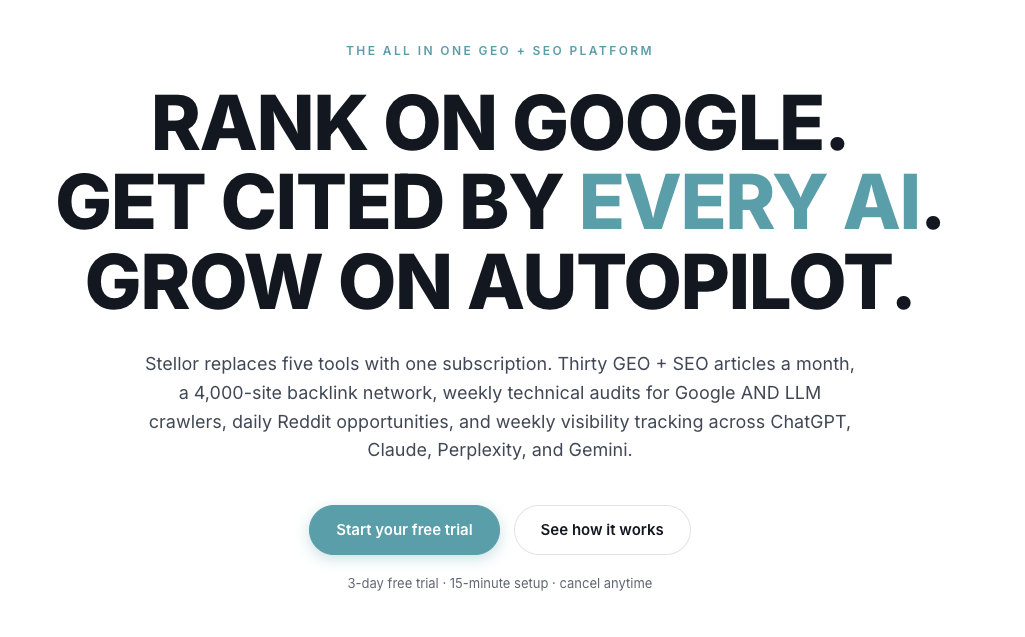
Stellor’s all-in-one GEO + SEO platform consolidates content production, backlink building, technical audits, Reddit visibility, and AI citation tracking into a single dashboard. You get the data you need for a complete monthly report without logging into multiple tools or reconciling conflicting numbers. The platform publishes 30 SEO-optimized articles per month, runs weekly technical audits, and tracks your citation rate across ChatGPT, Claude, Perplexity, and Gemini every week. For service businesses that want to show up in both Google results and AI recommendations, that is the reporting foundation you need. Explore more on the Stellor blog and start a free 3-day trial with no credit card required.
Frequently asked questions
Why is monthly SEO reporting better than weekly or quarterly reporting?
Monthly reporting provides the right balance: enough data to identify real trends while avoiding the short-term noise that triggers overreaction in weekly reports. Monthly cadence aligns with 80% of agency-client relationships and catches issues before the delays of quarterly reporting allow them to compound.
How long should an effective monthly SEO report be?
An effective monthly SEO report should be 8 to 12 pages, with the most critical business-impact metrics in the first few pages. The ideal report length keeps executives informed quickly without requiring them to read through extensive technical data to find the headline numbers.
What key metrics should SMBs focus on in monthly SEO reports?
SMBs should prioritize organic traffic, keyword ranking changes, backlink profile growth, technical SEO health, and revenue attribution. Monthly SEO reports that cover these five areas give business owners a complete picture of performance without overwhelming them with secondary data.
How does monthly SEO reporting help with SEO ROI justification?
Monthly reporting builds a documented record of progress that makes it straightforward to justify SEO spend at budget reviews. Since organic search drives 53.3% of website traffic, a monthly report that connects ranking improvements to traffic and traffic to leads gives decision-makers the evidence they need to maintain or increase investment.